‘Crushing consequences’: experts see growing risk as wildfires crash into communities

Advertisement

Advertise with us

The fire department in Slave Lake, Alta., had a long-standing plan for tackling wildfire encroaching on the community, but in May 2011, flames from a nearby forest blewover suppression effortsand destroyed several hundred homes and other buildings.

Read this article for free:


or

Already have an account? Log in here »

To continue reading, please subscribe:

Subscribe and receive a limited-edition Free Press branded hat or tote.

Digital Subscription

One year of digital access for only $205*

  • Enjoy unlimited reading on winnipegfreepress.com
  • Read the E-Edition, our digital replica newspaper
  • Access News Break, our award-winning app
  • Play interactive puzzles

*First annual payment billed as $205.00 + GST for one year. This annual subscription will automatically renew at $233.00 + GST every 52 weeks (10% off the regular annual price of $259.35). Offer available to new and qualified returning subscribers only. Cancel any time.

To continue reading, please subscribe:

Add Free Press access to your Brandon Sun subscription for only an additional

$1 for the first 4 weeks*

  • Enjoy unlimited reading on winnipegfreepress.com
  • Read the E-Edition, our digital replica newspaper
  • Access News Break, our award-winning app
  • Play interactive puzzles
Start now

*Your next Brandon Sun subscription payment will increase by $1.00 and you will be charged $17.95 plus GST for four weeks. After four weeks, your payment will increase to $24.95 plus GST every four weeks.

Hey there, time traveller!
This article was published 30/05/2023 (1174 days ago), so information in it may no longer be current.

The fire department in Slave Lake, Alta., had a long-standing plan for tackling wildfire encroaching on the community, but in May 2011, flames from a nearby forest blewover suppression effortsand destroyed several hundred homes and other buildings.

“I think that was the most shocking time of my entire career and maybe of my life, where you’re so sure that something’s going to work, and then it doesn’t … with crushing consequences,” said Jamie Coutts, the former Slave Lake fire chief.

A firefighter for more than 30 years, Coutts said wildfires have been burning “hotter, faster (and) crazier” over the last decade, and “every single person that lives in the forest is on a collision course with something disastrous happening.”
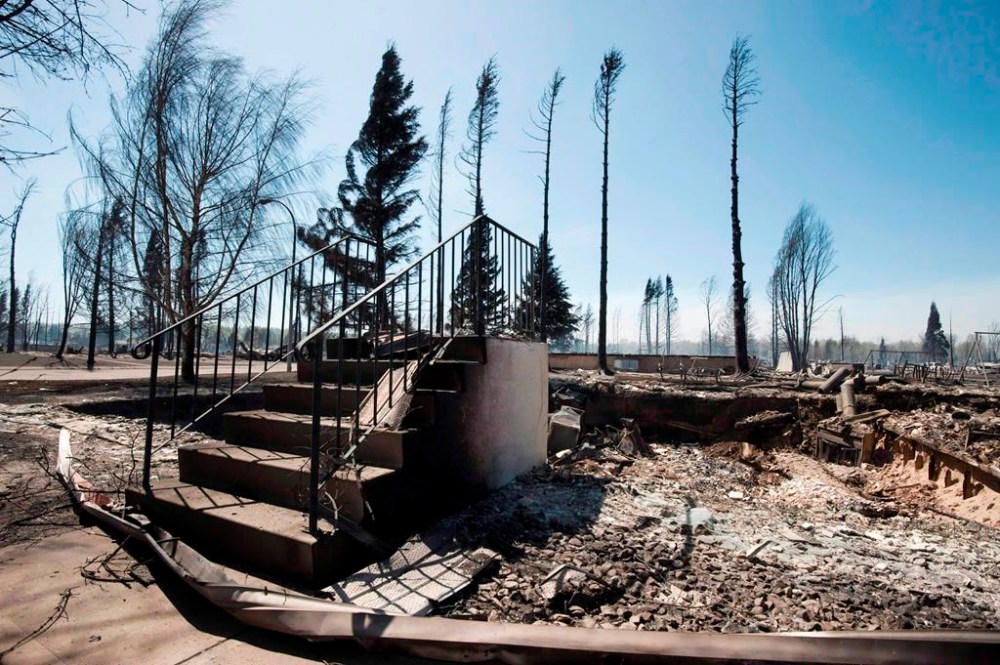
A set of steps is all that remains of a house in Slave Lake, Alta., on Monday, May 16, 2011. THE CANADIAN PRESS/Ian Jackson

Research suggests that so-called interface fires, which occur where forests and flames meet human development, are on the rise.

An interface fire crashed into suburban Halifax on Sunday, destroying or damaging dozens of homes in the west of the city.

The Nova Scotia blaze follows early season wildfires that have forced tens of thousands of people to evacuate from their homes in Alberta.

Sandy Erni, a research scientist with the Canadian Forest Service focusing on fire risk, said interface fires can involve either residential neighbourhoods or industrial infrastructure.

Erni is the co-author of a 2021 study that used greenhouse-gas emissions scenarios established by the Intergovernmental Panel on Climate Change to model potential increases in wildland-human interface fires by the end of this century.

The study published in the Canadian Journal of Forest Research concluded that interface fires are increasing in frequency, particularly in northern and central areas, and the number of people exposed to the blazes is likely to grow considerably.

Fortunately, in Canada, people are mostly escaping wildfires with their lives, said Coutts, although a fast-moving blaze killed two people and destroyed much of the village of Lytton in British Columbia’s southern Interior in late June 2021.

In northern California, 85 people were killed in 2018 when a wildfire turned into an urban inferno that destroyed most of the town of Paradise.

“What would the pushback be from the public in Canada if people started to die, and why do we have to wait for that?” Coutts said in an interview.

“Why can’t we make a change now, before we have those kinds of losses?”

Coutts wants to see a more widespread adoption of FireSmart guidelines, which aim to reduce wildfire risks to homes, communities and critical infrastructure, as well as changes to national and provincial building codes to address building materials, the space allowed between structures and the proximity of trees.

Some homeowners may choose to reduce the risk of interface fire by removing trees and vegetation, installing sprinklers and choosing less flammable materials for roofing and siding, he said, although not everyone can afford such measures.

Wildfire is unpredictable, especially when wind is a factor, said Coutts, adding he’s seen people’s homes burn after they did “all the right things” to reduce the risk.

Erni said the Canadian government has undertaken a national wildfire risk assessment, with mapping set to be publicly released next year.

Each region and community has its own risk profile depending on factors including the local climate and the types of trees and vegetation in the surrounding forest.

In general, communities within the Boreal zone — which encompasses 75 per cent of the country’s forests and woodlands — are at higher risk than others, said Erni, who’s based at the Great Lakes Forestry Centre in Sault Ste. Marie, Ont.

The rising threat of interface fire is clear, but without regionally specific climate modelling, it’s hard to say exactly how that risk will change over time, she said.

This report by The Canadian Press was first published May 30, 2023.

Report Error Submit a Tip

More Stories

Could renewed interest in strategically critical rare earth elements finally make sub-sector profitable?

Joel Schlesinger 6 minute read Preview

Could renewed interest in strategically critical rare earth elements finally make sub-sector profitable?

Joel Schlesinger 6 minute read Yesterday at 3:00 AM CDT

Rare earth elements are among the most critical of mined resources for modern economies.

They’re essential in manufacturing specialized magnets used in a host of technologies from wind turbines and electric vehicles to hard drives, smartphones, television screens, and fibre optics. Most notably, however, rare earth minerals are increasingly vital to the defence industry.

These 17 elements — closely related chemically and usually found all together in mineral deposits — have indeed been growing in geopolitical importance as the United States, Canada and other Western nations recognize their dependence on production from China.

It is the world’s largest producer and processor of rare earths, including the most in-demand elements neodymium and praseodymium used to manufacture very light and powerful magnets for an array of technologies, including the most advanced weapons of modern warfare.

Read
Yesterday at 3:00 AM CDT

West Kildonan Industrial residents call for speed bumps after child hit by truck

Morgan Modjeski 3 minute read Preview

West Kildonan Industrial residents call for speed bumps after child hit by truck

Morgan Modjeski 3 minute read Updated: Yesterday at 3:09 PM CDT

Residents in the West Kildonan Industrial neighbourhood are calling on the city to install speed bumps in their area after a child was hit and dragged by a vehicle Thursday.

Katelyn Bemister lives near the area where the child — who was hospitalized as a result of the incident and has been upgraded to stable condition — was struck. She says people frequently speed in the area.

“They’re going really fast, and they’re not really paying attention at all to the pedestrians in the area,” says Bemister.

In video supplied to the Free Press by a resident, the child can be seen riding a bike down a sidewalk along the 500 block of North Point Boulevard.

Read
Updated: Yesterday at 3:09 PM CDT

Impaired driving victim honoured

Morgan Modjeski 5 minute read Preview

Impaired driving victim honoured

Morgan Modjeski 5 minute read Yesterday at 6:16 PM CDT

Ten years after he was killed in a collision involving an impaired driver in 2016, Robbie Anderson’s name has been added to MADD Canada’s Manitoba Memorial honouring those killed in drunk and drug-impaired-related crashes.

His older brother Chris Anderson, was one of two dozen people who gathered at the Glen Eden Funeral Home and Cemetery in West St. Paul Saturday to remember their loved ones, 86 victims whose names are etched into the granite monument near the heart of the graveyard.

“It’s heavy,” said Anderson when asked what it was like to be part of the ceremony and see his brother’s name added. “It’s been something I’ve been thinking about for a while.”

Grateful for MADD’s work and its efforts to honour Robbie, who was 27 when he died, Anderson said his brother, represented the “absolute best of us.”

Read
Yesterday at 6:16 PM CDT

Rise of social media reflects rise of self-promotion — to the detriment of genuine storytelling

Reviewed by Matt Henderson 5 minute read Preview

Rise of social media reflects rise of self-promotion — to the detriment of genuine storytelling

Reviewed by Matt Henderson 5 minute read Yesterday at 3:00 AM CDT

A conversation is overheard between two people; one congratulates the other on their success, evident through countless posts on LinkedIn, but the other confesses the prolific aggrandizement is due to slumping success.

A young man on an airplane spends three hours poring over selfies taken on a vacation, zooming in on his biceps and using AI to retouch photos before posting on Instagram.

Anonymous and cowardly trolls on Reddit attempt to end another person’s career.

All this “storytelling” was observed in one day by this reviewer.

Read
Yesterday at 3:00 AM CDT

Sea Bears finish on top

Joshua Frey-Sam 6 minute read Preview

Sea Bears finish on top

Joshua Frey-Sam 6 minute read Yesterday at 8:27 PM CDT

Beauty. Bliss. Ecstasy.

That is how Aug. 15, 2026 will be remembered in Winnipeg.

What was once a pipe dream in the city’s hoops community became an epic reality on Saturday, when Simon Hildebrandt, who grew up playing on the courts of this very town, made good on a three-pointer from the wing to crown the Winnipeg Sea Bears Canadian Elite Basketball League champions.

A storybook ending to a 98-84 victory over the Brampton Honey Badgers sent a CEBL attendance record of 12,519 fans into pandemonium at Canada Life Centre and capped a Finals run for the ages — one that was fraught with injury, impromptu player exits and unprecedented circumstances.

Read
Yesterday at 8:27 PM CDT

Foster mom pleads guilty to assault that left six-year-old-girl paralyzed

Dean Pritchard 4 minute read Preview

Foster mom pleads guilty to assault that left six-year-old-girl paralyzed

Dean Pritchard 4 minute read Friday, Aug. 14, 2026

A Winnipeg foster mother has admitted to violently assaulting her ill foster daughter and leaving her paralyzed after the girl resisted the woman’s efforts to provide her with medication, a court has heard.

Marilyn Keno, 26, pleaded guilty Friday to one count of aggravated assault.

Keno remains in custody and will be sentenced at a later date following the completion of a court-ordered pre-sentence report.

The maximum sentence for aggravated assault is 14 years in prison. Crown attorney Alanna Littman and defence lawyer Jeremy Kostiuk did not disclose what sentences they will be recommending.

Read
Friday, Aug. 14, 2026