For the third time this week, Earth sets an unofficial heat record. What’s behind those big numbers?

Advertisement

Advertise with us

Earth's average temperature set a new unofficial record high on Thursday, the third such milestone in a week that already rated as the hottest on record and what one prominent scientist says could be the hottest in 120,000 years.

Read this article for free:


or

Already have an account? Log in here »

To continue reading, please subscribe:

Subscribe and receive a limited-edition Free Press branded hat or tote.

Digital Subscription

One year of digital access for only $205*

  • Enjoy unlimited reading on winnipegfreepress.com
  • Read the E-Edition, our digital replica newspaper
  • Access News Break, our award-winning app
  • Play interactive puzzles

*First annual payment billed as $205.00 + GST for one year. This annual subscription will automatically renew at $233.00 + GST every 52 weeks (10% off the regular annual price of $259.35). Offer available to new and qualified returning subscribers only. Cancel any time.

To continue reading, please subscribe:

Add Free Press access to your Brandon Sun subscription for only an additional

$1 for the first 4 weeks*

  • Enjoy unlimited reading on winnipegfreepress.com
  • Read the E-Edition, our digital replica newspaper
  • Access News Break, our award-winning app
  • Play interactive puzzles
Start now

*Your next Brandon Sun subscription payment will increase by $1.00 and you will be charged $17.95 plus GST for four weeks. After four weeks, your payment will increase to $24.95 plus GST every four weeks.

Hey there, time traveller!
This article was published 06/07/2023 (1134 days ago), so information in it may no longer be current.

Earth’s average temperature set a new unofficial record high on Thursday, the third such milestone in a week that already rated as the hottest on record and what one prominent scientist says could be the hottest in 120,000 years.

But it’s also a record with some legitimate scientific questions and caveats, so much so that the National Oceanic and Atmospheric Administration has distanced itself from it. It’s grabbed global attention, even as the number — 63 degrees Fahrenheit (17.23 degrees Celsius) — doesn’t look that hot because it averages temperatures from around the globe.

Still, scientists say the daily drumbeat of records — official or not — is a symptom of a larger problem where the precise digits aren’t as important as what’s causing them.
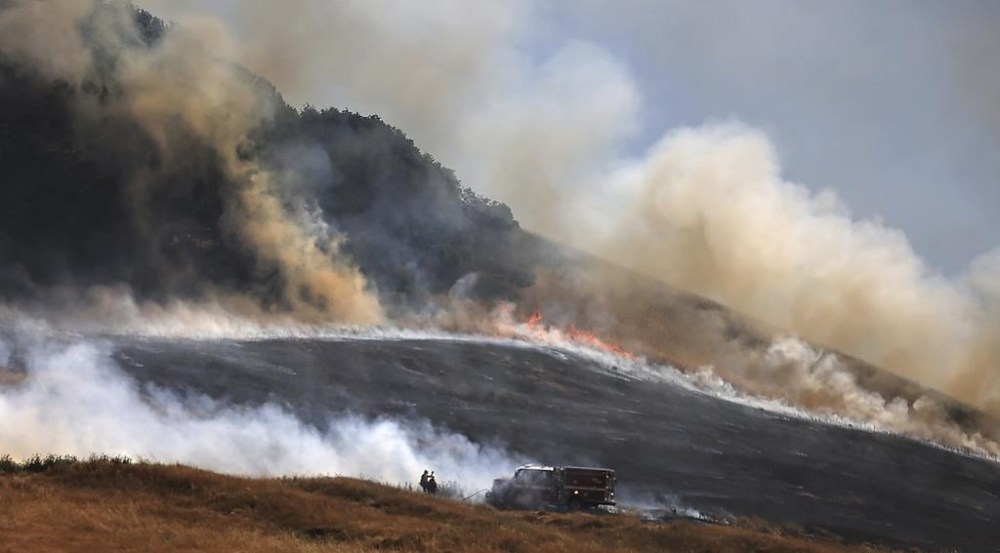
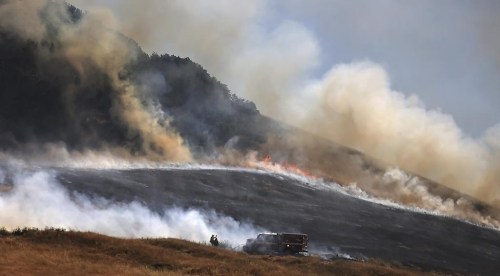
The San Antonio Fire spreads uphill west of Petaluma, Ca., Friday, June 30, 2023. The entire planet sweltered for the two unofficial hottest days in human recordkeeping Monday and Tuesday, according to University of Maine scientists at the Climate Reanalyzer project. The unofficial heat records come after months of unusually hot conditions due to climate change and a strong El Nino event. (Kent Porter/The Press Democrat via AP)

“Records grab attention, but we need to make sure to connect them with the things that actually matter,” climate scientist Friederike Otto of the Imperial College of London said in an email. “So I don’t think it’s crucial how ‘official’ the numbers are, what matters is that they are huge and dangerous and wouldn’t have happened without climate change.”

Thursday’s planetary average surpassed the 62.9-degree mark (17.18-degree mark) set Tuesday and equaled Wednesday, according to data from the University of Maine’s Climate Reanalyzer, a tool that uses satellite data and computer simulations to measure the world’s condition. Until Monday, no day had passed the 17-degree Celsius mark (62.6 degrees Fahrenheit) in the tool’s 44 years of records.

Now, the entire week that ended Thursday averaged that much.

Johan Rockstrom, director of the Potsdam Institute for Climate Impact Research in Germany, called the 63-degree mark “an exceptional outlier” that is nearly 6 degrees warmer than the average of the last 12,000 years. Rockstrom said it will “with high likelihood translate to even more severe extremes in the form of floods, droughts, heat waves and storms.”

“It is certainly plausible that the past couple days and past week were the warmest days globally in 120,000 years,” University of Pennsylvania climate scientist Michael Mann said. He cited a 2021 study that says Earth is the warmest since the last age ended, and said Earth likely hasn’t been as warm dating all the way to the ice age before that some 120,000 years ago.

Climate scientist Zeke Hausfather of the tech company Stripe and Berkeley Earth temperature monitoring group said he wouldn’t be surprised if it is the warmest in 120,000 years. But he said long-term proxy measurements like tree rings aren’t precise.

This week’s average includes places that are sweltering under dangerous heat — like Jingxing, China, which checked in almost 110 degrees Fahrenheit (43.3 degrees Celsius) — and the merely unusually warm, like Antarctica, where temperatures across much of the continent were as much as 8 degrees Fahrenheit (4.5 degrees Celsius) above normal this week.

A man watches waves caused by high tide hit his house on the shore of the Arabian Sea in Mumbai, India, Thursday, July 6, 2023. (AP Photo/Rafiq Maqbool)

Temperatures were so brutally hot Thursday in Adrar, Algeria, that the temperature never got below 103.3 degrees (39.6 degrees Celsius ) even at night when it is supposed to cool. That was the hottest ever nighttime low for Africa, according to weather historian and climatologist Maximiliano Herrera.

The temperature is ramping up across Europe this week, too. Germany’s weather agency, DWD, has predicted highs of 37 degrees C (99 degrees F) on Sunday and the Health Ministry has issued a warning to vulnerable people.

While there are small spots of cooler-than-normal temperatures across the globe, the University of Maine measurement is an average. That means some places — including both polar regions — will be extraordinarily warmer than normal and others will be cooler. On average it’s about 1.8 degrees Fahrenheit (1 degree Celsius) warmer than the 1979-2000 average, which is warmer than the 20th and 19th century averages.

And 70% of the world is covered by oceans, which have been spiking record heat for months.

Scientists say the heat is driven by two factors: Long-term warming from greenhouse gas emissions from the burning of fossil fuels and a natural El Nino warming of part of the Pacific that changes weather globally and makes an already warming world a bit hotter.

The National Oceanic and Atmospheric Administration on Thursday issued a note of caution about the Maine tool’s findings, saying it could not confirm data that results in part from computer modeling, saying it wasn’t a good substitute for observations.
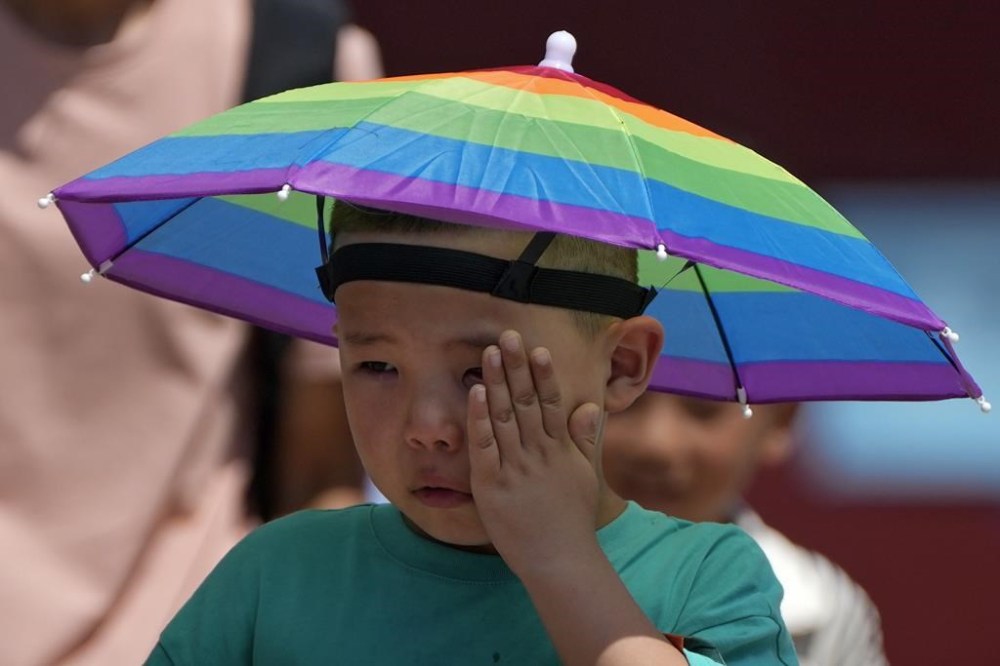
A boy wearing a rainbow umbrella wipes his sweat as he visits the Forbidden City on a sweltering day in Beijing, Friday, July 7, 2023. Earth's average temperature set a new unofficial record high on Thursday, the third such milestone in a week that already rated as the hottest on record. (AP Photo/Andy Wong)

Scientists don’t understand and haven’t delved much into daily fluctuations, said Princeton University climate scientist Gabriel Vecchi. Much more meaningful to them are global data over months, years and especially decades.

“The fact that we haven’t had a year colder than the 20th century average since the Ford administration (1976) is much more relevant,” Vecchi said.

Kathleen Hall Jamieson, director of the Annenberg Public Policy Center at the University of Pennsylvania, said immediacy of daily records is important.

“Tell me that yesterday was the hottest day on record and I can relate the claim to ways in which yesterday’s heat constrained my behavior,” she said. “I can’t do the same with monthly or yearly data. … We experience the world hour-by-hour, day-by-day, not in monthly or yearly averages.”

Discussions about how official the records are aren’t as important as the public getting the message “that Earth is warming and humans are responsible,” said Max Boykoff, a University of Colorado environmental studies professor who tracks media coverage of climate change.

“The issue of climate change doesn’t often get its 15 minutes of fame. When it does, it’s usually tied to something abstract like a scientific report or a meeting of politicians that most people can’t relate to,” said George Mason University climate communications professor Ed Maibach.

A boy uses a national flag to shield from the sun as visitors line up to enter the Forbidden City on a sweltering day in Beijing, Friday, July 7, 2023. Earth's average temperature set a new unofficial record high on Thursday, the third such milestone in a week that already rated as the hottest on record. (AP Photo/Andy Wong)

“Feeling the heat — and breathing the wildfire smoke, as so many of us in the Eastern U.S. and Canada have been doing for the past month — is a tangible shared public experience that can be used to focus the public conversation,” he said.

___

Frank Jordans in Berlin contributed.

___

Follow AP’s climate and environment coverage at https://apnews.com/hub/climate-and-environment

___

A woman wearing an electric fan, putting a cooling pad on her forehead and carrying an umbrella visits the Forbidden City on a sweltering day in Beijing, Friday, July 7, 2023. Earth's average temperature set a new unofficial record high on Thursday, the third such milestone in a week that already rated as the hottest on record. (AP Photo/Andy Wong)

Follow Seth Borenstein on Twitter at @borenbears

___

Associated Press climate and environmental coverage receives support from several private foundations. See more about AP’s climate initiative here. The AP is solely responsible for all content.

Report Error Submit a Tip

More Stories

Ducks Unlimited makes province’s largest-ever conservation-land purchase

Zoe Pierce 3 minute read Preview

Ducks Unlimited makes province’s largest-ever conservation-land purchase

Zoe Pierce 3 minute read Tuesday, Aug. 11, 2026

A Manitoba landscape that helped save the Giant Canada goose from extinction has now been permanently protected in the province’s largest conservation land purchase in history.

Read
Tuesday, Aug. 11, 2026

Mom grieves loss of daughter, 4, on Long Plain First Nation

Morgan Modjeski 4 minute read Preview

Mom grieves loss of daughter, 4, on Long Plain First Nation

Morgan Modjeski 4 minute read Tuesday, Aug. 11, 2026

The mother of a four-year-old girl killed and two other children injured on Long Plain First Nation said she raised concerns about their care months before her daughter’s death.

Read
Tuesday, Aug. 11, 2026

It’s one thing to climb aboard rail-relocation train, quite another to pay for the ride

Dan Lett 5 minute read Preview

It’s one thing to climb aboard rail-relocation train, quite another to pay for the ride

Dan Lett 5 minute read Yesterday at 3:57 PM CDT

Anyone who wants a brighter, safer, healthier future for the city of Winnipeg should really want the renewed hopes of rail relocation to finally become reality. And the sooner, the better.

Premier Wab Kinew announced Wednesday the province was going to forge a plan to relocate the Canadian Pacific Kansas City central yards and many of other the lines that run through Winnipeg to a bypass that runs around the city.

This “plan to design a plan” strategy was devised by a task force headed up by former federal MP and cabinet minister Lloyd Axworthy, who in 2024 was given a two-year mandate to find the best way to rid the city of some or all of its rail infrastructure.

For the record, Kinew and Axworthy said a relocation would likely take 20 years to complete, which makes this week’s announcement an important statement of intent, but little more. The sobering reality is that this promising idea has been proposed by political leaders, and then abandoned, for decades.

Read
Yesterday at 3:57 PM CDT

Signs the Carney approach is working

Editorial 4 minute read Preview

Signs the Carney approach is working

Editorial 4 minute read Yesterday at 2:00 AM CDT

It was, if nothing else, a glowing review in trying times.

Matt Winkler, the editor in chief emeritus of Bloomberg News, spoke last week on Bloomberg Business News Daily about a recent Bloomberg analysis of the performance of the Canadian economy, and this country as a target for investment

“This is one of the greatest periods for overseas investment in Canada that we’ve seen in the century, and it may be unprecedented, because we have to wait for the rest of the year. … Money is pouring into Canada like we have not seen from everywhere. Stocks and bonds are the obvious beneficiaries,” Winkler said. He argued that Canada is both liked and seen as reasonable.

“The point is… Canada since Mark Carney became prime minister in 2025, has outperformed everyone in America and also the Eurozone and anywhere in the world. The 10 largest stock markets in the world, Canada appreciated the most, more than 40 per cent. … Its bond market is also doing great, partially because the inflation rate in Canada, unlike the Eurozone or America, is actually trending lower, and is outperforming both the Eurozone and the U.S.”

Read
Yesterday at 2:00 AM CDT

Rainbow Stage star relates to Elle Woods’ perseverance

Ben Waldman 4 minute read Preview

Rainbow Stage star relates to Elle Woods’ perseverance

Ben Waldman 4 minute read 5:00 AM CDT

Nearly 9,000 aspiring barristers and solicitors cross their fingers and send in their LSAT scores to Harvard University each year, but less than 10 per cent of applicants wind up on campus in Cambridge, Mass.

In Legally Blonde, the musical opening tonight at Rainbow Stage, Elle Woods (Claire Mac Master) defies the undercutting judgment of her blue-blood boyfriend Warner (Duncan Cox) to earn a spot in the Ivy League, leaving her doubters aghast and crimson-faced.

“What?” asked Elle — played by Reese Witherspoon in the 2001 film version — “Like it’s hard?”

The New York-born Mac Master never had any aspirations to pursue a law career, but can relate to her character’s plucky self-determination based on her experience at Toronto Metropolitan University’s undergraduate acting program, which accepts 25 applicants each year from an international pool of hundreds.

Read
5:00 AM CDT

Spotty service, U.S. roaming charges leave Somerset woman calling for answers

Nicole Buffie 6 minute read Preview

Spotty service, U.S. roaming charges leave Somerset woman calling for answers

Nicole Buffie 6 minute read Yesterday at 5:37 PM CDT

A southwestern Manitoba woman is voicing her concerns about cell service in the area after she was billed more than $100 in U.S. roaming charges despite never leaving her community.

Teresa Acheson received a notification on her phone Monday at about 7:30 a.m. saying she had entered the United States and would be charged $13 per day for unlimited calls and text messages.

The only problem is that she was not in the U.S. She was lying in bed at her home near Somerset, some 50 kilometres away from the U.S. border.

“People have said to watch if you’re driving close to the border because you’ll get dinged, but I was sitting at home,” she said Wednesday.

Read
Yesterday at 5:37 PM CDT