Aging infrastructure struggling to keep up with storms, wildfires, changing climate
Advertisement
Read this article for free:
or
Already have an account? Log in here »
To continue reading, please subscribe:

Digital Subscription
One year of digital access for only $205*
- Enjoy unlimited reading on winnipegfreepress.com
- Read the E-Edition, our digital replica newspaper
- Access News Break, our award-winning app
- Play interactive puzzles
*First annual payment billed as $205.00 + GST for one year. This annual subscription will automatically renew at $233.00 + GST every 52 weeks (10% off the regular annual price of $259.35). Offer available to new and qualified returning subscribers only. Cancel any time.
To continue reading, please subscribe:
Add Free Press access to your Brandon Sun subscription for only an additional
$1 for the first 4 weeks*
- Enjoy unlimited reading on winnipegfreepress.com
- Read the E-Edition, our digital replica newspaper
- Access News Break, our award-winning app
- Play interactive puzzles
*Your next Brandon Sun subscription payment will increase by $1.00 and you will be charged $17.95 plus GST for four weeks. After four weeks, your payment will increase to $24.95 plus GST every four weeks.
Read unlimited articles for free today:
or
Already have an account? Log in here »
Hey there, time traveller!
This article was published 27/07/2023 (1148 days ago), so information in it may no longer be current.
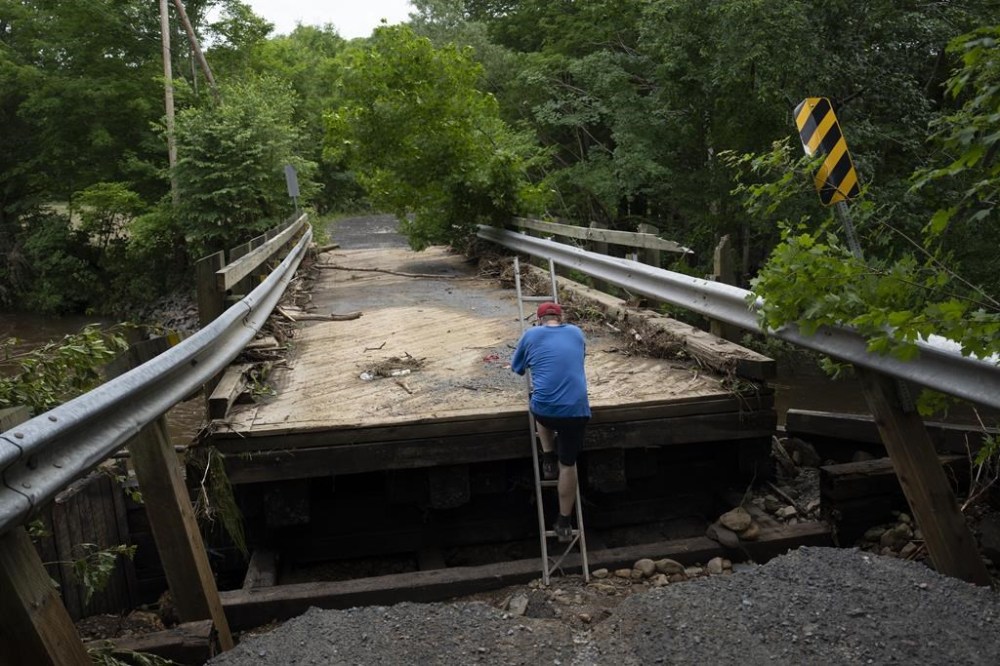
FREDERICTON – The torrential rain that washed out roads, bridges and a key rail link in Nova Scotia on the weekend is is being described as another sign that engineers cannot rely on past weather patterns to design infrastructure able to withstand rising sea levels and destructive storms.
Slobodan Simonovic said that when planning infrastructure, builders consider population needs, precipitation and other weather data.
“This design is usually based on historical observations, how much rain we’ve had in the past,” said Simonovic, professor emeritus at the department of civil and environmental engineering at Western University in London, Ont.
“Now this is changing, and historical observations are not sufficiently representative of future conditions. With climate change, there is a very significant modification in both frequency and severity of these rain events.”
For example, roads are not able to drain water because they aren’t designed to deal with so much rain falling in a short period, he said. Officials in Halifax have called the storm that dumped as much as 250 millimetres of rain in places over the weekend a one-in-a-thousand-years weather event.
Halifax Mayor Mike Savage said the city’s infrastructure had already taken a beating from post-tropical storm Fiona in September and the ferocious wildfires that scorched parts of the province two months ago.
Some of the areas in Nova Scotia that experienced flooding were denuded by the fires. That reduced their ability to absorb water and resulted in higher run-off, said John Clague, a professor of geosciences at Simon Fraser University, in Burnaby, B.C.
“The infrastructure is overwhelmed because it isn’t designed for such repeated, extreme events,” he said.
It might once have been calculated that such events would occur once over 100 years or 500 years, Clague said. “But the point now is that … an event like that’s going to happen every 50 years or every 20 years. And that’s within the life cycle of engineering structures.”
Nova Scotia Minister of Public Works, Kim Masland, said the effects of climate change are being considered as the province builds new roads and bridges. The minister said Nova Scotia is following Transportation Association of Canada guidelines that take climate change into account.
“So if you look at some of the projects you’ll see our bridges are (built) higher and we are putting in larger culverts in areas to handle that water flow,” Masland told reporters Thursday.
The Canadian government published a report this year that outlined challenges the country could face in a changing climate and provided a blueprint for how communities can respond.
“There is a need to significantly scale up investment to support Canadian communities in making their infrastructure more resilient to a changing climate,” the report said.
Floods are one of the most costly and widespread hazards, it said. Annual coastal flood damage to buildings and homes is projected to increase to $300 million from the current $60 million in the next 30 years.
More wildfires are also threatening communities, infrastructure and industry. Smoke can disperse over large areas and affect human health, the report said. It added that the cost of fighting fires — about $1 billion a year — doesn’t include property loss, industrial shutdowns and health-related expenses, which are all expected to rise.
“The increasing rate, severity and unpredictability of climate-related natural disasters are straining Canada’s emergency response systems, and impacting the reliability of supply chains, putting our food security and livelihoods at risk.”
Shoshanna Saxe, associate professor in the University of Toronto’s department of civil and mineral engineering, said the numbers in the report underestimate the risk.
“I think it’s going to be a lot more than that,” said Saxe, who also holds the Canada Research Chair in Sustainable Infrastructure.
The Insurance Bureau of Canada declared last year one of the costliest in history, with $3.1 billion in insured damage in Canada, caused by flooding and storms, including post-tropical storm Fiona that hit Atlantic Canada in September.
Simonovic said most infrastructure in Canada is built to last between 50 and 100 years. Much of what is now in place was built in the period after the Second World War for a smaller population and based on data from nearly a century ago.
Water isn’t the only problem, he noted. Rising temperatures and intense wildfires have also caused roads to buckle and bridges to collapse, as seen in Lytton, B.C., just over two years ago.
Saxe called Canada’s infrastructure a “mixed bag.” Some roads, bridges and buildings are fine but others need billions in repair. “They were designed for an older climate and that’s not the kind that we live in anymore,” she said. “There’s a lot of money needed to keep up with change.”
Saxe said governments face two choices: “We’re going to have higher taxes or we’re going to have rapidly degrading infrastructure.”

The case to be made for improved infrastructure is that it adds to people’s quality of life, she said. Most people think of roads and bridges, but infrastructure includes power and energy transmission, wastewater treatment centres, water pipes, airports, ports, schools, hockey rinks and libraries.
“It mostly operates in the background and we take it for granted. We accept (that) whenever we open the tap, water will come out …. We expect roads will function, that railways will function and power will come down the power lines,” she said.
“Climate change is going to make all of that harder, more expensive and less reliable.”
This report by The Canadian Press was first published July 27, 2023.
— With files from Keith Doucette in Halifax.
Related Articles
Fire evacuation orders and alerts eased in B.C.
Advertisement Advertise With Us
Advertisement Advertise With Us