Ecuadorians reject oil drilling in the Amazon, ending operations in a protected area

Advertisement

Advertise with us

RIO DE JANEIRO (AP) — Ecuadorians voted against drilling for oil in a protected area of the Amazon, an important decision that will require the state oil company to end its operations in a region that’s home to isolated tribes and is a hotspot of biodiversity.

Read this article for free:


or

Already have an account? Log in here »

To continue reading, please subscribe:

Subscribe and receive a limited-edition Free Press branded hat or tote.

Digital Subscription

One year of digital access for only $205*

  • Enjoy unlimited reading on winnipegfreepress.com
  • Read the E-Edition, our digital replica newspaper
  • Access News Break, our award-winning app
  • Play interactive puzzles

*First annual payment billed as $205.00 + GST for one year. This annual subscription will automatically renew at $233.00 + GST every 52 weeks (10% off the regular annual price of $259.35). Offer available to new and qualified returning subscribers only. Cancel any time.

To continue reading, please subscribe:

Add Free Press access to your Brandon Sun subscription for only an additional

$1 for the first 4 weeks*

  • Enjoy unlimited reading on winnipegfreepress.com
  • Read the E-Edition, our digital replica newspaper
  • Access News Break, our award-winning app
  • Play interactive puzzles
Start now

*Your next Brandon Sun subscription payment will increase by $1.00 and you will be charged $17.95 plus GST for four weeks. After four weeks, your payment will increase to $24.95 plus GST every four weeks.

Hey there, time traveller!
This article was published 21/08/2023 (1137 days ago), so information in it may no longer be current.

RIO DE JANEIRO (AP) — Ecuadorians voted against drilling for oil in a protected area of the Amazon, an important decision that will require the state oil company to end its operations in a region that’s home to isolated tribes and is a hotspot of biodiversity.

With over 90% of the ballots counted by early Monday, around six in 10 Ecuadorians rejected the oil exploration in Block 43, situated within Yasuni National Park. The referendum took place along with the presidential election, which will be decided in a runoff between leftist candidate Luisa González and right-wing contender Daniel Noboa. The country is experiencing political turmoil following the assassination of one of the candidates, Fernando Villavicencio.

Yasuni National Park is inhabited by the Tagaeri and Taromenani, who live in voluntary isolation, and other Indigenous groups. In 1989, it was designated, along with neighboring areas, a world biosphere reserve by the United Nations Educational, Scientific and Cultural Organization, also known as UNESCO. Encompassing a surface area of around 1 million hectares (2.5 million acres), the area boasts 610 species of birds, 139 species of amphibians and 121 species of reptiles. At least three species are endemic.
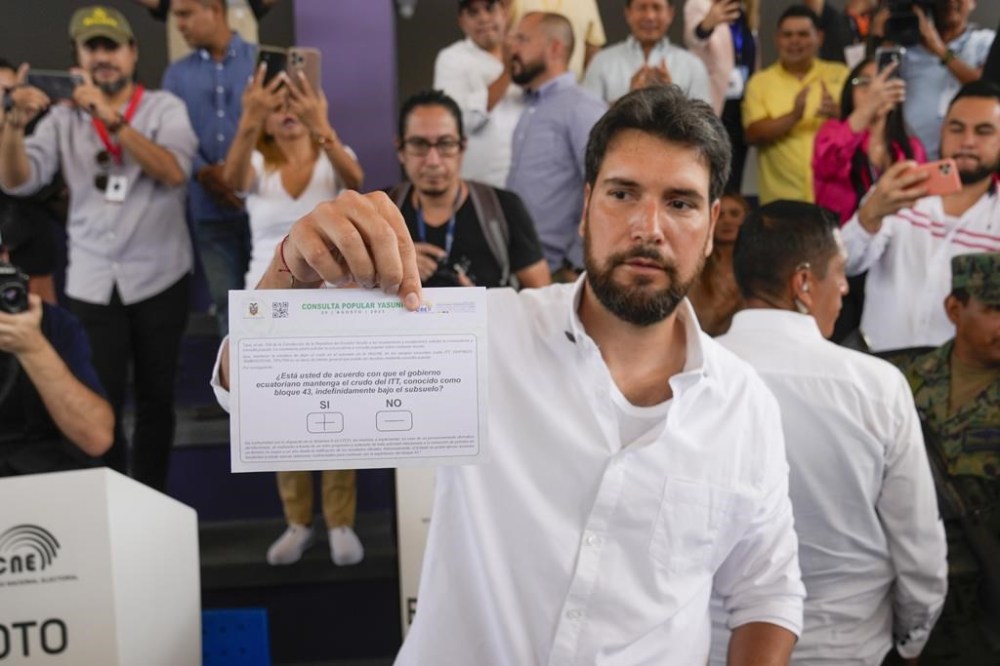
Presidential candidate Jan Topic, of the Country Without Fear Coalition, shows his ballot in a referendum on whether the country should ban oil operations in the Amazons during in a snap election in Guayaquil, Ecuador, Sunday, Aug. 20, 2023. In a historic decision, Ecuadorians voted on Sunday against the oil drilling of Yasuni National Park, which is a protected area in the Amazon that's home to two uncontacted tribes and serves as a biodiversity hotspot. (AP Photo/Martin Mejia, File)

“Ecuadorians have come together for this cause to provide a life opportunity for our Indigenous brothers and sisters and also to show the entire world, amidst these challenging times of climate change, that we stand in support of the rainforest,” Nemo Guiquita, a leader of the Waorani tribe, told The Associated Press in a phone interview.

The referendum is the result of a long and winding process. It started in 2007, when then-President Rafael Correa announced that Ecuador would refrain from oil exploration in Block 43 if rich nations compensated the poverty-stricken country. This was to be accomplished through establishment of a $3.6 billion fund, equal to 50% of the projected revenue from the block.

However, the fund drew in only a small fraction of the intended amount. As a result, in August 2013, Correa declared Ecuador’s intention to proceed with oil exploration in the block. In response, Indigenous and environmentalist movements initiated a campaign under the banner of the Yasunidos movement, seeking to amass signatures for the referendum. After almost one decade of legal battles and bureaucratic hurdles, the Supreme Court ruled in May that the measure must be incorporated into this year’s election.

The outcome represents a significant blow to Ecuadorian President Guillermo Lasso who advocated for oil drilling, asserting that its revenues are crucial to the country’s economy. State oil company Petroecuador, which currently produces almost 60,000 barrels a day in Yasuni, will be required to dismantle its operations in the coming months.

The South American country started exploring oil on a large scale in the Amazon in the 1970s when it became an Organization of the Petroleum Exporting Countries member —membership it withdrew in 2020. For decades, oil has been Ecuador’s main export. In 2022, it represented 35.5% of total exports, according to the country’s Central Bank. Block 43 alone contributes $1.2 billion annually to the federal budget.

In a statement Monday, Petroecuador said it would await the conclusion of the ballot counting before commenting on the referendum. The company added that it would comply with the decision of the Ecuadorian people.

The referendum applies only to Block 43. Within the Amazon region, oil production extends to other sections of Yasuni park and into Indigenous territories. Accidents are commonplace, mostly through oil spills into the rivers.

“It’s not that we’re going to feel relieved. We can breathe a moment of calm, we’re happy, but there are many more oil wells in Waorani territory causing harm,” says Indigenous leader Guiquita. “We hope that with this public consultation, there will be a path marked by the fact that the decision belongs to the people and that we can remove all those who are extracting oil and polluting our land.”
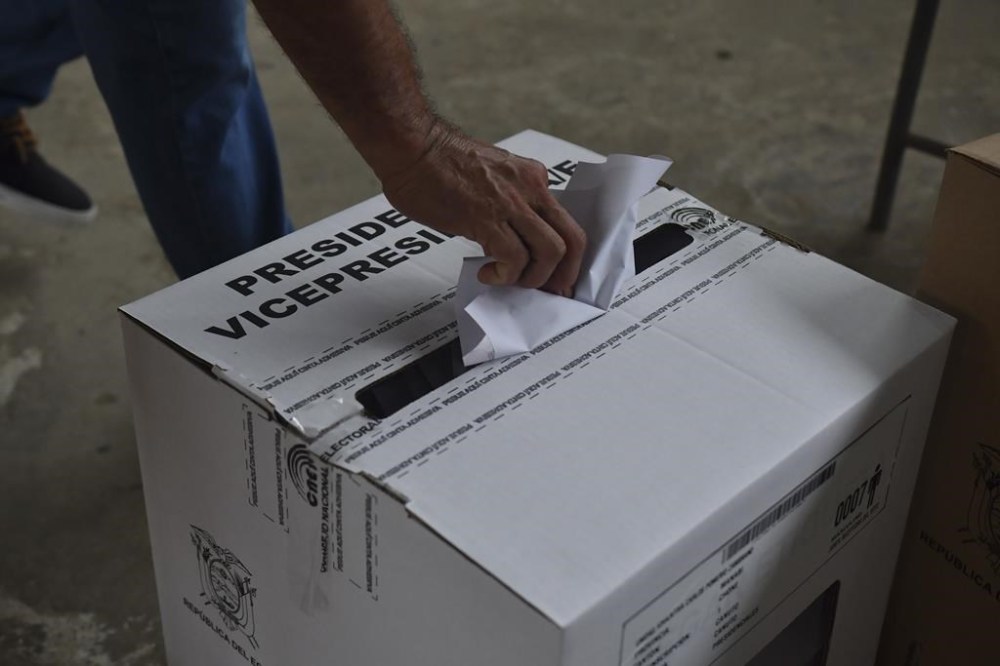
FILE - A voter casts his ballot in a snap election in Canuto, Ecuador, Sunday, Aug. 20, 2023. In a historic decision, Ecuadorians voted on Sunday against the oil drilling of Yasuni National Park, which is a protected area in the Amazon that's home to two uncontacted tribes and serves as a biodiversity hotspot. (AP Photo/Ariel Ochoa, File)

___

A previous version of this story was corrected to reflect the referendum was on oil exploration in Block 43, not 44.

___

Associated Press climate and environmental coverage receives support from several private foundations. See more about AP’s climate initiative here. The AP is solely responsible for all content.
Report Error Submit a Tip

More Stories

Collisions send people to hospital; one fatality

2 minute read Yesterday at 10:42 AM CDT

Five people are in hospital following a two-vehicle collision on Monday at the corner of Pembina Highway and Plaza Drive in which three pedestrians were struck.

On Sept. 28, just after 4:30 p.m., a Ford Fusion was travelling northbound on Pembina Highway through the Plaza Drive intersection with a green light when it was struck by a westbound Honda Fit that failed to stop for a red light at Plaza Drive. The Honda Fit mounted the sidewalk, striking three young children who were with an adult.

The three children were transported to hospital in stable condition with minor injuries. The driver of the Honda, a woman in her 70s, and the passenger, a man in his 80s, were transported to hospital in unstable condition. They were both upgraded to stable condition. The driver was issued a ticket under the Highway Traffic Act.

The Winnipeg Police Service’s Traffic Division is investigating.

Bombers coach happy to be back at work after backbreaking loss to Argos

Taylor Allen 6 minute read Preview

Bombers coach happy to be back at work after backbreaking loss to Argos

Taylor Allen 6 minute read Tuesday, Sep. 29, 2026

It’s the first practice day after a backbreaking loss.

The Winnipeg Blue Bombers are in a challenging predicament with four games remaining — starting Saturday on the road against the Montreal Alouettes (11-3) — that leaves their playoff aspirations far from solidified.

And yet, head coach Mike O’Shea makes his way behind the podium, looks out at a room of reporters and is grinning ear to ear.

Why so happy?

Read
Tuesday, Sep. 29, 2026

Winnipeg Book Festival starts a new chapter

Ben Sigurdson 4 minute read Preview

Winnipeg Book Festival starts a new chapter

Ben Sigurdson 4 minute read 2:01 AM CDT

Once known as Thin Air, the 2026 Winnipeg Book Festival marks a new chapter heading into its 29th year celebrating fiction, non-fiction and poetry with a new name, new staff and a shorter, more streamlined fest based at The Forks.

Read
2:01 AM CDT

Acquisition of former residential school grounds will help educate future generations: premier

Connor McDowell and Morgan Modjeski 6 minute read Preview

Acquisition of former residential school grounds will help educate future generations: premier

Connor McDowell and Morgan Modjeski 6 minute read Tuesday, Sep. 29, 2026

Premier Wab Kinew says a former Brandon-area campground acquired by the province will help educate future generations about the horrors of residential schools.

“We live in an era where people are trying to deny what happened in residential schools,” Kinew said during a Tuesday afternoon visit to Turtle Crossing Campground, near the former Brandon Indian Residential School. “It’s an important part of our national history, and keeping that truth alive.”

Kinew officially announced the province’s plan Tuesday, in partnership with the City of Brandon, to acquire and protect the site where the bodies of more than 50 Indigenous children are located.

The premier said the property has “huge national significance” for education about residential school history because it is one of the “most documented” in the country. He carried photographs, and some 20th century newspaper clippings from the Brandon Sun around the site Tuesday.

Read
Tuesday, Sep. 29, 2026

Winnipeg’s challenge: preparing for weather extremes

Adam Johnston 5 minute read Preview

Winnipeg’s challenge: preparing for weather extremes

Adam Johnston 5 minute read 2:00 AM CDT

A new United Nations report warns the world will exceed the 1.5 C Paris limit by 2030.

Read
2:00 AM CDT

Ecuadorians reject oil drilling in the Amazon, ending operations in a protected area

Associated Press, The Associated Press 5 minute read Preview

Ecuadorians reject oil drilling in the Amazon, ending operations in a protected area

Associated Press, The Associated Press 5 minute read Monday, Aug. 21, 2023

RIO DE JANEIRO (AP) — Ecuadorians voted against drilling for oil in a protected area of the Amazon, an important decision that will require the state oil company to end its operations in a region that’s home to isolated tribes and is a hotspot of biodiversity.

With over 90% of the ballots counted by early Monday, around six in 10 Ecuadorians rejected the oil exploration in Block 43, situated within Yasuni National Park. The referendum took place along with the presidential election, which will be decided in a runoff between leftist candidate Luisa González and right-wing contender Daniel Noboa. The country is experiencing political turmoil following the assassination of one of the candidates, Fernando Villavicencio.

Yasuni National Park is inhabited by the Tagaeri and Taromenani, who live in voluntary isolation, and other Indigenous groups. In 1989, it was designated, along with neighboring areas, a world biosphere reserve by the United Nations Educational, Scientific and Cultural Organization, also known as UNESCO. Encompassing a surface area of around 1 million hectares (2.5 million acres), the area boasts 610 species of birds, 139 species of amphibians and 121 species of reptiles. At least three species are endemic.

“Ecuadorians have come together for this cause to provide a life opportunity for our Indigenous brothers and sisters and also to show the entire world, amidst these challenging times of climate change, that we stand in support of the rainforest,” Nemo Guiquita, a leader of the Waorani tribe, told The Associated Press in a phone interview.

Read
Monday, Aug. 21, 2023