Ship traffic ramps up through the Northwest Passage as Arctic ice retreats

Advertisement

Advertise with us

MONTREAL - Michael Wenger still remembers the patches of blood red and vivid violet that daub the landscape of the Northwest Passage.

Read this article for free:


or

Already have an account? Log in here »

To continue reading, please subscribe:

Subscribe and receive a limited-edition Free Press branded hat or tote.

Digital Subscription

One year of digital access for only $205*

  • Enjoy unlimited reading on winnipegfreepress.com
  • Read the E-Edition, our digital replica newspaper
  • Access News Break, our award-winning app
  • Play interactive puzzles

*First annual payment billed as $205.00 + GST for one year. This annual subscription will automatically renew at $233.00 + GST every 52 weeks (10% off the regular annual price of $259.35). Offer available to new and qualified returning subscribers only. Cancel any time.

To continue reading, please subscribe:

Add Free Press access to your Brandon Sun subscription for only an additional

$1 for the first 4 weeks*

  • Enjoy unlimited reading on winnipegfreepress.com
  • Read the E-Edition, our digital replica newspaper
  • Access News Break, our award-winning app
  • Play interactive puzzles
Start now

*Your next Brandon Sun subscription payment will increase by $1.00 and you will be charged $17.95 plus GST for four weeks. After four weeks, your payment will increase to $24.95 plus GST every four weeks.

Hey there, time traveller!
This article was published 05/11/2023 (1063 days ago), so information in it may no longer be current.

MONTREAL – Michael Wenger still remembers the patches of blood red and vivid violet that daub the landscape of the Northwest Passage.

“People usually think it’s ice and glaciers and rocks. And then you get there and you see these meadows, with all the different plants,” he said, speaking by phone from Reykjavik, Iceland, where he was attending an Arctic Circle Assembly conference.

“It’s very colourful,” said Wenger, CEO of Polar Journal AG, who worked as an expedition guide on a northern cruise vessel in 2016.
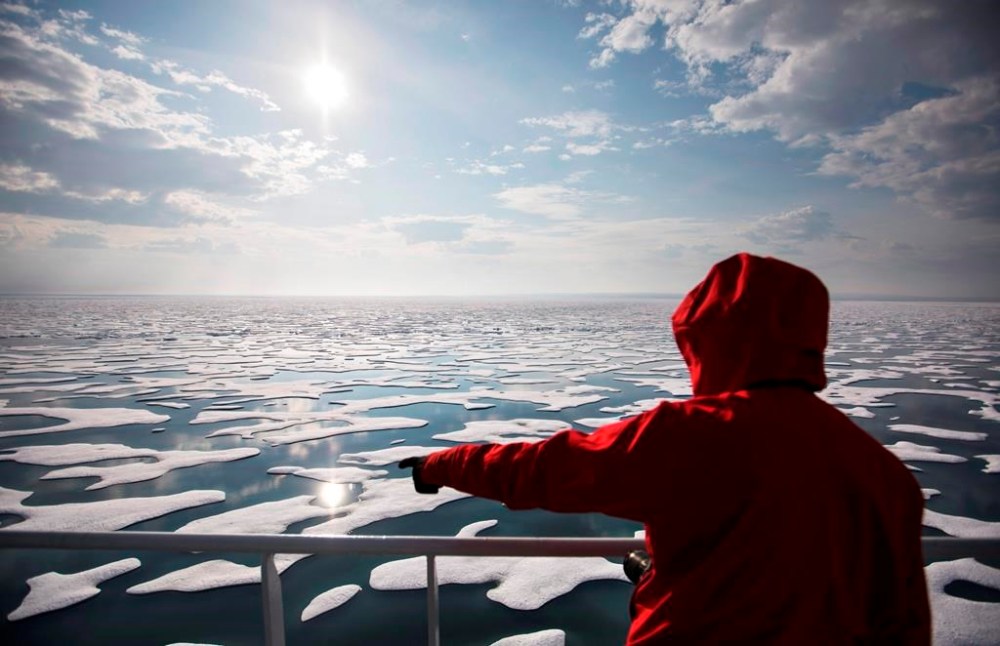
A researcher points out a possible sighting of wildlife aboard the Finnish icebreaker MSV Nordica as it traverses the Northwest Passage through the Canadian Arctic Archipelago, Saturday, July 22, 2017. Alongside the melt, more and more ships are sweeping across the Northwest Passage as a heating planet clears a path for boat traffic through the Arctic corridor, raising hopes for commercial viability as well as concerns about the environmental and social impact. THE CANADIAN PRESS//David Goldman

A growing number of people are now getting to witness those vibrant tundras first-hand. The same climate shifts that affect Arctic flora have also forced a massive retreat in Arctic sea ice — even in the passage, where geography and wind currents freeze the waters for a longer period of the year than in other parts of the Far North.

“It’s happening at a crazy rate,” said Bernard Funston, former chairman of the Canadian Polar Commission.

In step with the melt, more and more ships are sweeping across the Northwest Passage as a heating planet clears a path for boat traffic through the Arctic corridor, raising hopes for commercial viability as well as concerns about the environmental and social impact.

Steeped in lore since before Roald Amundsen became the first European to fully chart it in 1906, the Northwest Passage runs 1,450 kilometres from east to west, threading an archipelago of islands between Baffin Bay and the Beaufort Sea via a half-dozen routes under a single name. Effectively off-limits to transcontinental shipping for centuries, the seaway hosted a bulk freighter from end to end for the first time in 2013.

With a hull strengthened to withstand floating ice, the Nordic Orion that year hauled a load of metallurgical coal from Vancouver and across the Arctic coastline to Finland. The journey shaved 1,000 nautical miles from the traditional route through the Panama Canal and shipped 25 per cent more cargo due to the greater depth of the passage.

The ramp-up since has been striking, with bulk carriers, fuel tankers, cruise liners and research expeditions leading the charge.

The number of unique vessels operating in the Canadian Arctic rose 35 per cent to 212 between 2016 and 2022, according to figures provided by the international Arctic Council.

Researchers say the Northwest Passage will likely never compete with trade arteries like the Panama Canal due to the inconsistent navigation season, lack of ports and still-hazardous conditions.

But the diminishing ice, growth of northern resource development and more recently Russia’s invasion of Ukraine have already prompted more commercial vessels to travel the channels.

“The season is getting longer and the ships are getting bigger,” said Hjalti Hreinsson, a project manager at the Arctic Council. Cruise liners are among the largest vessels venturing through.

More ships carry the potential for more underwater noise, fuel pollution and invasive species, affecting communities and the environment in and around the passage.

“The biodiversity of the area is being directly threatened not merely by the passage of mega ships but by proposed seismic testing and other activities that would follow,” Peter Ittinuar, the first Inuk member of Parliament, said in a 2017 paper, referring to oil and gas exploration.

In Pond Inlet, locals told Wenger they used to hunt narwhal in a day or two. “Now they have to go out for five or six days before they even see a narwhal,” Wenger said. Noise-sensitive beluga and bowhead whales, essential to subsistence hunting traditions, also flee the sound of engines, while seals retreat in sync with the sea ice.

The anxieties of shippers and residents can overlap. If boats are stranded or an accident occurs, the tiny shoreline towns are ill-equipped to handle an influx of rescuees or transform into staging grounds for a cleanup effort.

In 2018, the Russian-flagged Akademik Ioffe research vessel ran aground in the passage’s Gulf of Boothia with 162 people on board, prompting rescue by a pair of Canadian Coast Guard icebreakers — and reflection on the perils of the waterway.

“The weather changes, it basically pushes ice right in front of the vessels and then they get caught,” said Wenger.

Several other deterrents remain before the Northwest Passage can become a full-blownhighway.

For massive container ships, parts of the route are too shallow and the passage offers no ports where the vessels can drop cargo, which they typically do at several points along a voyage.

“There’s a complete and utter lack of infrastructure. So it’s risky for companies to do this, and it’s not foolproof. Just because it’s shorter doesn’t mean it’s going to take less time,” said Jackie Dawson, the Canada Research Chair in the human and policy dimensions of climate change at the University of Ottawa.

“There’s just a lack of predictability. And if you do have an accident, there’s no one immediately there to help.”

Still, the numbers speak for themselves. “Even pleasure craft is going up really quickly,” Dawson said. “People are excited by the idea of traversing the Northwest Passage.

“In my world, a lot of scientists who would have wanted to work in Russia now want to work here,” she added, referring to that country’s attack on its neighbour. “We’re going to see more science vessels.”

The trend is already underway, with 13 research ships cruising arctic waters in Canada last year versus four in 2016, according to the Arctic Council group.

For Wenger, the call of the wild animals — polar bears, seals, muskox — he saw in the passage persists. But other images remain even more frozen in his mind.

“Seeing an area that had been dubbed one of the hardest waterways to cross due to the ice conditions … without any ice — that was a real wow,” he recalled. “I didn’t expect that.”

This report by The Canadian Press was first published Nov. 5, 2023.

Report Error Submit a Tip

More Stories

Broadening prediction-market gambling a bad idea

Editorial 4 minute read Preview

Broadening prediction-market gambling a bad idea

Editorial 4 minute read 2:01 AM CDT

Let’s make a prediction: sooner or later, when Canadian governments find a way to take their own cut of the action, prediction-contract gambling on everything from sports to entertainment to political decisions is going to come to Canada.

And that’s a horrible, dangerous, pernicious idea.

Unless you have particular access to information — either inside information or strategic information based on skills or education — you’re not likely to make money at it. In fact, structurally, you’re likely to lose. In prediction markets, you basically pay an amount, plus fees from the company involved, to bet on whether something will or will not happen within a certain time frame. The amount you pay for your contract depends on how other people are also betting.

As Wealthsimple describes it, “You buy whichever side you think is right. Prices move with demand, so if the market leans towards one outcome, the more that side costs. If a lot of people are backing the TSX to finish above 38,000, yes gets more expensive and no gets cheaper.”

Read
2:01 AM CDT

Mayoral candidate Vogiatzakis criticized for living outside Winnipeg

Malak Abas 4 minute read Preview

Mayoral candidate Vogiatzakis criticized for living outside Winnipeg

Malak Abas 4 minute read Updated: Yesterday at 6:03 PM CDT

A mayoral hopeful took heat from other candidates Friday for living outside Winnipeg while running in the civic election.

Mike Vogiatzakis’s primary residence is in the Rural Municipality of St. Andrews, about 25 kilometres north of Winnipeg — a community with its own mayor and councillors.

But the funeral director said he owns a home in Winnipeg where he divides his time, and he would move to the city full-time if elected mayor.

“It doesn’t matter where a person lives. Why are we dividing St. Andrews and Manitoba and Winnipeg? I’ve met the criteria to run for mayor,” Vogiatzakis said Friday morning.

Read
Updated: Yesterday at 6:03 PM CDT

Blown lead spoils Jets opener

Mike McIntyre 7 minute read Preview

Blown lead spoils Jets opener

Mike McIntyre 7 minute read Yesterday at 11:09 PM CDT

Younger. Faster. Stronger.

They may still be a long ways from a finished product, but it’s safe to say the new-look Winnipeg Jets made a mostly favourable first impression on Friday night in front of a sold-out crowd at Canada Life Centre.

Sure, a 4-3 overtime loss to a hard-nosed Boston Bruins outfit is going to sting a little, especially since the home team was just 98 seconds away from a regulation victory.

But if the Jets can bottle up this kind of energy and effort, they should enjoy plenty of success over the course of the 84-game campaign.

Read
Yesterday at 11:09 PM CDT

Creative powerhouse Perry Rosemond never lost Winnipeg roots

Ben Waldman 7 minute read Preview

Creative powerhouse Perry Rosemond never lost Winnipeg roots

Ben Waldman 7 minute read 6:00 AM CDT

He created King of Kensington, directed the troops in the Royal Canadian Air Farce, and his creative eye was behind the lens for television shows starring Johnny Cash, Tom Jones, Mr. Dress-Up and the Friendly Giant.

He also wrote and developed the Canadian version of Sesame Street during his time as the head of school and preschool programming for CBC in Toronto, and directed a televised special in 2002 for Winnipeg sketch comedy troupe Royal Liechtenstein Theatre Company.

But before his name featured in the credits of some of the most iconic and influential pieces of the Cancon canon, Perry Rosemond was an only child living in a crammed, multi-generational home in Winnipeg’s North End, racing each day to beat the morning bell next door at William Whyte School.

In memoirs that have yet to be published, the late television producer recalled his childhood. “(T)here were 14 of us in the house at 193 Andrews St., and it wasn’t that big of a house,” he writes.

Read
6:00 AM CDT

Health minister warns $1.2 billion in annual federal funding set to expire in March

Scott Billeck 4 minute read Preview

Health minister warns $1.2 billion in annual federal funding set to expire in March

Scott Billeck 4 minute read Thursday, Oct. 1, 2026

Manitoba’s health minister is warning of possible cuts to health care with $1.2 billion in annual funding from Ottawa set to expire next year.

“We’re very concerned that what would be the largest cut to health care in a generation is right in front of us,” Health Minister Uzoma Asagwara said Thursday at the Manitoba legislature. “It means that services that Manitobans depend on will be in jeopardy and be at risk.

“Any reductions, any cuts from Canada, will have direct impacts on the health outcomes of Manitobans.”

Asagwara, who serves as the provincial and territorial health minister lead, chaired a virtual meeting Tuesday with provincial and territorial health ministers to discuss federal funding for health care, mental health care and substance use services, which is scheduled to expire March 31, 2027.

Read
Thursday, Oct. 1, 2026

Clock ticks down on destruction of records documenting residential school abuses

Marsha McLeod 13 minute read Preview

Clock ticks down on destruction of records documenting residential school abuses

Marsha McLeod 13 minute read Yesterday at 12:49 PM CDT

In less than a year, a private company is set to destroy the largest cache of records detailing the widespread abuse of Indigenous children at residential schools in Canada.

The destruction, which was ordered by an Ontario court in 2014 and later upheld by the Supreme Court, is set to take place on Sept. 19, 2027.

This countdown is igniting emotional conversations that seek to balance the immense historical value of the records alongside the confidentiality survivors were promised as part of the process of providing detailed testimony about abuses they’d suffered.

The records were created as part of the Indian Residential Schools Settlement Agreement, a class-action settlement stemming from survivors who began suing the federal government in the late 1990s over the harm they’d been subjected to at residential schools.

Read
Yesterday at 12:49 PM CDT