Canadian-built underwater observatory transmitting data from around Antarctica

Advertisement

Advertise with us

VICTORIA - A cache of scientific equipment that could fit in the back of an SUV has been lowered into the Southern Ocean, north of the Antarctic Peninsula, and is already streaming open-source data for anyone wanting to monitor the ocean's health.

Read this article for free:


or

Already have an account? Log in here »

To continue reading, please subscribe:

Subscribe and receive a limited-edition Free Press branded hat or tote.

Digital Subscription

One year of digital access for only $205*

  • Enjoy unlimited reading on winnipegfreepress.com
  • Read the E-Edition, our digital replica newspaper
  • Access News Break, our award-winning app
  • Play interactive puzzles

*First annual payment billed as $205.00 + GST for one year. This annual subscription will automatically renew at $233.00 + GST every 52 weeks (10% off the regular annual price of $259.35). Offer available to new and qualified returning subscribers only. Cancel any time.

To continue reading, please subscribe:

Add Free Press access to your Brandon Sun subscription for only an additional

$1 for the first 4 weeks*

  • Enjoy unlimited reading on winnipegfreepress.com
  • Read the E-Edition, our digital replica newspaper
  • Access News Break, our award-winning app
  • Play interactive puzzles
Start now

*Your next Brandon Sun subscription payment will increase by $1.00 and you will be charged $17.95 plus GST for four weeks. After four weeks, your payment will increase to $24.95 plus GST every four weeks.

Hey there, time traveller!
This article was published 18/01/2024 (943 days ago), so information in it may no longer be current.

VICTORIA – A cache of scientific equipment that could fit in the back of an SUV has been lowered into the Southern Ocean, north of the Antarctic Peninsula, and is already streaming open-source data for anyone wanting to monitor the ocean’s health.

Scientists say the underwater observatory collects measurements, including temperature, oxygen concentration and chlorophyll levels, and will fill a gap in data to help understand the impacts of climate change in the waters around Antarctica.

The project is being jointly run by Ocean Networks Canada, out of the University of Victoria, and the Spanish National Research Council.
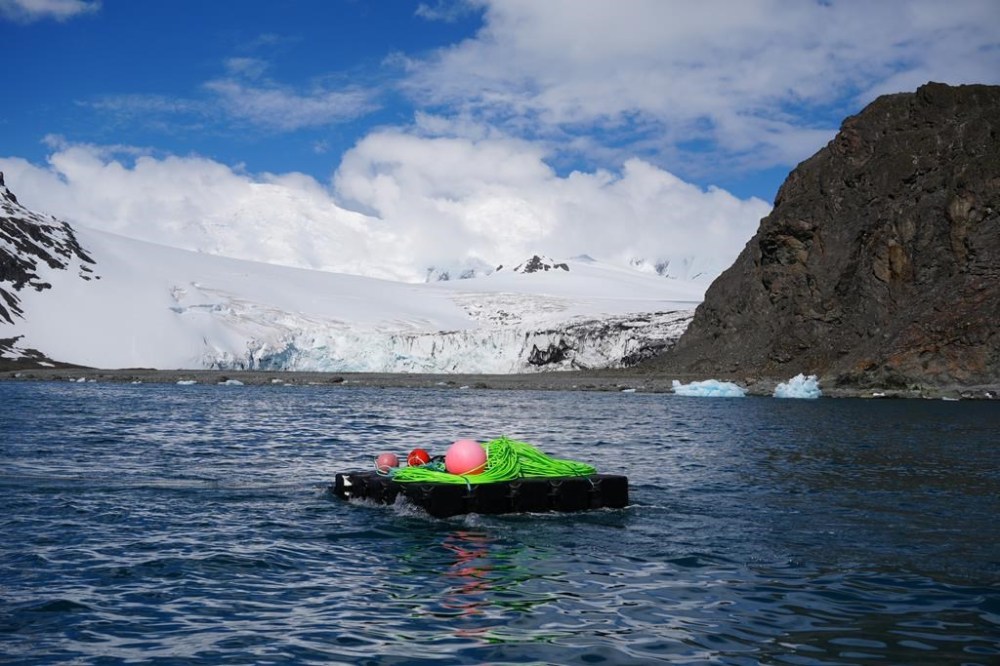
The Southern Ocean observatory, a package of sensors which includes equipment to measure temperature, oxygen concentration and chlorophyll levels on the water, is shown being deployed at the Juan Carlos I Antarctic scientific station, in Antarctica in an undated handout photo. THE CANADIAN PRESS/HO-Consejo Superior de Investigaciones Científicas, Didac Casado Rodriguez, *MANDATORY CREDIT*

Ocean Networks’ CEO Kate Moran says data in the Antarctic, prior to the station being installed, primarily came from surface satellites, some floating research equipment and people on cruises.

The Canadian-built equipment is now about 23 metres deep near a Spanish research station on Livingston Island in the South Shetlands Archipelago, where it is expected to stay for years.

Kohen Bauer, a senior staff scientist at Ocean Networks Canada, says the Southern Ocean and its circumpolar current are critical to how much the water in the area circulates, and having long-term data from a stationary location will help researchers spot changes.

The current that circles the continent connects basins for the Atlantic, Indian and South Pacific oceans.

The observatory, which also measures conductivity, depth and clarity in the water, posts updated data to Ocean Networks Canada’s online dashboard about every 30 minutes.

“This is meant to be a long, continuous, time series and there’s actually very few of those in the world, let alone in the Southern Ocean,” Bauer says.

“We’re trying to establish a continuous time series of these ocean variables. And it’s with these established time series that we can start to ask, or interpret the data, in the context of key questions, both at the local and actually at the regional and potentially global scale.”

Data could pick up changes to sea ice, glacier formation and ice retreat, he says.

“Then, ultimately, it’s about connecting those types of observations to, let’s say, more global questions such as climate change,” he says.

Moran says understanding how the ocean is absorbing the carbon dioxide emitted by greenhouse gases helps to predict the future.

“Colder oceans, like the Arctic, and the Southern Ocean, can absorb more CO2 than other places,” she says.

“So, understanding how that is happening now, and how we can forecast it, helps us to understand further the natural carbon system to help us forecast the future, no matter what happens in terms of emissions.”

Last year, following a symposium focused on the Southern Ocean, 300 scientists from 25 nations issued a statement calling for better observation.

It says the ocean has seen record low levels of sea-ice, record high temperatures and dramatic shifts in penguin populations, among other changes.

“The chronic lack of observations for the Southern Ocean challenges our ability to detect and assess the consequences of change,” the statement says.

“As such, it is more pressing than ever to have a sustained and co-ordinated Southern Ocean observing system to provide an understanding of current conditions, inform predictions of future states, and support policies and regulations for the benefit of society.”

David Hik, the chief scientist for Polar Knowledge Canada, which manages Canada’s scientific contributions in the Antarctic under the Ministry of Northern Affairs, says the observatory and the work with Spain is an example of the kind of contribution Canada can make to Antarctic science.

“Any new observations are going to have a significant impact on our ability to better understand what’s happening in those environments, and how they’re changing over time,” he says.

This report by The Canadian Press was first published Jan. 18, 2024.

Report Error Submit a Tip

More Stories

Hayden Panettiere, who starred in ‘Heroes’ and ‘Nashville,’ dies at 36

Hannah Schoenbaum, The Associated Press 6 minute read Preview

Hayden Panettiere, who starred in ‘Heroes’ and ‘Nashville,’ dies at 36

Hannah Schoenbaum, The Associated Press 6 minute read Updated: Yesterday at 12:26 PM CDT

Hayden Panettiere, a onetime child star who soared to fame in the TV shows “Heroes” and “Nashville” while enduring struggles with alcohol addiction and depression, has died. She was 36.

Police said Panettiere was found unresponsive in an apartment in Greenville, South Carolina, shortly before 2 p.m. Sunday. Lifesaving measures were performed but she was pronounced dead at the scene.

No cause of death has been determined and Panettiere's death remains under investigation. An autopsy found no signs of trauma and police said officers saw no signs of foul play.

The television and film performer, who would have turned 37 on Friday, had been open about her private battles and wrote at length about them in the memoir, “This Is Me,” which came out in May. She described lifelong scars from her early fame, and acknowledged being addicted to alcohol and enduring postpartum depression after the birth of her daughter, Kaya, with Ukrainian boxer Wladimir Klitschko in 2014.

Read
Updated: Yesterday at 12:26 PM CDT

Officer who shot dog dead after it bit him won’t face charges

Scott Billeck 3 minute read Preview

Officer who shot dog dead after it bit him won’t face charges

Scott Billeck 3 minute read Yesterday at 1:06 PM CDT

A Manitoba First Nations police officer will not face charges for fatally shooting a dog last year, despite the Crown describing the officer’s conduct as “concerning.”

The Independent Investigation Unit of Manitoba announced it would not recommend charges Monday, more than a year after the incident was reported to the police watchdog.

A Manitoba First Nations Police Service officer went to a home in Swan Lake First Nation to make an arrest in June 2025, the IIU said. No arrest was made as the person police were looking for was not there. As the officer was leaving, a dog chained outside bit him.

The officer later returned with a carbine rifle and shot and killed the dog.

Read
Yesterday at 1:06 PM CDT

Paralyzed foster girl has system under a microscope

Chris Kitching 6 minute read Preview

Paralyzed foster girl has system under a microscope

Chris Kitching 6 minute read 2:00 AM CDT

An internal investigation by Manitoba’s Families Department is nearly complete in the case of a six-year-old girl who is paralyzed after being assaulted by her foster mother in Winnipeg.

The review by child-welfare officials is intended to prevent similar incidents, but it’s unlikely the public will learn the findings or recommendations.

“We’re working closely with the (child and family services) authority to make sure that every recommendation is taken seriously and implemented,” Families Minister Nahanni Fontaine said Monday.

“They’re important (investigations) because they help us identify what went wrong so we can make those changes to ensure something like this tragedy never happens again.”

Read
2:00 AM CDT

Best to fess up about grandkid-sitting fatigue

Maureen Scurfield 5 minute read Yesterday at 2:00 AM CDT

Dear Miss Lonelyhearts: We love our grandchildren, but now we’re sick of them. The two sets of parents — our adult children — have been parking their kids out here on the farm with us while they take back-to-back road trips to see their friends. We’ve had enough.

Grandma and I want them to come back and get the “brats” (just joking, they’re nice kids) so we can relax.

You have to be so careful with city kids around the farm who don’t know when they’re going to make a mistake and get hoofed by an animal or run over by a farm implement.

How do we tell our kids the party is over early, and they really need to come back before grandma and I give out?

It’s back and it’s better than ever.

National non-profit ogranization motionball will be returning for its annual event — the 2026 Marathon of Sports Winnipeg — at the Dakota Community Centre Sept. 19. This fundraising event will help support the Special Olympics Manitoba and Canada foundation in hopes of reaching their goal of $100,000.

Local Special Olympic athletes, including the province’s own Alec Baldwin, as well as registered participants will join together to play a variety of team sports such as basketball, kinball and bocce ball.

Canadian-built underwater observatory transmitting data from around Antarctica

Ashley Joannou, The Canadian Press 4 minute read Preview

Canadian-built underwater observatory transmitting data from around Antarctica

Ashley Joannou, The Canadian Press 4 minute read Thursday, Jan. 18, 2024

VICTORIA – A cache of scientific equipment that could fit in the back of an SUV has been lowered into the Southern Ocean, north of the Antarctic Peninsula, and is already streaming open-source data for anyone wanting to monitor the ocean’s health. Scientists say the underwater observatory collects measurements, including temperature, oxygen concentration and chlorophyll levels, and will fill a gap in data to help understand the impacts of climate change in the waters around Antarctica. The project is being jointly run by Ocean Networks Canada, out of the University of Victoria, and the Spanish National Research Council. The Southern […]

Read
Thursday, Jan. 18, 2024