Native American tribes gain new authority to stop unwanted hydopower projects
Advertisement
Read this article for free:
or
Already have an account? Log in here »
To continue reading, please subscribe:

Digital Subscription
One year of digital access for only $205*
- Enjoy unlimited reading on winnipegfreepress.com
- Read the E-Edition, our digital replica newspaper
- Access News Break, our award-winning app
- Play interactive puzzles
*First annual payment billed as $205.00 + GST for one year. This annual subscription will automatically renew at $233.00 + GST every 52 weeks (10% off the regular annual price of $259.35). Offer available to new and qualified returning subscribers only. Cancel any time.
To continue reading, please subscribe:
Add Free Press access to your Brandon Sun subscription for only an additional
$1 for the first 4 weeks*
- Enjoy unlimited reading on winnipegfreepress.com
- Read the E-Edition, our digital replica newspaper
- Access News Break, our award-winning app
- Play interactive puzzles
*Your next Brandon Sun subscription payment will increase by $1.00 and you will be charged $17.95 plus GST for four weeks. After four weeks, your payment will increase to $24.95 plus GST every four weeks.
Read unlimited articles for free today:
or
Already have an account? Log in here »
Hey there, time traveller!
This article was published 22/02/2024 (940 days ago), so information in it may no longer be current.
Federal regulators have granted Native American tribes more power to block hydropower projects on their land after a flurry of applications were filed to expand renewable energy in the water-scarce U.S. Southwest.
Previously, the Federal Energy Regulatory Commission granted developers approval to move ahead with planning even if tribes objected. That practice came to an end last week. Now, a new commission policy allows tribes to quickly veto proposals, forcing businesses to cooperate if they want the federal government to grant them exclusive rights to their hydropower projects.
“This is the acknowledgement and respect of tribal sovereignty, which is critical,” said George Hardeen, spokesperson for the Navajo Nation’s president’s office.
The Federal Energy Regulatory Commission recently rejected seven proposals for projects on the Navajo Nation, which stretches 27,000 square miles (69,000 square kilometers) across Arizona, New Mexico and Utah. When it issued those rejections, the commission also announced the policy change, handing tribes the same power as federal agencies to block projects.
“It applies anywhere that a hydropower project might be proposed on tribal lands throughout the United States,” said Aaron Paul, an attorney with Grand Canyon Trust, a conservation group.
The Hopi Tribe, which is completely surrounded by Navajo, urged the commission to cement the policy announcement in a formal rule, worrying a different administration would be less favorable to tribes and change the policy.
The hydropower projects are essentially big batteries that generate energy when demand is high and there aren’t a lot of other renewable sources like solar and wind available. Hydropower can be turned on when it is needed and works by releasing water from an upper reservoir to a lower one.
At a later point when the electric grid has excess power, water is pumped in a loop back up to the higher reservoir, recharging the battery.
Developers have expressed new interest in building these pumped hydropower projects as coal-fired plants shut down in the Southwest. The canyons, towering mesas and dramatic river valleys in the area are ideal terrain because the projects require moving water between different elevations.
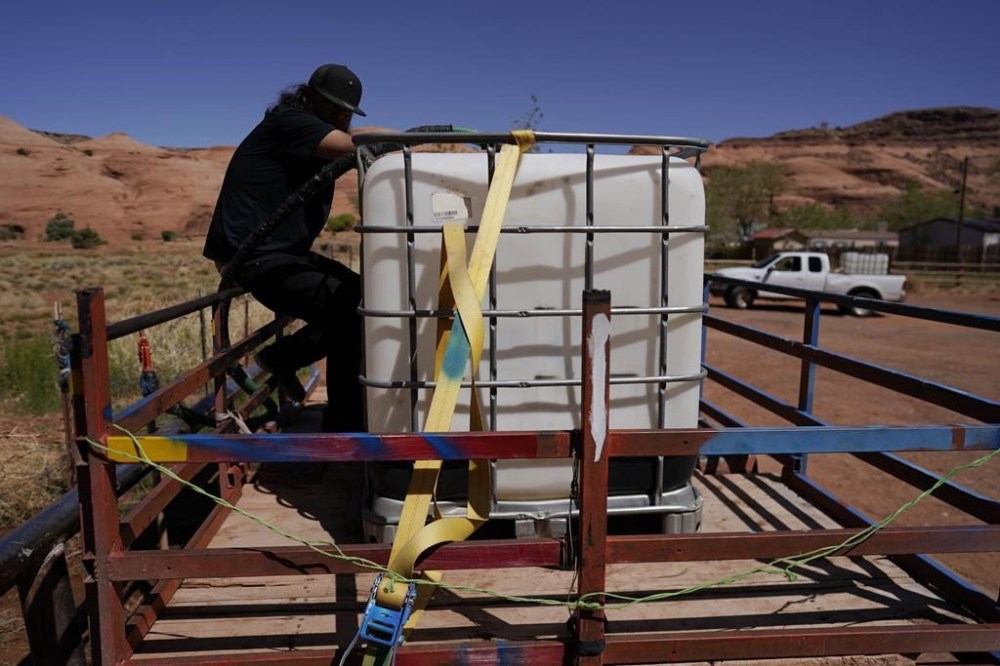
Environmental groups and some members of the Navajo Nation argue the projects require enormous amounts of water — particularly in a part of the country that already doesn’t have enough. Roughly one-third of the 175,000 people on the Navajo Nation don’t have running water at home.
People are sensitive to how scarce water is, and “they would more likely say ‘no’ to these kinds of projects,” Hardeen said.
Some of the proposals that were rejected came from Nature and People First. For example, the company told federal regulators it wanted to build the Black Mesa East project on the Navajo reservation in Arizona that would have two upper reservoirs with a combined capacity of 100,000 acre-feet and a single, lower reservoir with the same total storage capacity. An acre-foot of water serves two or three homes annually.
The project was proposed near a home site lease that Jheremy Young’s family has held for generations. He’s happy the commission blocked it. The area around the mesa is rugged, quiet and vast, and water has to be hauled in.
“That’s where my dad came from, that’s where his father came from,” Young said. “The sentimental value of the land — the story, the history — were the biggest concern.”
The Navajo Nation told federal regulators the company hadn’t consulted with the correct tribal authorities or addressed key concerns about water use and harm to golden eagle and other species’ habitats. Hardeen said now, developers will first need to go through the Navajo Nation Division of Natural Resources.
Denis Payre, president and CEO of Nature and People First, said the commission’s decision was “undeniably disheartening.” The company secured support from local Navajo communities and talked with Navajo government officials for a project he said would create jobs.
“Developing pumped storage projects is inherently challenging; this additional obstacle threatens to halt our collective efforts,” Payre said.
The company submitted a proposal for a much larger project than it intends to construct, giving it flexibility to build a smaller project on the piece of land it finds is best after study and tribal consultation.
That approach and using that amount of water engenders opposition, according to the Center for Biological Diversity, an environmental group.
“If you are going to propose a small project, actually propose a small project,” said Taylor McKinnon, the center’s Southwest director.
The Federal Energy Regulatory Commission also rejected proposals from Rye Development, which said it values tribal consultation and will continue to study opportunities on tribal land.
Malcolm Woolf, president and CEO of the industry group National Hydropower Association, said he supported tribes’ right to stop unwanted projects. But he said the new policy could halt planning too soon.
The commission denied preliminary permits for the seven projects, which only recognize a business is first in line to develop a project and allows further studies. Developers have to consult with tribes before they can be granted a license and start building.
Companies don’t want to navigate a complicated permitting process and spend years working with a tribe only for another business to swoop in and win rights to the project at the last minute, Woolf said.

One company quickly caught up in the new policy is Pumped Hydro Storage, which wants a preliminary permit for a project near the Little Colorado River on Navajo Nation land in Arizona. In light of its new policy, the commission asked for more input from those it potentially impacts before they decide what to do.
The company’s manager, Steve Irwin, said pumped storage is important but hard to build on the Navajo Nation’s land.
“There’s no clear pathway to doing business on the reservation,” Irwin said. “It’s almost like you have to have 100% unanimous consensus. It’s not majority, it’s got to be 100%, and it’s like, you are never going to get 100%.”
___
The Associated Press receives support from the Walton Family Foundation for coverage of water and environmental policy. The AP is solely responsible for all content. For all of AP’s environmental coverage, visit https://apnews.com/hub/climate-and-environment