With budget mostly silent on climate change, critics say Ontario lacks plan to adapt

Advertisement

Advertise with us

TORONTO - The Ontario budget's failure to directly address climate change represents a "gross abdication of responsibility" by the government, some critics argue, saying the province rapidly needs to do more to adapt to a changing climate.

Read this article for free:


or

Already have an account? Log in here »

To continue reading, please subscribe:

Subscribe and receive a limited-edition Free Press branded hat or tote.

Digital Subscription

One year of digital access for only $205*

  • Enjoy unlimited reading on winnipegfreepress.com
  • Read the E-Edition, our digital replica newspaper
  • Access News Break, our award-winning app
  • Play interactive puzzles

*First annual payment billed as $205.00 + GST for one year. This annual subscription will automatically renew at $233.00 + GST every 52 weeks (10% off the regular annual price of $259.35). Offer available to new and qualified returning subscribers only. Cancel any time.

To continue reading, please subscribe:

Add Free Press access to your Brandon Sun subscription for only an additional

$1 for the first 4 weeks*

  • Enjoy unlimited reading on winnipegfreepress.com
  • Read the E-Edition, our digital replica newspaper
  • Access News Break, our award-winning app
  • Play interactive puzzles
Start now

*Your next Brandon Sun subscription payment will increase by $1.00 and you will be charged $17.95 plus GST for four weeks. After four weeks, your payment will increase to $24.95 plus GST every four weeks.

Hey there, time traveller!
This article was published 29/03/2024 (904 days ago), so information in it may no longer be current.

TORONTO – The Ontario budget’s failure to directly address climate change represents a “gross abdication of responsibility” by the government, some critics argue, saying the province rapidly needs to do more to adapt to a changing climate.

The budget presented Tuesday cites investments in climate-friendly public transit, electric vehicle manufacturing and conservation, but critics say it’s mostly silent on how the government will specifically help communities mitigate the effects of climate change and adapt to the realities of it.

“This is a gross, abdication of responsibility because the climate crisis continues to worsen,” said Keith Brooks, a programs director with Environmental Defence, an environmental advocacy organization.
The Ontario budget's failure to directly address climate change represents a
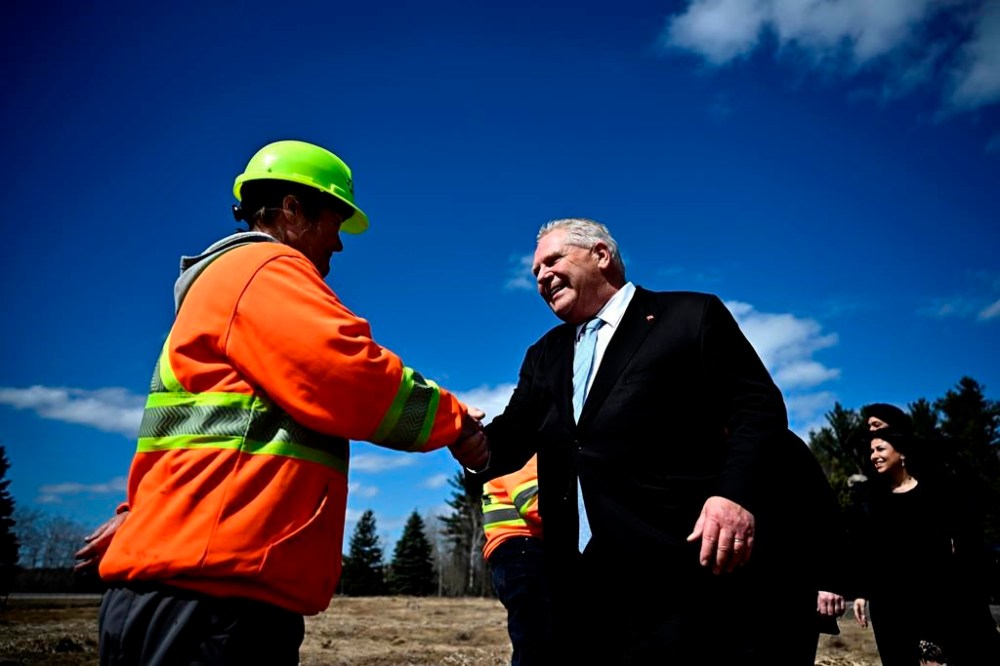
The Ontario budget's failure to directly address climate change represents a "gross abdication of responsibility" by the government, some critics argue, saying the province rapidly needs to do more to adapt to a changing climate. Ontario Premier Doug Ford greets workers prior to a funding announcement, in Ottawa, on Thursday, March 28, 2024. THE CANADIAN PRESS/Justin Tang

“Many of the tools that need to be used to fix the climate crisis are in the provincial toolbox.”

The 200-page budget makes only two references to climate change, both in sections about the sustainable bond program, which the government uses to raise money to finance projects considered environmentally friendly.

The federal carbon price, on the other hand, came up 10 times in the finance minister’s budget speech as he criticized Ottawa’s measure.

As last summer’s extreme heat and wildfires gave way to the warmest winter on record, threatening tourism sectors and melting winter roads to remote First Nations, critics say the government needs to show it’s better prepared.

“This is not a government that is serious about dealing with one of the great issues of our time,” said Gideon Forman, an Ontario climate change and transportation policy analyst at the David Suzuki Foundation.

In a statement, the environment minister’s press secretary mentioned a number of the budget’s initiatives, including green bonds to finance “extreme-weather resistant infrastructure” and clean steel production.

“We’ve proven that you can protect the environment without a costly, job-killing carbon tax,” said Alex Catherwood, press secretary to Minister Andrea Khanjin.

Governments in Quebec and British Columbia, meanwhile, made climate change a feature of their recent budgets. Quebec’s budget included a section on environment and climate change adaptation, paired with a $127.5-million investment over five years. The B.C. budget pledged $1 billion to climate-related initiatives, including bolstered wildfire response.

The Ontario budget set base funding for forest firefighting at $134.9 million this year, $81 million less than it spent overall in 2023.

But Catherwood said it would be “completely inaccurate” to suggest the forecasted spending was a budget cut, saying the government would “spare no expense in ensuring the safety of people, property, and communities.”

Catherwood said base funding for emergency fire preparedness had nearly doubled to $135.9 million since 2018, with additional support for firefighter retention and recruitment.

It comes as experts say climate change is intensifying wildfires and warn 2024 could rival last year’s season.

Green Party Leader Mike Schreiner says the budgeted money, however, shows “that we have a Ford government that’s woefully unprepared for the climate crisis.”

“If you talk to wildland firefighters, they will tell you that the money is much better spent if we properly prepare ahead of time rather than reacting after, in last year’s case, a million acres are on fire,” Schreiner told reporters this week.

The government’s fiscal watchdog, and its own climate assessment report, have warned that climate change threatens to upend everything from infrastructure to food security.

Ontario’s Financial Accountability Office reported in November that the dangers of a changing climate could add more than $4 billion per year to the cost of maintaining Ontario’s public infrastructure. The report said the province and municipalities could cut that cost by proactively making hospitals, schools, stormwater pipes and other public infrastructure more resilient to extreme heat and rainfall.

Businesses too have pressed for better climate preparation from the government. The Ontario Chamber of Commerce, in response to the budget, urged the province to take “bold action” in the second half of its mandate to support climate resilience through a climate adaptation and mitigation plan.

Brooks, from Environmental Defence, said the budget appears to indicate the government is tuning out “all of the evidence that tells us we need to be investing more in mitigating emissions and adapting to climate change that’s already locked in.”

The government did score praise from some environmental groups for certain initiatives.

The budget’s $20-million investment over four years in the Greenlands Conservation Partnership was welcomed by Nature Conservancy Canada and the Ontario Land Trust Alliance, two non-profit partners in the program.

The fund is used to purchase private lands and turn them into local and regional land trusts, protecting 167,000 hectares of land since the program’s launch in 2020.

“Conserving natural spaces plays an important role in mitigating and adapting to the effects of climate change by providing safe havens for wildfire, capturing and storing carbon, and improving resilience to weather events, such as flooding and drought,” Dana Kleniewski, Nature Conservancy Canada’s acting regional vice-president in Ontario, wrote in a statement.

This report by The Canadian Press was first published March 29, 2024.

Report Error Submit a Tip

More Stories

Canada-U.S. trade relationship is broken, but the damage can — and will — be repaired

Tom Brodbeck 5 minute read Preview

Canada-U.S. trade relationship is broken, but the damage can — and will — be repaired

Tom Brodbeck 5 minute read Thursday, Sep. 17, 2026

Canada needs to get serious about diversifying its trade beyond the United States. But at the same time, Canadians should expect relations with the U.S. to normalize after Donald Trump is no longer in the White House.

For generations, Canada-U.S. trade was considered almost a fact of geography. The two countries share the world’s longest undefended border, deeply integrated supply chains and a century of commercial relationships.

Canadian manufacturers depend on American customers. American manufacturers depend on Canadian suppliers. Energy, agriculture, automotive production and countless other industries operate across the border as though it barely exists.

That isn’t going to change dramatically, even in the midst of a bitter trade war unleashed by the U.S. president.

Read
Thursday, Sep. 17, 2026

His blissful kiss is well worth the risk

Maureen Scurfield 4 minute read Yesterday at 2:00 AM CDT

DEAR MISS LONELYHEARTS: The best kisser I ever met knocked me off balance. My little joke was, “That’s why we have to go home now and lie down in a hurry!” We’ve been seeing each other for almost six months. This man can convince me to do almost anything — so much fun!

But, now he’s been transferred out of province for bigger money at a new company.

He’s leaving soon and he could have asked me to move with him, as his trucking partner, but he didn’t! Other women will soon have their hands on him, believe me!

I’m already 27 and I don’t want to date any more guys — just him. Now what can I do? I feel sadder every day.

Family account spiced with magic realism, geopolitical intrigue and a ghost story

Reviewed by Zilla Jones 4 minute read Preview

Family account spiced with magic realism, geopolitical intrigue and a ghost story

Reviewed by Zilla Jones 4 minute read 2:01 AM CDT

Tom Lin’s second novel Babylon, South Dakota moves beyond a historical account of an immigrant family’s struggle, delightfully blending and bending genres.

Lin is a Chinese-born novelist whose family emigrated to the U.S. when he was four years old. His debut novel, The Thousand Crimes of Ming Tsu, won the 2022 Andrew Carnegie Medal for Excellence in Fiction, making him the youngest ever recipient of that award. He earned a PhD in English from the University of California Davis and is currently an assistant professor of English and creative writing at the University of Iowa.

Babylon, South Dakota takes place in an unspecified time period that can be understood to be during the Mao era — likely the 1950s or ’60s. A young Chinese couple, the Hsuis, immigrate to the rural community that gives the book its title. They take the names Saul and Mei and settle on a 160-acre homestead left to them by a distant relative.

Saul’s dream is to breed and sell chrysanthemums from seeds he brought from China, while Mei wants to raise livestock. They speak no English, know nothing of life in the United States, are unprepared for the harshness of winter and the isolation of the farm and bring nothing with them except some gold, which Mei hides around the house for emergencies. Their only link to the outside world is a discarded and marginally functioning TV set, which Saul rescues and rigs up.

Read
2:01 AM CDT

Steinbach Credit Union member warns others after scammer steals $10K

Scott Billeck 5 minute read Preview

Steinbach Credit Union member warns others after scammer steals $10K

Scott Billeck 5 minute read Yesterday at 5:19 PM CDT

A Winnipeg single mother whose bank account was drained of nearly $10,000 says Steinbach Credit Union needs to warn its members about what she believes is a broader security problem.

The woman, who is not being named to protect her identity, said a scammer gained access to her account earlier this week after calling SCU’s contact centre, claiming to be her and successfully completing the credit union’s authentication process.

She said she knows of at least six others who have experienced similar incidents in which callers impersonate SCU account holders and pass the authentication checks.

The woman discovered something was wrong when her minor son asked why money had been transferred out of an account they jointly hold.

Read
Yesterday at 5:19 PM CDT

‘She was looking to destroy me’: convicted harasser faces new charges

Dean Pritchard 6 minute read Preview

‘She was looking to destroy me’: convicted harasser faces new charges

Dean Pritchard 6 minute read Thursday, Sep. 17, 2026

When Agnieszka Ciochon-Newton moved into the 55-plus apartment building on Stradbrook Avenue last year, she came across as “timid, soft-spoken and sensitive,” said building manager Tanya Owen.

Little did Owen know the meek-looking 58-year-old woman would soon turn her life and the lives of many of her tenants upside down and threaten her career and family.

“She was looking to destroy me for a simple tenant disagreement,” Owen said Thursday.

Court records show Ciochon-Newton was arrested earlier this month and charged with seven counts of criminal harassment, two counts of uttering threats and one count each of fraud, breaking and entering, attempting to obstruct justice, intimidation of a justice official, mischief and defamatory libel.

Read
Thursday, Sep. 17, 2026

Not falling back means time loop remains unclosed

Jen Zoratti 4 minute read 2:01 AM CDT

I demand restitution. Where’s my hour?

In the traditional fall-back, spring-forward time change set up — you know, ol’ trusty that’s been effect for lo these 63 years — we lost an hour in the spring that we got back in the fall.

That was the social contract: you commit to feeling like you’re on cold medication for a week in March because you know a glorious extra hour of sleep will be returned to you in November. (Unless, of course, you have little kids, but look: we all make our choices.)

Well, that transaction, flawed as it was, isn’t happening this year. That hour you sacrificed to the sun gods in the spring? Gone. Not coming back. We’ve sprung forward and we shan’t be falling back — not in November, and (possibly) not ever. The scale shall remain unbalanced and the loop shall remain unclosed as Manitoba has adopted permanent daylight time.