Another endangered right whale dies after a collision with a ship off the East Coast
Advertisement
Read this article for free:
or
Already have an account? Log in here »
To continue reading, please subscribe:

Digital Subscription
One year of digital access for only $205*
- Enjoy unlimited reading on winnipegfreepress.com
- Read the E-Edition, our digital replica newspaper
- Access News Break, our award-winning app
- Play interactive puzzles
*First annual payment billed as $205.00 + GST for one year. This annual subscription will automatically renew at $233.00 + GST every 52 weeks (10% off the regular annual price of $259.35). Offer available to new and qualified returning subscribers only. Cancel any time.
To continue reading, please subscribe:
Add Free Press access to your Brandon Sun subscription for only an additional
$1 for the first 4 weeks*
- Enjoy unlimited reading on winnipegfreepress.com
- Read the E-Edition, our digital replica newspaper
- Access News Break, our award-winning app
- Play interactive puzzles
*Your next Brandon Sun subscription payment will increase by $1.00 and you will be charged $17.95 plus GST for four weeks. After four weeks, your payment will increase to $24.95 plus GST every four weeks.
Read unlimited articles for free today:
or
Already have an account? Log in here »
Hey there, time traveller!
This article was published 04/04/2024 (907 days ago), so information in it may no longer be current.
An increasingly deadly year for the endangered North Atlantic right whale got worse this week when another member of the species was killed in a collision with a ship, federal authorities said Thursday.
The giant species of whale numbers less than 360 and is vulnerable to ship strikes and entanglement in fishing gear. The whales have suffered high mortality in recent years, and several have died already this year off Georgia and Massachusetts.
The most recent right whale to die was found floating 50 miles (80 kilometers) offshore east of Back Bay National Wildlife Refuge in Virginia Beach, Virginia, last Saturday, the National Oceanic and Atmospheric Administration said in a news release. The whale was a mother who gave birth to her sixth calf this season, the agency said.
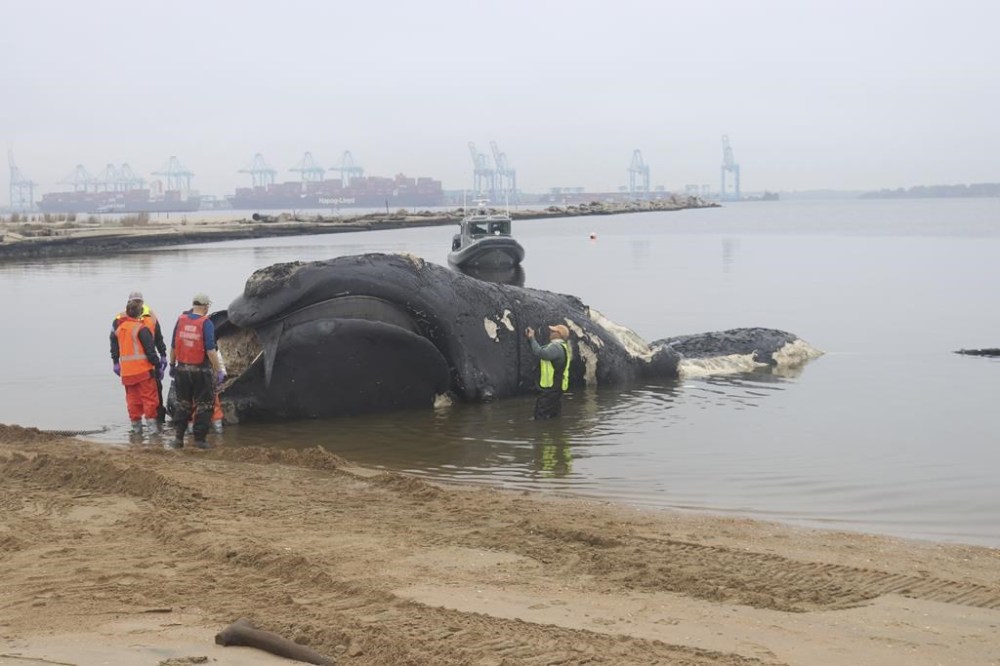
Preliminary findings of a necropsy show “catastrophic injuries with a dislocation of the whale’s spine” that “are consistent with blunt force trauma from a vessel strike prior to death,” the agency said Thursday.
The right whale’s population fell about 25% from 2010 to 2020. Numerous environmental groups have said the animal can’t withstand such dramatic population loss.
“Human impacts continue to threaten the survival of this species,” NOAA said in its statement.
The whales were once numerous off the East Coast, but they were decimated during the commercial whaling era. They are slow to reproduce and the population has a dangerously low number of reproductive females.

The whale’s calf is not expected to survive without its mother and has not been seen in weeks, NOAA said.
Environmental groups have called for tighter regulations on commercial fishing and shipping to try to save the whales. They have cited studies that the whales are harmed by ocean warming, which has caused their food sources to move.
The shifting food resources have in turn caused the whales to stray from protected areas of ocean, making them more vulnerable, scientists have said. The whales migrate every year from calving grounds off Georgia and Florida to feeding grounds off New England and Canada.
It’s an increasingly perilous journey. Some environmentalists have sued to try to force the federal government to finalize a new vessel speed rule the groups say is critical to protecting the whales.
“The choice is simple: Vessels either slow down or the North Atlantic right whale goes extinct,” said Sarah Sharp, an animal rescue veterinarian with International Fund for Animal Welfare who assisted in the necropsy. “How many more right whales are going to be sacrificed before something changes?”