Alberta irrigators’ study proposes $5 billion in water storage for drier future

Advertisement

Advertise with us

Alberta's irrigation district managers are proposing a $5-billion plan for water storage and conservation in the province's south as the region faces increasingly tight supplies of the vital resource.

Read this article for free:


or

Already have an account? Log in here »

To continue reading, please subscribe:

Subscribe and receive a limited-edition Free Press branded hat or tote.

Digital Subscription

One year of digital access for only $205*

  • Enjoy unlimited reading on winnipegfreepress.com
  • Read the E-Edition, our digital replica newspaper
  • Access News Break, our award-winning app
  • Play interactive puzzles

*First annual payment billed as $205.00 + GST for one year. This annual subscription will automatically renew at $233.00 + GST every 52 weeks (10% off the regular annual price of $259.35). Offer available to new and qualified returning subscribers only. Cancel any time.

To continue reading, please subscribe:

Add Free Press access to your Brandon Sun subscription for only an additional

$1 for the first 4 weeks*

  • Enjoy unlimited reading on winnipegfreepress.com
  • Read the E-Edition, our digital replica newspaper
  • Access News Break, our award-winning app
  • Play interactive puzzles
Start now

*Your next Brandon Sun subscription payment will increase by $1.00 and you will be charged $17.95 plus GST for four weeks. After four weeks, your payment will increase to $24.95 plus GST every four weeks.

Hey there, time traveller!
This article was published 05/04/2024 (896 days ago), so information in it may no longer be current.

Alberta’s irrigation district managers are proposing a $5-billion plan for water storage and conservation in the province’s south as the region faces increasingly tight supplies of the vital resource.

“Water is so variable,” said Margo Redelback of the Alberta Irrigation Districts Association, which commissioned the report containing the recommendations.

“Climate change is going to make that more variable, so it’s important for us to be thinking about what we should consider.”
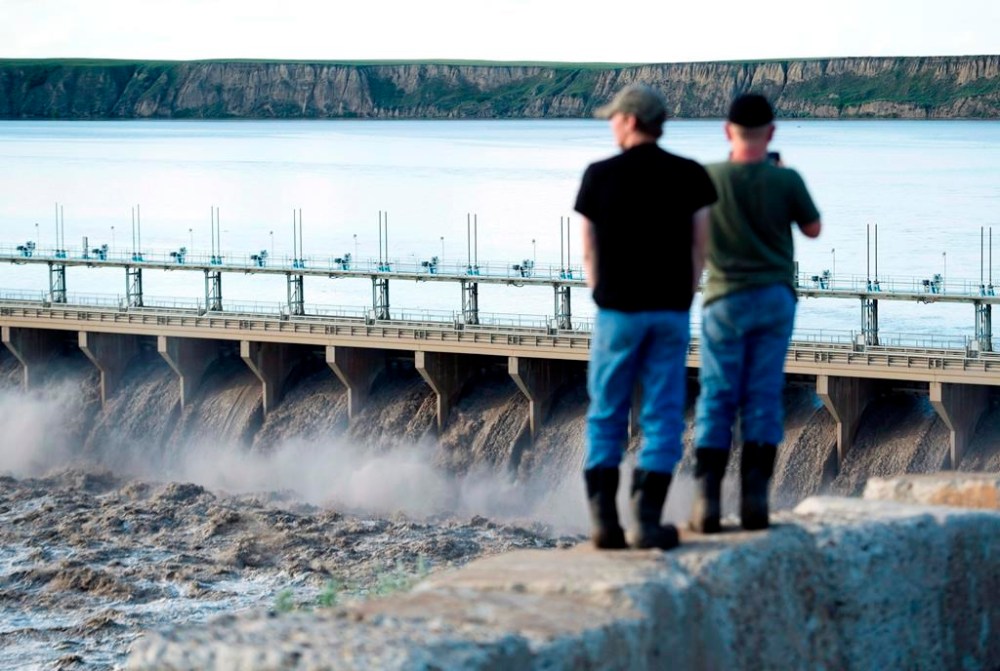
Alberta's irrigation district managers are proposing a $5-billion plan for water storage and conservation in the province's south as the region faces increasingly tight supplies of the vital resource. People watch as water from the Bow River flows through the Bassano Dam before meeting up with the South Saskatchewan River in Bassano, Alta., on Saturday, June 22, 2013. THE CANADIAN PRESS/Nathan Denette

The report focuses on the South Saskatchewan River basin, which covers most of southern Alberta and includes other major rivers such as the Bow, the Red Deer and the Oldman. It’s home to 1.8 million people, as well as almost all of the province’s irrigated farms and major water users like beef processing plants.

The report, which brought together 40 different organizations to reach its recommendations, looked at the fate of those rivers as climate change continues to move Alberta into a hotter, drier era.

With the exception of extreme scenarios in which glaciers no longer feed the basin, Redelback said southern Alberta will continue to have enough water. But it will probably come at different times of the year, or will drain away as runoff instead of being released slowly by melting ice or snow.

Under all scenarios of warming, end-of-summer water flows are projected to be lower. That comes as the region’s population is expected to grow.

“It’s really about timing,” Redelback said. “We’re going to have more variable water falling.

“For that reason, there’s large potential storage projects that could be considered.”

The report proposes eight projects that would either improve and expand existing reservoirs or build new ones, for a total of about $5 billion.

The two most expensive, at an estimated $1.5 billion each, would be new dams and reservoirs for the Bow River near Brooks in the southeast and the Red Deer River near the central Alberta city of Red Deer. The province has already committed about $10 million to study those projects.

The report proposes a 20-year timeline for realization of all its proposals.

The report also proposes the construction and preservation of wetlands, which in addition to providing wildlife habitat and carbon storage, store water and slow it down before it runs off.

Redelback acknowledged the projects will have to be managed carefully to keep enough water in rivers and streams for environmental needs.

“There’s probably some challenges in some places with some instream flow objectives. If you have careful operating objectives, they could be overcome.”

The storage projects, if built, would probably mean less water flowing downstream to Saskatchewan — although Redelback said Alberta’s legal requirements would continue to be met.

The report says the projects could generate up to $6 billion in economic activity.

It doesn’t mention interbasin water transfer, mentioned by Alberta Environment Minister Rebecca Schulz, or the entry into the basin of thirsty new industries such as coal mining.

Paul McLauchlin of Rural Municipalities Alberta, whose group wasn’t involved in the report, said the document is the first he’s seen that incorporates climate projections into water planning.

“(The report) isn’t pulling any punches but it’s providing a path forward,” he said. “In an uncertain world, you want some certainty.”

He said other river basins in the province should receive the same treatment.

Redelback said the report is meant to fuel discussion and provide guidance to government.

This report by The Canadian Press was first published April 5, 2024.

Report Error Submit a Tip

More Stories

Space war and other distractions

Gwynne Dyer 5 minute read 2:00 AM CDT

When Troy Meink, the chief of the U.S. Space Force, announces for no obvious reason that the United States “now has on-orbit space-control weapons,” people naturally assume that something is up. Why is Meink admitting the truth now? He’s even boasting about it!

Sex sounds in stereo a sad score for singleton

Maureen Scurfield 5 minute read Yesterday at 2:00 AM CDT

DEAR MISS LONELYHEARTS: I just moved into a big old house with two buddies who curl and play hockey with me. They have girlfriends, but I don’t.

I thought they’d be staying at their girlfriends’ places on nights they were “sleeping” together, but oh no!

So now I get to listen to the duelling sex noises of two couples, on weekends and some weeknights as well.

Do I have any rights here? I really don’t want to admit defeat and move back in with my parents, when feels like I just moved out. But it’s really uncomfortable to be the only guy with no sex life in this household, and then having to hear it, while it’s happening.

Province rips Bell over second 911 outage

Chris Kitching 6 minute read Preview

Province rips Bell over second 911 outage

Chris Kitching 6 minute read Updated: Yesterday at 6:08 PM CDT

A 911 outage that lasted about 90 minutes in Manitoba and other provinces early Thursday morning was caused by a problem with Bell’s next-generation network amid concerns about recurring disruptions.

Read
Updated: Yesterday at 6:08 PM CDT

Manitoba abandoning spring, fall clock changes

Carol Sanders 8 minute read Preview

Manitoba abandoning spring, fall clock changes

Carol Sanders 8 minute read Updated: 8:48 AM CDT

Time’s up for the time change in Manitoba.

Manitobans won’t be setting their clocks back an hour in November. The province has decided to permanently stay on daylight time after surveying residents on the twice annual clock adjustment.

“We heard from Manitobans loud and clear — no more changing the clocks in Manitoba,” Premier Wab Kinew said in a news release Thursday.

Most of the 72,000 votes submitted in an online EngageMB survey — 92 per cent — said they would like to see the practice end. The survey asked if they preferred earlier sunrises in winter with standard time or the later sunsets in summer with daylight time. More than half of survey participants (58 per cent) indicated a preference to stay on permanent daylight time; 34 per cent voted to eliminate the time change but stay on standard time.

Read
Updated: 8:48 AM CDT

Jets vets weigh in on franchise goalie Hellebuyck not reporting to training camp

Mike McIntyre 7 minute read Preview

Jets vets weigh in on franchise goalie Hellebuyck not reporting to training camp

Mike McIntyre 7 minute read Yesterday at 6:35 PM CDT

Hockey is the ultimate team sport, where it’s supposed to be about the crest on your chest rather than the name on your back.

So how is Connor Hellebuyck’s trade request and subsequent training camp strike playing out inside the Winnipeg Jets locker room — particularly among other core players he’s gone to battle with over the years?

“Obviously the news is heartbreaking,” Jets forward Kyle Connor said Thursday.

“It feels like we had such a special group here and for whatever reason — I can’t speak to the reason until we hear from the man, I’m not going to speculate on what it is but I know that a lot of guys in that room that are heartbroken.”

Read
Yesterday at 6:35 PM CDT

A quick look at where provinces and territories stand on time changes

The Canadian Press 2 minute read Preview

A quick look at where provinces and territories stand on time changes

The Canadian Press 2 minute read Updated: 6:28 AM CDT

WINNIPEG - Manitoba's government said Thursday the province will be sticking with daylight time year-round, making it the latest jurisdiction to move away from twice-annual time changes. Here's a look at where things stand across Canada:

British Columbia said in March that it was moving to permanent Pacific daylight time. The change also means that parts of northeastern B.C., which have been on mountain standard time year round, are now in alignment with the rest of the province.

Alberta also switched to permanent daylight time this year in what it calls Alberta time. The change means it now has the same time as Saskatchewan year round.

Saskatchewan has been on permanent central standard time since 1966.

Read
Updated: 6:28 AM CDT