Scientists are grasping at straws while trying to protect infant corals from hungry fish

Advertisement

Advertise with us

FORT LAUDERDALE, Fla. (AP) — South Florida researchers trying to prevent predatory fish from devouring laboratory-grown coral are grasping at biodegradable straws in an effort to restore what some call the rainforest of the sea.

Read this article for free:


or

Already have an account? Log in here »

To continue reading, please subscribe:

Subscribe and receive a limited-edition Free Press branded hat or tote.

Digital Subscription

One year of digital access for only $205*

  • Enjoy unlimited reading on winnipegfreepress.com
  • Read the E-Edition, our digital replica newspaper
  • Access News Break, our award-winning app
  • Play interactive puzzles

*First annual payment billed as $205.00 + GST for one year. This annual subscription will automatically renew at $233.00 + GST every 52 weeks (10% off the regular annual price of $259.35). Offer available to new and qualified returning subscribers only. Cancel any time.

To continue reading, please subscribe:

Add Free Press access to your Brandon Sun subscription for only an additional

$1 for the first 4 weeks*

  • Enjoy unlimited reading on winnipegfreepress.com
  • Read the E-Edition, our digital replica newspaper
  • Access News Break, our award-winning app
  • Play interactive puzzles
Start now

*Your next Brandon Sun subscription payment will increase by $1.00 and you will be charged $17.95 plus GST for four weeks. After four weeks, your payment will increase to $24.95 plus GST every four weeks.

Hey there, time traveller!
This article was published 10/04/2024 (902 days ago), so information in it may no longer be current.

FORT LAUDERDALE, Fla. (AP) — South Florida researchers trying to prevent predatory fish from devouring laboratory-grown coral are grasping at biodegradable straws in an effort to restore what some call the rainforest of the sea.

Scientists around the world have been working for years to address the decline of coral reef populations. Just last summer, reef rescue groups in South Florida and the Florida Keys were trying to save coral from rising ocean temperatures. Besides working to keep existing coral alive, researchers have also been growing new coral in labs and then placing them in the ocean.

But protecting the underwater ecosystem that maintains upwards of 25% of all marine species is not easy. Even more challenging is making sure that coral grown in a laboratory and placed into the ocean doesn’t become expensive fish food.
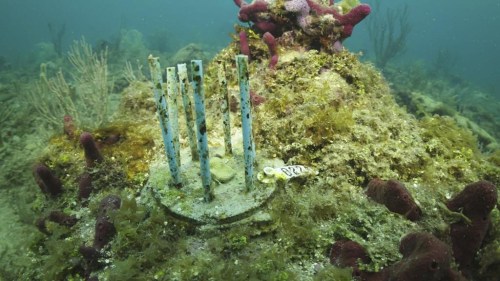
This July 26, 2023 image provided by phade® by WinCup, Inc., shows a
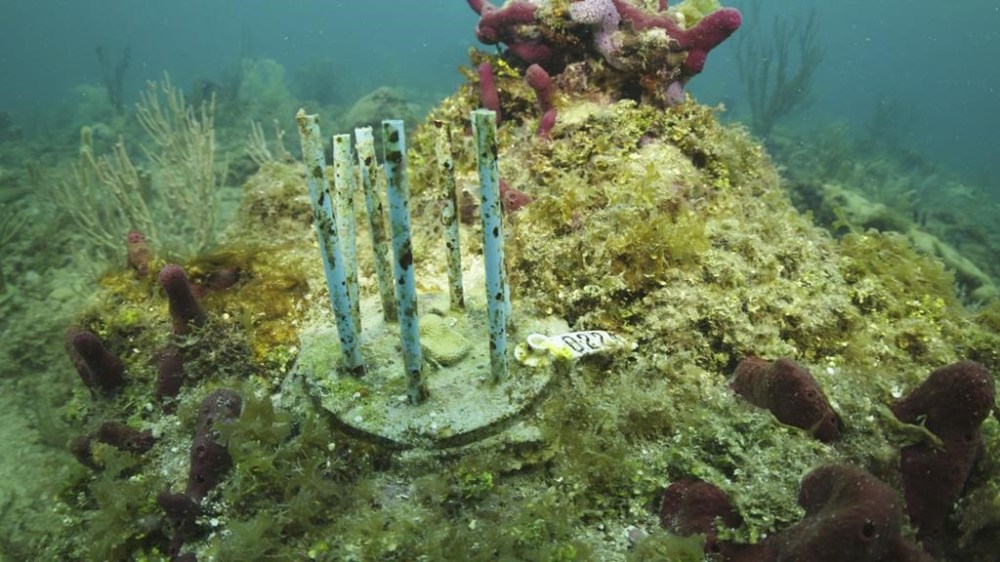
This July 26, 2023 image provided by phade® by WinCup, Inc., shows a "Coral Fort," made of biodegradable drinking straws that researchers are using to prevent laboratory-grown coral from becoming really expensive fish food, off the coast of Fort Lauderdale, Fla. Scientists around the world have been working for years to address the decline of coral reef populations. Just last summer, reef rescue groups in South Florida and the Florida Keys were trying to save coral from rising ocean temperatures. (Chris Gug/phade® by WinCup, Inc. via AP)

Marine researcher Kyle Pisano said one problem is that predators like parrot fish attempt to bite and destroy the newly transplanted coral in areas like South Florida, leaving them with less than a 40% survival rate. With projects calling for thousands of coral to be planted over the next year and tens of thousands of coral to be planted over the next decade, the losses add up when coral pieces can cost more than $100 each.

Pisano and his partner, Kirk Dotson, have developed the Coral Fort, claiming the small biodegradable cage that’s made in part with drinking straws boosts the survival rate of transplanted coral to over 90%.

“Parrot fish on the reef really, really enjoy biting a newly transplanted coral,” Pisano said. “They treat it kind of like popcorn.”

Fortunately the fish eventually lose interest in the coral as it matures, but scientists need to protect the coral in the meantime. Stainless steel and PVC pipe barriers have been set up around transplanted coral in the past, but those barriers needed to be cleaned of algae growth and eventually removed.

Pisano had the idea of creating a protective barrier that would eventually dissolve, eliminating the need to maintain or remove it. He began conducting offshore experiments with biodegradable coral cages as part of a master’s degree program at Nova Southeastern University. He used a substance called polyhydroxyalkanoate, a biopolymer derived from the fermentation of canola oil. PHA biodegrades in ocean, leaving only water and carbon dioxide. His findings were published last year.

The coral cage consists of a limestone disc surrounded by eight vertical phade brand drinking straws, made by Atlanta-based WinCup Inc. The device doesn’t have a top, Pisano said, because the juvenile coral needs sunlight and the parrot fish don’t generally want to position themselves facing downward to eat.

Dotson, a retired aerospace engineer, met Pisano through his professor at Nova Southeastern, and the two formed Reef Fortify Inc. to further develop and market the patent-pending Coral Fort. The first batch of cages were priced at $12 each, but Pisano and Dotson believe that could change as production scales up.

Early prototypes of the cage made from phade’s standard drinking straws were able to protect the coral for about two months before dissolving in the ocean, but that wasn’t quite long enough to outlast the interest of parrot fish. When Pisano and Dotson reached out to phade for help, the company assured them that it could make virtually any custom shape from its biodegradable PHA material.

“But it’s turning out that the boba straws, straight out of the box, work just fine,” Dotson said.

Boba straws are wider and thicker than normal drinking straws. They’re used for a tea-based drink that includes tapioca balls at the bottom of the cup. For Pisano and Dotson, that extra thickness means the straws last just long enough to protect the growing coral before harmlessly disappearing.

Reef Fortify is hoping to work with reef restoration projects all over the world. The Coral Forts already already being used by researchers at Nova Southeastern and the University of Miami, as well as Hawaii’s Division of Aquatic Resources.

Rich Karp, a coral researcher at the University of Miami, said they’ve been using the Coral Forts for about a month. He pointed out that doing any work underwater takes a great deal of time and effort, so having a protective cage that dissolves when it’s no longer needed basically cuts their work in half.

“Simply caging corals and then removing the cages later, that’s two times the amount of work, two times the amount of bottom time,” Karp said. “And it’s not really scalable.”

Experts say coral reefs are a significant part of the oceanic ecosystem. They occupy less than 1% of the ocean worldwide but provide food and shelter to nearly 25 percent of sea life. Coral reefs also help to protect humans and their homes along the coastline from storm surges during hurricanes.

Report Error Submit a Tip

More Stories

Completely separating inmates unrealistic, inquest judge says in report on three Stony Mountain slayings

Erik Pindera 5 minute read Preview

Completely separating inmates unrealistic, inquest judge says in report on three Stony Mountain slayings

Erik Pindera 5 minute read 1:43 PM CDT

Nothing short of keeping inmates separated at all times could have prevented three unrelated prisoner-on-prisoner killings several years ago in Stony Mountain Institution’s maximum-security unit, an inquest judge has found.

Provincial court Judge Lindy Choy made the finding after overseeing an inquest earlier this year into the slayings of Adrian Fillion, 42, Michael Monney, 27, and Nolan Thomas, 26, all of which occurred at the hands of fellow maximum-security inmates in the federal prison just north of Winnipeg. The killings occurred when cells were unlocked, allowing inmates to briefly move around to other areas in the cell block.

“The overall impression I was left with from the (Stony Mountain Institution) witnesses was that management of inmates in a custodial facility is a very complex undertaking. There are clearly multiple levels of oversight involved in any decisions that are made and it is all done in a very structured manner,” Choy wrote in her report on the inquest, which was made public Tuesday.

“While maintaining complete physical distance between inmates at all times would have prevented the homicides from occurring, we know that from a social and psychological perspective, this is not generally realistic nor acceptable.”

Read
1:43 PM CDT

Port of Churchill signs agreement with Dutch port

Aaron Epp 2 minute read Preview

Port of Churchill signs agreement with Dutch port

Aaron Epp 2 minute read 4:40 PM CDT

Arctic Gateway Group, operator of the Port of Churchill, has signed an agreement with the Port of Rotterdam in the Netherlands to attract business and strengthen supply chains linking Western Canada and Europe.

The agreement enables the two ports to work together to develop new trade in critical minerals and energy products, connect Canadian producers with European buyers, and identify opportunities to improve the supply chain from Western Canadian resource projects through Churchill and into European markets.

The Port of Rotterdam is Europe’s largest port and home to more than 3,000 businesses across its industrial complex, serving as a major gateway for critical raw materials and energy.

Meanwhile, the Port of Churchill has been identified as a transformative national strategy for Canada and is emerging as a northern trade corridor connecting Western Canada’s resources to global markets.

Read
4:40 PM CDT

Kinew adds cabinet portfolio to focus on first responders

Carol Sanders and Nicole Buffie 5 minute read Preview

Kinew adds cabinet portfolio to focus on first responders

Carol Sanders and Nicole Buffie 5 minute read Updated: Yesterday at 6:40 PM CDT

Premier Wab Kinew shuffled his cabinet Monday and created a new ministerial position that will oversee first responders in the province.

Kinew appointed David Pankratz, the MLA for Waverley, as minister responsible for first responder initiatives.

Tuxedo MLA Carla Compton was appointed minister responsible for accessibility, taking over the role from Families Minister Nahanni Fontaine.

The new ministers were sworn in at a ceremony at the legislature Monday afternoon.

Read
Updated: Yesterday at 6:40 PM CDT

Province to acquire campground near former residential school

Morgan Modjeski 3 minute read Preview

Province to acquire campground near former residential school

Morgan Modjeski 3 minute read 6:00 AM CDT

A burial site for dozens of children who died while attending the Brandon Indian Residential School will be acquired by the province, the Free Press has learned.

Premier Wab Kinew will announce the province’s plan to protect Turtle Crossing Campground at a news conference in Brandon Wednesday to mark National Day for Truth and Reconciliation. The move is in partnership with the City of Brandon.

The graves of at least 56 children are located at the campground, the Sioux Valley Dakota Nation has said, pointing to a geophysical study conducted by an archaeology firm in 2018.

There have been longstanding concerns from Indigenous leaders and community members that people were camping on the resting place of children victimized by colonialism.

Read
6:00 AM CDT

Orange Shirt Day project fits students to a tee

Maggie Macintosh 5 minute read Preview

Orange Shirt Day project fits students to a tee

Maggie Macintosh 5 minute read Yesterday at 6:57 PM CDT

On the eve of Orange Shirt Day, hundreds of black T-shirts will be handed out to teenagers at Elmwood High School — and there wasn’t a mixup in the clothing procurement process.

The student-run business behind the initiative wanted to make a statement about “truth and reconciliation” being a year-round activity, said Daniel Concepcion, a Grade 12 student.

Daniel said given that black is a staple in the wardrobe of teenagers, he hopes these shirts won’t sit on hangers for 364 days of the year.

“Every child matters, every part of the day, every day,” the 17-year-old said.

Read
Yesterday at 6:57 PM CDT

Jets pick up netminder as relatively new 23-man roster announced

Mike McIntyre 7 minute read Preview

Jets pick up netminder as relatively new 23-man roster announced

Mike McIntyre 7 minute read Updated: Yesterday at 9:25 PM CDT

Let’s get the caveats out of the way: Nothing is set in stone, nor written in permanent ink, and what you see right now could change in the blink of an eye.

With that being said, allow us to introduce you to the 2026-27 Winnipeg Jets — where change is very much in the air.

The 23-man roster submitted to the NHL offices by Monday’s 4 p.m. deadline includes seven players who were not on the team at this time last year. In fact, there could be as many as 10 new faces in the opening-night lineup on Friday against Boston when you factor in three regulars didn’t start the 2025-26 campaign due to injury.

That’s a lot of turnover, which isn’t surprising for a team that finished 26th overall in the standings and was — to most fans and pundits — too old and too slow.

Read
Updated: Yesterday at 9:25 PM CDT