Singh defends NDP carbon price position — without directly supporting a consumer levy
Advertisement
Read this article for free:
or
Already have an account? Log in here »
To continue reading, please subscribe:

Digital Subscription
One year of digital access for only $205*
- Enjoy unlimited reading on winnipegfreepress.com
- Read the E-Edition, our digital replica newspaper
- Access News Break, our award-winning app
- Play interactive puzzles
*First annual payment billed as $205.00 + GST for one year. This annual subscription will automatically renew at $233.00 + GST every 52 weeks (10% off the regular annual price of $259.35). Offer available to new and qualified returning subscribers only. Cancel any time.
To continue reading, please subscribe:
Add Free Press access to your Brandon Sun subscription for only an additional
$1 for the first 4 weeks*
- Enjoy unlimited reading on winnipegfreepress.com
- Read the E-Edition, our digital replica newspaper
- Access News Break, our award-winning app
- Play interactive puzzles
*Your next Brandon Sun subscription payment will increase by $1.00 and you will be charged $17.95 plus GST for four weeks. After four weeks, your payment will increase to $24.95 plus GST every four weeks.
Read unlimited articles for free today:
or
Already have an account? Log in here »
Hey there, time traveller!
This article was published 15/04/2024 (903 days ago), so information in it may no longer be current.
OTTAWA – The federal leader of the New Democrats spent Monday insisting his party’s position on carbon pricing remains unchanged.
But Jagmeet Singh refused to say explicitly whether he supports the consumer levy, and Canadians having to pay it on everyday items like gasoline.
“Our position is not changed — at all,” he told reporters.
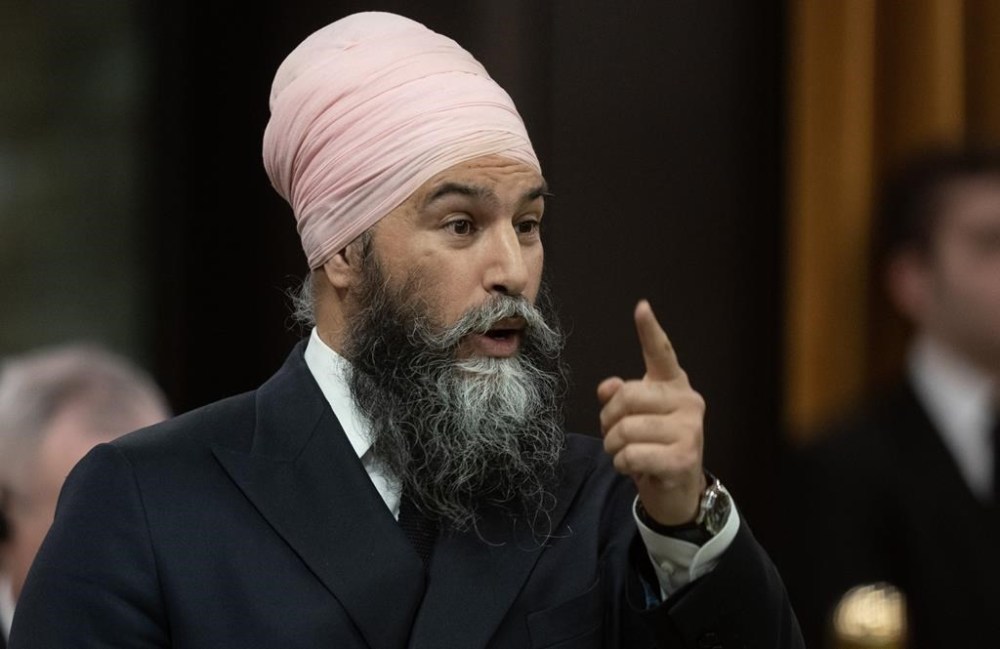
“We absolutely support a price on pollution. We’ve always supported it.”
Singh faced reporters for the first time since a speech last week at the annual Progress Summit, where he created confusion about the NDP position on the federal consumer levy on fuel.
In the address, Singh sang the praises of “affordable, low-carbon options” and vowed to “not punish people” who can’t change how they heat their homes or get to work.
He later said the New Democrats would be putting forward a vision to tackle climate change that would emphasize initiatives with the most impact, such as methane regulations and a carbon price on industrial emitters.
“Make those even stricter, make those even stronger, look at other ways for us to really take on big polluters,” Singh told reporters last Thursday.
“We don’t want working people to feel like they’re shouldering the burden. That’s not fair. And frankly, not a New Democrat solution to the problem.”
His comments followed those of NDP environment critic Laurel Collins, who said carbon pricing was not the “be-all, end-all” of climate action as she explained the NDP’s decision to vote alongside Conservatives for a parliamentary motion critical of the Liberal policy.
The NDP has long championed carbon pricing and inked it into its 2019 campaign.
The apparent shift in tone even seemed to flummox Prime Minister Justin Trudeau, who last week admitted he doesn’t understand the NDP’s position.
Trudeau noted that Singh is facing “political pressure” from conservative premiers and Conservative Leader Pierre Poilievre, who want to scrap the policy.
Poilievre has indeed been travelling the country, including to NDP strongholds across British Columbia and northern Ontario, to rally supporters around his “axe the tax” message.
Public opinion polls show both the NDP and Liberals are bleeding support to the Conservatives as Poilievre champions affordability as his main issue, painting the supply-and-confidence agreement they entered into in March 2022 as a “costly coalition.”
The NDP says the deal has delivered Canadians wins on pharmacare and dental care, although it has been a struggle for that to sink in.
While the Tory leader blames the consumer carbon price for adding to Canadians’ anxieties about affordability, both the Liberals and NDP accuse him of having no plan to tackle climate change.
Following Singh’s speech last week, the NDP released a statement insisting it supports the “consumer carbon price.”
But when asked Monday to clarify whether he maintains that position himself, Singh would only say the party’s voting record makes clear that it supports “a price on pollution,” not specifying whether that includes a levy paid by consumers despite multiple questions to that effect.
“We absolutely support a price on pollution. We have not changed our position on that,” he said.
“We need to make sure we fight the climate crisis with everything we have, but the Liberals are eroding that trust by not supporting working-class people,” Singh added.
He accused the Liberal government of continuing to provide subsides to oil and gas companies without providing supports to working-class families.
Singh had earlier chided Trudeau’s move to exempt home heating oil from the carbon price for three years, calling it a divisive decision.
Nearly one in three households in Atlantic Canada relies on home heating oil, and the carve-out to the government’s signature climate policy came after Liberal MPs in the region raised concerns about the rising cost of living.
Trudeau and Environment Minister Steven Guilbeault have ruled out making any further exceptions.
That’s despite demands from Western premiers, like Saskatchewan’s Scott Moe, who say households that use natural gas should get the same break.

Moe is among a majority of provincial leaders, including lone Liberal Premier Andrew Furey of Newfoundland and Labrador, who are asking Trudeau to convene a meeting to discuss alternatives to the consumer carbon price.
Trudeau has said provinces were on board when the government decided to move ahead with carbon pricing years ago.
Today’s premiers are too busy complaining and not coming up with their own plans to reduce greenhouse-gas emissions, the prime minister has charged.
A Conservative motion calling on Trudeau to sit down with premiers for a televised meeting passed in the House of Commons last week with support from the NDP and the Bloc Québécois.
This report by The Canadian Press was first published April 15, 2024.