B.C. needs dedicated, cross-government wildfire strategy: former minister
Advertisement
Read this article for free:
or
Already have an account? Log in here »
To continue reading, please subscribe:

Digital Subscription
One year of digital access for only $205*
- Enjoy unlimited reading on winnipegfreepress.com
- Read the E-Edition, our digital replica newspaper
- Access News Break, our award-winning app
- Play interactive puzzles
*First annual payment billed as $205.00 + GST for one year. This annual subscription will automatically renew at $233.00 + GST every 52 weeks (10% off the regular annual price of $259.35). Offer available to new and qualified returning subscribers only. Cancel any time.
To continue reading, please subscribe:
Add Free Press access to your Brandon Sun subscription for only an additional
$1 for the first 4 weeks*
- Enjoy unlimited reading on winnipegfreepress.com
- Read the E-Edition, our digital replica newspaper
- Access News Break, our award-winning app
- Play interactive puzzles
*Your next Brandon Sun subscription payment will increase by $1.00 and you will be charged $17.95 plus GST for four weeks. After four weeks, your payment will increase to $24.95 plus GST every four weeks.
Read unlimited articles for free today:
or
Already have an account? Log in here »
Hey there, time traveller!
This article was published 14/05/2024 (878 days ago), so information in it may no longer be current.
A former British Columbia forests minister says the province is on the right track as it responds to worsening wildfires, but the scale of the challenge is so great, it’s falling behind and needs to prioritize a “whole-of-society” approach.
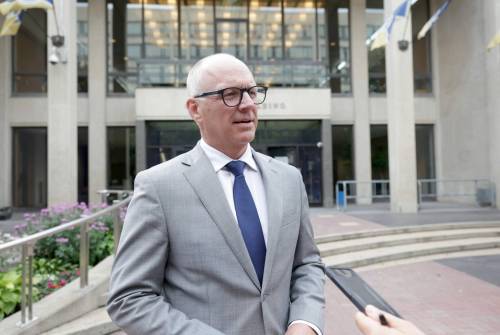
Doug Donaldson says the place to start should be a dedicated provincial wildfire strategy that lays out responsibilities for each government ministry, while supporting the participation of local communities, civil society and the forest industry.
The former member of the legislature for Stikine, who served as forests minister from 2017 to 2020, says the BC Wildfire Service has a strategy but it’s about a decade old.

He says it needs to be updated and “elevated” into a cross-ministry strategy that could launch the province toward the approach it needs to respond to wildfires that are increasingly threatening communities in B.C.
Donaldson is the co-author of a new report released Tuesday from a wildfire-focused research group based at the University of Victoria.
He describes the report as a “snapshot” of wildfire risk and response in B.C. and a “launching pad” for further work.
The report comes as officials keep a close eye on the forecast in northeastern B.C., where wildfires have forced several thousand people out of their homes, including the entire community of 4,700 in Fort Nelson.
The province has said it’s working to “modernize” landscape planning and is developing several strategies related to ecological resilience, such as the forthcoming watershed security strategy and ecosystem health framework.
Last fall, Premier David Eby appointed an expert task force on emergencies to advise the province how it could better respond to climate-related disasters. A landscape resilience strategy was among their recommendations.
The devastating wildfire season of 2003 prompted a review with dozens of recommendations for the province after more than 300 homes were destroyed, most of them in Kelowna.
Donaldson said 2003 served as an “initial wake-up call,” but fires have only increased in severity, size, and the level of threat they pose to communities.
“Even those in the BC Wildfire Service say we need a provincial wildfire strategy, something that’s cross-ministry, cross-government,” he said.
The province alone can’t handle the scale of the challenge, he added.
“We have to involve all of society, industry, civil society organizations, local government and of course First Nations governments.”
Donaldson said climate change is partly to blame for worsening fires, but they’re also the result of decades of fire suppression and leaving woody fuels to build up on the landscape while communities push farther into forested areas.
The report from the Wildfire Resilience Project at the university points to the 2021 provincial strategic threat analysis, which found that 39 million hectares or 45 per cent of public land in B.C. is ranked at high or extreme threat of wildfire.
Yet Donaldson said B.C.’s target for prescribed and Indigenous cultural burns is about 5,000 hectares per year. A provincial web page shows just over 2,200 hectares were treated in 23 burns last year, and 61 burns were planned for 2024.
With the cost of such burns ranging from $1,000 to $10,000 per hectare, Donaldson says B.C. needs to look at “innovative economic models” to reduce forest fuels.
That means involving the forest industry, he said. One example could be the reintroduction of broadcast burning, in which a fire is intentionally lit and allowed to spread within predetermined boundaries in an area that’s been logged.
Donaldson said he saw the benefits of broadcast burning firsthand during a flight over the massive Plateau fire in B.C.’s central Interior in 2017.
“You could tell the ferocity of the wildfire that went through, and yet there’d be these green plantations, you know, scorched around the perimeter but green.”
The area had been harvested in the late 1980s or early 1990s, when broadcast burning was still being used, Donaldson said in an interview on Tuesday.
The practice was stopped in the same era, mainly due to negative public reaction to smoke in communities, he said.
Donaldson said there’s also potential to reduce fire risk by changing forestry regulations, such as requirements related to the condition of the landscape after logging.
“If it’s a high or extreme wildfire risk block, they can leave it afterwards, no worse,” he said. “That regulation could be amended on utilization standards to say, you have to leave it in a less risky state after you finish.”
B.C. spent close to $1 billion last year on wildfire suppression, Donaldson added.
“You can see that this is not a sustainable route that we’re on.”
This report by The Canadian Press was first published May 14, 2024.