‘Otherworldly’ Portuguese man o’ war becoming more common on Nova Scotia’s inshore
Advertisement
Read this article for free:
or
Already have an account? Log in here »
To continue reading, please subscribe:

Digital Subscription
One year of digital access for only $205*
- Enjoy unlimited reading on winnipegfreepress.com
- Read the E-Edition, our digital replica newspaper
- Access News Break, our award-winning app
- Play interactive puzzles
*First annual payment billed as $205.00 + GST for one year. This annual subscription will automatically renew at $233.00 + GST every 52 weeks (10% off the regular annual price of $259.35). Offer available to new and qualified returning subscribers only. Cancel any time.
To continue reading, please subscribe:
Add Free Press access to your Brandon Sun subscription for only an additional
$1 for the first 4 weeks*
- Enjoy unlimited reading on winnipegfreepress.com
- Read the E-Edition, our digital replica newspaper
- Access News Break, our award-winning app
- Play interactive puzzles
*Your next Brandon Sun subscription payment will increase by $1.00 and you will be charged $17.95 plus GST for four weeks. After four weeks, your payment will increase to $24.95 plus GST every four weeks.
Read unlimited articles for free today:
or
Already have an account? Log in here »
Hey there, time traveller!
This article was published 08/07/2024 (819 days ago), so information in it may no longer be current.
HALIFAX – With a little help from the warming Gulf Stream, Nova Scotia beachgoers are encountering a strangecreature with a balloon-like body whose sting packs a higher punch than that of jellyfish.
Last week, a Portuguese man o’ war appeared at a surfing hot spot on Lawrencetown Beach in Dartmouth, N.S. The animal, a species of siphonophore — closely related to jellyfish — has a transparent, inflated sail often adorned with purple, blue or pink markings. It drifts through the water, propelled by currents and wind.
Although there are no concrete numbers on how often the Portuguese man o’ war is spotted in Nova Scotia, Sandra Johnston, with the province’s Natural Resources Department, said sightings have become more common along east and south shore beaches since 2020.
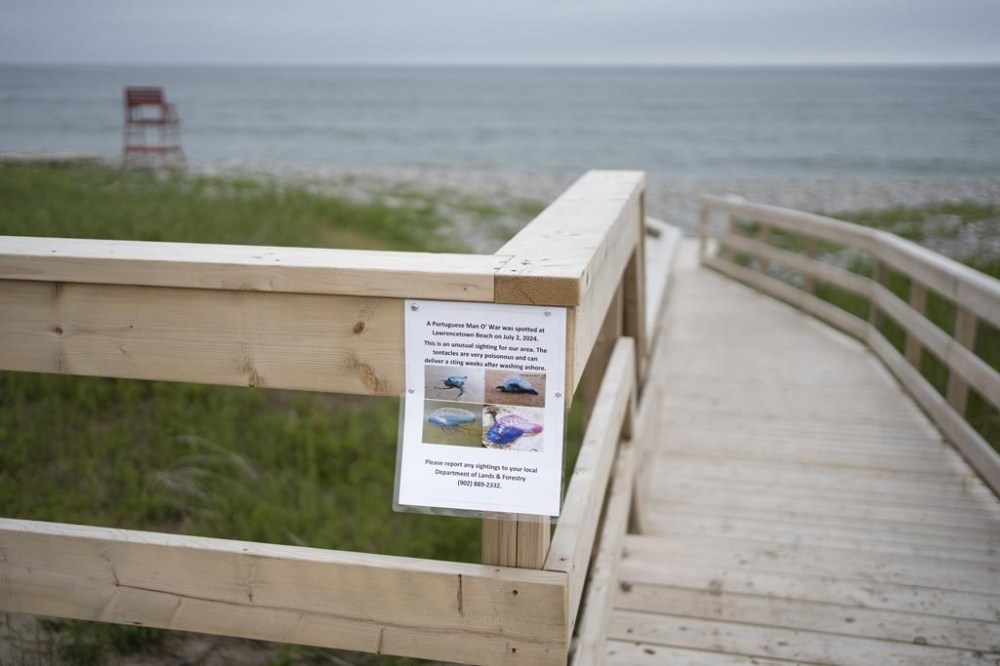
“(Getting stung) is quite a painful sting. It is just like a jellyfish sting but significantly stronger that lasts around 20 minutes,” Johnston said in an interview.
Boris Worm, a biology professor at Dalhousie University in Halifax who studies marine conservation and biodiversity, called the subtropic creature “absolutely fascinating and otherworldly.”
Worm said the rise in Portuguese man o’ war sightings in Nova Scotia is likely because the Gulf Stream — a channel of warm water that flows up the eastern coast of North America — has become stronger in the northwest Atlantic Ocean and has warmed the south shore of Nova Scotia faster than it has other parts of the ocean.
The Portuguese man o’ war live in subtropical gyres — revolving masses of water that have become home to lots of different organisms. As the Gulf Stream’s influence gets stronger, tropical and subtropical creatures are being transported further away, all the way to Nova Scotia’s inshore.
While other jellyfish-related species tend to live in deeper water, the Portuguese man o’ war drifts closer to the surface. Its tentacles usually extend a few metres behind it — in extreme cases they can be as long as 30 metres — and Worm said their length increases the risk of contact with swimmers.
“You could swim without ever seeing the sail or the organisms that could be some 10, 20 or 50 feet away, but the tentacles might still drift behind and sting you,” Worm said.
Other tropical fish making appearances in Nova Scotia from warming waters include butterfly fish, trigger fish and sea horses.

Neither Nova Scotia Parks nor the Nova Scotia Lifeguard Society tracks Portuguese man o’ war sightings; Nova Scotia Parks said it issues advisories online and on-site when the creature is spotted. Nova Scotia Health says hospital visits aren’t tracked by cause, so there’s no way to know how many people seek care for Portuguese man o’ war stings each year.
Atlantic Canada Poison Centre’s Jill Duncan said the low likelihood of serious injury from these stings further obscures how many people are stung each year. “The most common thing that happens when you get stung is pain and red welts in the area that you’re stung,” Duncan said in an interview.
“It’s uncommon to go into a hospital and even (more) uncommon for there to be serious effects and death.”
Contrary to the “old wives tales” that urine is an effective antidote to a jellyfish sting, Duncan said, the best treatment after contact with a Portuguese man o’ war is to rinse the wound with salt water and submerge it in warm water afterward.
This report by The Canadian Press was first published July 8, 2024.