Tiny homes, built largely with philanthropic support, offer more patch than solution to homelessness
Advertisement
Read this article for free:
or
Already have an account? Log in here »
To continue reading, please subscribe:

Digital Subscription
One year of digital access for only $205*
- Enjoy unlimited reading on winnipegfreepress.com
- Read the E-Edition, our digital replica newspaper
- Access News Break, our award-winning app
- Play interactive puzzles
*First annual payment billed as $205.00 + GST for one year. This annual subscription will automatically renew at $233.00 + GST every 52 weeks (10% off the regular annual price of $259.35). Offer available to new and qualified returning subscribers only. Cancel any time.
To continue reading, please subscribe:
Add Free Press access to your Brandon Sun subscription for only an additional
$1 for the first 4 weeks*
- Enjoy unlimited reading on winnipegfreepress.com
- Read the E-Edition, our digital replica newspaper
- Access News Break, our award-winning app
- Play interactive puzzles
*Your next Brandon Sun subscription payment will increase by $1.00 and you will be charged $17.95 plus GST for four weeks. After four weeks, your payment will increase to $24.95 plus GST every four weeks.
Read unlimited articles for free today:
or
Already have an account? Log in here »
Hey there, time traveller!
This article was published 10/07/2024 (772 days ago), so information in it may no longer be current.
In response to a nationwide crisis that has left more than 650,000 people without housing, 100 tiny home villages for the homeless have opened in the United States over the past five years.
That growth, from just 34 in 2019 to 123 today, represents a quadrupling, according to data collected by Yetimoni Kpeebi, a researcher at Missouri State University. At least 43% of these villages are privately funded through donations from philanthropists, businesses, and corporations, Kpeebi said.
Sobrato Philanthropies, run by billionaire Silicon Valley developer and philanthropist John Sobrato, and other groups such as the James M. Cox and Valhalla foundations have been helping to fund tiny home villages in San Francisco, San Jose, Oakland, and other expensive California cities. The Michael and Susan Dell Foundation is a key donor behind a 51-acre tiny home community in Austin, Texas. And in rural North Carolina, the Oak Foundation has supported the construction of a tiny home village for the severely mentally ill and chronically homeless.
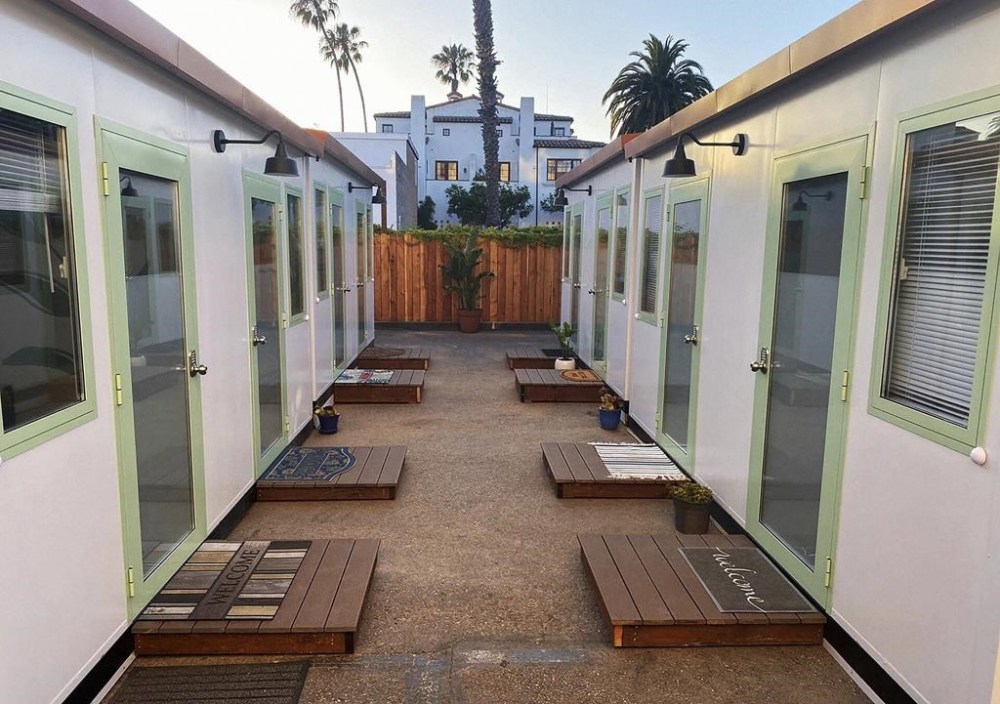
As ambitious as these efforts may be, they serve only a fraction of the estimated homeless population. While tiny homes — which typically are 100 to 400 square feet and sometimes include a kitchen and a bathroom — can be built quickly and cheaply, the larger tasks of securing permits, financing, and local government approval can add big costs and delays.
Skeptics worry that the construction of tiny homes doesn’t remedy the bigger issue, which is the widespread lack of affordable housing.
At best, tiny homes are a short-term solution to the country’s long-term issue of insufficient housing and social services for low-income Americans, said Margot Kushel, director of the Benioff Homelessness and Housing Initiative at the University of California San Francisco.
“I would say that tiny homes are an absolutely important part of the ecosystem, but they are not housing,” Kushel said.
Rural tiny homes
In Chatham County, North Carolina — where the median sale price for a home is around $690,000 — it has taken eight years to open a community of tiny homes. The Tiny Homes Village at the Farm at Penny Lane was the brainchild of local health and wellness nonprofit Cross Disability Services, or XDS, which is affiliated with the University of North Carolina and owns the 40-acre farm.
“We were providing all these expensive, great services for people, but they don’t have a place to live. They don’t have anything permanent. And that’s a huge problem,” said Thava Mahadevan, executive director of XDS.
XDS wanted to create housing that would cost less than $400 in monthly rent and be located at the farm. The UNC School of Social Work came on as a partner in 2016. The Oak Foundation, a longtime UNC funder, provided two grants totaling $1,050,000.
XDS’s first move was to ensure it could win county approval of the zoning for the village and that there was adequate underlying infrastructure, such as county water pipelines connected to the farm’s well. Construction workers then broke ground for the village in March 2020, but work was delayed by the pandemic.
The 15-unit tiny home village, which will open to residents in the fall, will provide affordable housing to people with serious mental illness. Each home will be about 400 square feet with a bathroom, kitchen, living area, and front porch. Medical and mental health services will be provided. And residents can live in the homes indefinitely.
The county is now looking into how it might encourage developers to build additional low-cost housing options for its population of roughly 79,000 as housing prices continue to climb, said Karen Howard, vice chair of the Chatham County board of commissioners.
Skyrocketing living costs have been especially tough for minimum wage workers in rural areas like Chatham County. North Carolina has one of the highest eviction rates in the country, and more than 1 million of its households pay over 30% of their income on housing. Georgia, Mississippi, and South Carolina have higher eviction rates than large cities such as Chicago, Los Angeles, and New York, according to research from Princeton University’s Eviction Lab.
West Coast efforts
But nowhere is the housing and homeless crisis as severe as in California, where more than 181,000 people are without permanent housing. Last year, Gov. Gavin Newsom vowed to provide 1,200 tiny homes for this population. So far, only about 150 have been purchased and none have opened, CalMatters recently reported.
Philanthropy has backed efforts to construct the homes more quickly, typically in partnership with local governments. Last year, the Sobrato Family Foundation said it would lease a two-acre lot of private land to San Jose for the construction of 75 tiny homes for $1 a year over the next decade. San Francisco-based nonprofit Dignity Moves is managing the development of the community and providing social services, with support from the James M. Cox and Valhalla foundations. The nonprofit was also part of the team that developed San Francisco’s 70-unit tiny home village and similar communities throughout the state.
“In our model, philanthropy pays for the construction, and then the expectation is that the city will pay for the ongoing supportive services,” said Dignity Moves CEO Elizabeth Funk.
This kind of interim housing is fairly new and is different from the kinds of congregate homeless shelters that cities have typically funded, she said. With interim housing, everyone has their own room and can stay for at least six months to two years rather than for a night or two, Funk added.
Tiny home communities offer more stability and can be places where social services can be effectively administered “because people aren’t in crisis mode,” she said.
California, Oregon, and Washington are the states with the greatest concentration of tiny home villages, according to data compiled by Missouri State University. Some communities have also tried to deal with unsheltered homelessness in more punitive ways. The town of Grants Pass, Oregon, wants to fine and jail people found sleeping in public spaces and mounted a legal challenge to a court ruling blocking the policy. The Supreme Court heard arguments for the case in April and could issue a decision as soon as this month.
Building tiny homes is better than penalizing people for living on the streets, but that isn’t enough, said Jesse Rabinowitz, campaigns and communications director at the National Homelessness Law Center.
“It’s good that cities and states are doing things to address the fact that people are living outside. Nobody should live outside, especially in the richest country in the world,” he said.

However, he said, “I am personally conflicted around tiny homes.” It seems to be a way of ushering people into interim housing rather than providing the more permanent affordable housing options that many homeless people want, Rabinowitz said.
Funk bristles at the criticism that tiny homes aren’t part of the housing-first approach that prioritizes permanent housing for people experiencing homelessness. Interim housing is a stage in that process, which is fundamentally about getting people off the streets and sheltered, she said.
“It is true that this is not a long-term solution. It’s a waiting room,” Funk said. “It is a dignified waiting room.”
_____
Stephanie Beasley is a senior writer at the Chronicle of Philanthropy, where you can read the full article. This article was provided to The Associated Press by the Chronicle of Philanthropy as part of a partnership to cover philanthropy and nonprofits supported by the Lilly Endowment. The Chronicle is solely responsible for the content. For all of AP’s philanthropy coverage, visit https://apnews.com/hub/philanthropy.