Rescued walrus calf ‘sassy’ and alert after seemingly being left by her herd in Alaska
Advertisement
Read this article for free:
or
Already have an account? Log in here »
To continue reading, please subscribe:

Digital Subscription
One year of digital access for only $205*
- Enjoy unlimited reading on winnipegfreepress.com
- Read the E-Edition, our digital replica newspaper
- Access News Break, our award-winning app
- Play interactive puzzles
*First annual payment billed as $205.00 + GST for one year. This annual subscription will automatically renew at $233.00 + GST every 52 weeks (10% off the regular annual price of $259.35). Offer available to new and qualified returning subscribers only. Cancel any time.
To continue reading, please subscribe:
Add Free Press access to your Brandon Sun subscription for only an additional
$1 for the first 4 weeks*
- Enjoy unlimited reading on winnipegfreepress.com
- Read the E-Edition, our digital replica newspaper
- Access News Break, our award-winning app
- Play interactive puzzles
*Your next Brandon Sun subscription payment will increase by $1.00 and you will be charged $17.95 plus GST for four weeks. After four weeks, your payment will increase to $24.95 plus GST every four weeks.
Read unlimited articles for free today:
or
Already have an account? Log in here »
Hey there, time traveller!
This article was published 25/07/2024 (804 days ago), so information in it may no longer be current.
JUNEAU, Alaska (AP) — A walrus calf seemingly left behind by her herd near Alaska’s northernmost city is alert and “sassy” as she receives care at a nonprofit wildlife response center hundreds of miles away following her recent rescue, a center spokesperson said Thursday.
Alaska SeaLife Center spokesperson Kaiti Grant said the nearly 165-pound (75-kilogram), crinkly-bodied Pacific walrus arrived at the center in Seward late Monday from Utqiagvik, some 800 miles (1,287 kilometers) away. An initial exam indicated the calf, thought to be a couple weeks old, was malnourished and dehydrated. The calf also had superficial wounds on her body, though it wasn’t clear what caused them, and little is known of the circumstances that caused her to be left alone, Grant said.
Hunters had reported that a walrus herd had recently been in the beach area where the calf was found, according to the center, which is also a public aquarium and research facility.
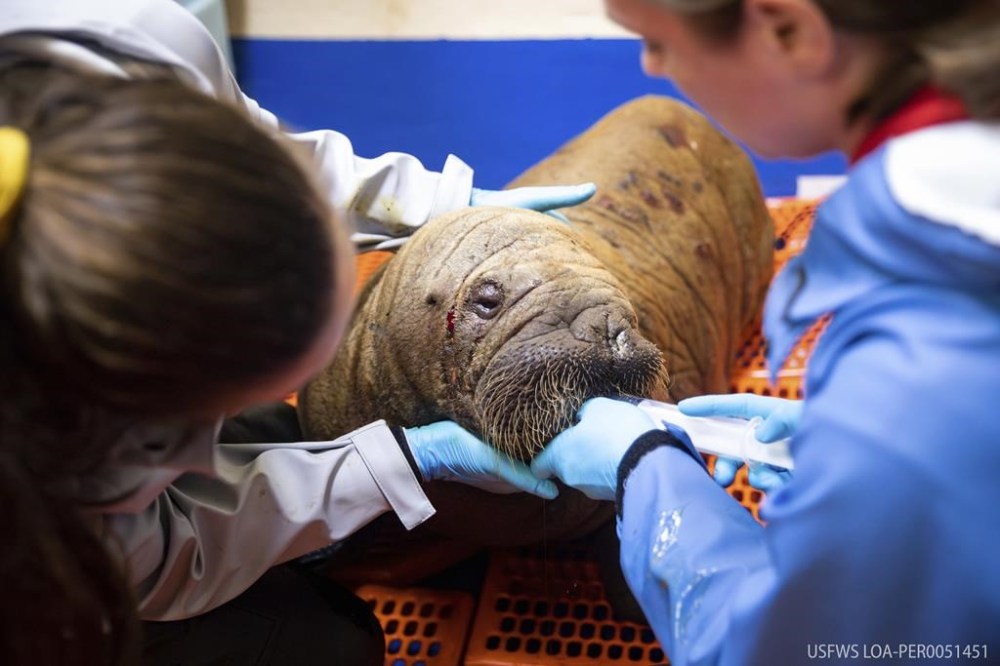
The calf arrived at the center nearly a year after it took in a 200-pound (90-kilogram) male calf that was found alone and miles from the ocean on Alaska’s North Slope. That baby, which struggled with health issues, such as nutrient malabsorption, and other complications, later died.
Grant called the loss of the calf last year devastating, but said staff were cautiously hopeful about their new patient, who is still undergoing tests and is just the 11th walrus the center has cared for in its 26-year history. The calf has taken to a bottle well, Grant said.
But she said the animals have special needs and the first several weeks likely will be a crucial stage until staff know the calf has stabilized.
Since walrus calves seek comfort through contact with their mothers, the center says staff provide round-the-clock attention.

Calves typically stay with their mothers for two years.
Pacific walruses live in the Bering and Chukchi seas. They haul out on sea ice and along the coast and islands of Alaska and Russia, according to the state Department of Fish and Game.