Alberta takes aim at GHG emissions cap, proposes rules on trespass and data gathering
Advertisement
Read this article for free:
or
Already have an account? Log in here »
To continue reading, please subscribe:

Digital Subscription
One year of digital access for only $205*
- Enjoy unlimited reading on winnipegfreepress.com
- Read the E-Edition, our digital replica newspaper
- Access News Break, our award-winning app
- Play interactive puzzles
*First annual payment billed as $205.00 + GST for one year. This annual subscription will automatically renew at $233.00 + GST every 52 weeks (10% off the regular annual price of $259.35). Offer available to new and qualified returning subscribers only. Cancel any time.
To continue reading, please subscribe:
Add Free Press access to your Brandon Sun subscription for only an additional
$1 for the first 4 weeks*
- Enjoy unlimited reading on winnipegfreepress.com
- Read the E-Edition, our digital replica newspaper
- Access News Break, our award-winning app
- Play interactive puzzles
*Your next Brandon Sun subscription payment will increase by $1.00 and you will be charged $17.95 plus GST for four weeks. After four weeks, your payment will increase to $24.95 plus GST every four weeks.
Read unlimited articles for free today:
or
Already have an account? Log in here »
Hey there, time traveller!
This article was published 26/11/2024 (673 days ago), so information in it may no longer be current.
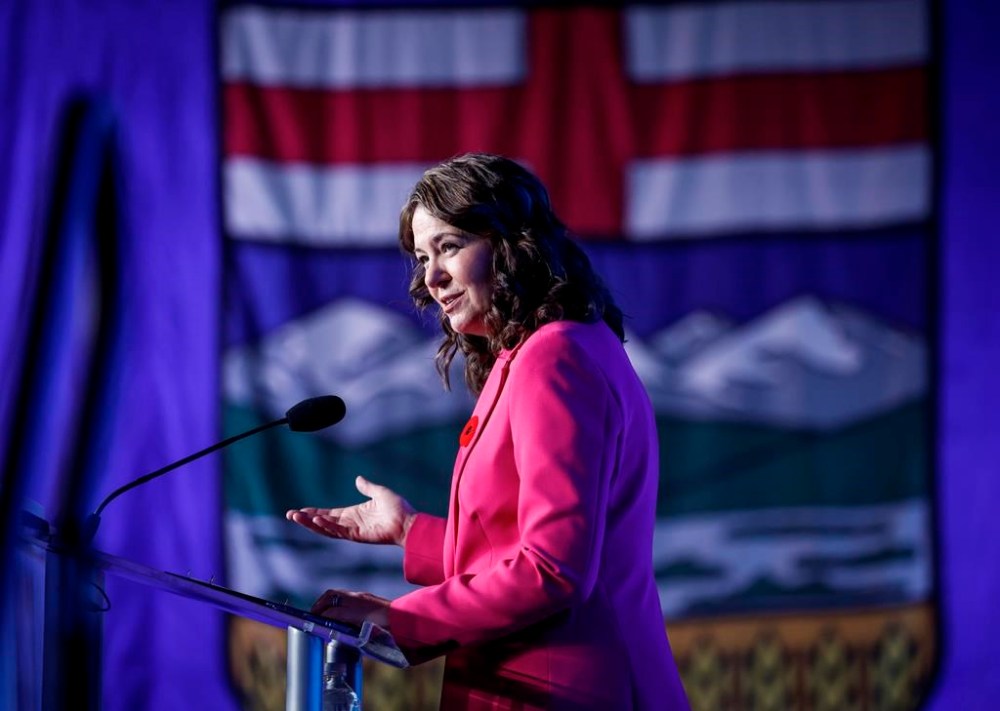
EDMONTON – Alberta Premier Danielle Smith says her government is eyeing a number of steps to challenge the proposed federal greenhouse gas emissions cap.
Announcing an upcoming motion under her Alberta Sovereignty within a United Canada Act on Tuesday, Smith said the government plans to challenge the cap in court when or if it becomes law, and that it will take the steps necessary to give the province exclusive authority and ownership of emissions data, ban federal employees from designated oil and gas facilities, and more.
“We’ve been very clear that we will use all means at our disposal to fight back against federal policies that hurt Alberta, and that’s exactly what we’re doing,” she said.
Under the sovereignty act, the government must first put a motion forward in the legislative assembly identifying a federal matter at issue and outlining potential steps the government should take to overcome it.
Once the motion is passed in the assembly, the act stipulates that Smith’s cabinet will then determine the legality of the chosen measures before taking action.
Smith said other steps the government will consider in response to the cap include instructing provincial authorities, such as the Alberta Energy Regulator, not to enforce it; declaring oil and gas facilities owned by Alberta “interest holders” as essential infrastructure; and beefing up the government’s ability to sell oil and gas on behalf of industry.
“We are asserting our ownership over our oil and gas resources,” Smith told reporters, adding that she expects oil and gas companies to support the steps being considered.
The proposed federal emissions cap, which is still in draft form, would require oil and gas companies to cut emissions by 35 per cent before 2030 to 2032.
Smith has called the cap unconstitutional, and on Tuesday she said it would cripple Alberta’s oil and gas economy.
She also said the cap would lead to a drop in production to the tune of one million barrels per day, which she said would lead to a five per cent loss in royalty revenues for Alberta.
In a joint statement, federal Environment Minister Steven Guilbeault and Energy Minister Jonathan Wilkinson disputed Smith’s claims, saying they believe the emissions cap is constitutional and wouldn’t lead to a production cut.
“The pollution cap will drive the industry to invest record profits back into the sector helping to fuel Canadian-made clean technologies and creating jobs in the process,” the statement reads. “Production and jobs will increase under this policy while pollution goes down – that’s a win-win-win.”
Guilbeault and Wilkinson also said Smith is “manipulating and politicizing” emissions reporting.
Eric Adams, a professor and constitutional law expert at the University of Alberta, said in an interview that this attempt at using the sovereignty act seems “more muscular” than the motion the government proposed nearly a year ago in response to the federal government’s draft net-zero electricity grid goals, although the act has yet to be tested in court.
“It’s not simply declaring that a particular federal law is unconstitutional in the view of the Alberta legislature,” Adams said of Smith’s announcement Tuesday.
He said some of the measures outlined by Smith likely wouldn’t stand in court, such as the ban on federal officers entering oil and gas facilities. However, he said the provincial government does have an argument for the cap intruding on provincial jurisdiction.
“There’s arguments on both sides,” Adams said, explaining the province would likely argue jurisdictional points, while the federal government would counter that criminal law such as what’s being proposed under the emissions cap is within their authority
NDP Leader Naheed Nenshi called the evocation of the sovereignty act performative, although he agreed the federal emissions cap would be harmful for Alberta.

“It’s not good policy for Alberta,” he said, adding that he thought Alberta could have done more to work with the federal government to find a better solution.
“We would never have got to this point if Alberta hadn’t been such an unwilling partner to actually take on this issue,” said Nenshi.
Smith did not say when the motion will be put forward in the legislature.
The federal government’s finalized regulations are expected to be published next spring.
This report by The Canadian Press was first published Nov. 26, 2024.