Takeaways from AP’s story on Everglades restoration efforts

Advertisement

Advertise with us

EVERGLADES, Fla. (AP) — The Everglades in South Florida were once about twice the size of New Jersey. Wildlife was abundant and water flowed freely from the Kissimmee River to Lake Okeechobee to the Florida Bay. But decades of engineering projects partitioned and drained the water, invasive species have transformed the land, and pollution from agriculture has impoverished water quality. Today, about half the Everglades original size remains.

Read this article for free:


or

Already have an account? Log in here »

To continue reading, please subscribe:

Subscribe and receive a limited-edition Free Press branded hat or tote.

Digital Subscription

One year of digital access for only $205*

  • Enjoy unlimited reading on winnipegfreepress.com
  • Read the E-Edition, our digital replica newspaper
  • Access News Break, our award-winning app
  • Play interactive puzzles

*First annual payment billed as $205.00 + GST for one year. This annual subscription will automatically renew at $233.00 + GST every 52 weeks (10% off the regular annual price of $259.35). Offer available to new and qualified returning subscribers only. Cancel any time.

To continue reading, please subscribe:

Add Free Press access to your Brandon Sun subscription for only an additional

$1 for the first 4 weeks*

  • Enjoy unlimited reading on winnipegfreepress.com
  • Read the E-Edition, our digital replica newspaper
  • Access News Break, our award-winning app
  • Play interactive puzzles
Start now

*Your next Brandon Sun subscription payment will increase by $1.00 and you will be charged $17.95 plus GST for four weeks. After four weeks, your payment will increase to $24.95 plus GST every four weeks.

Hey there, time traveller!
This article was published 19/12/2024 (657 days ago), so information in it may no longer be current.

EVERGLADES, Fla. (AP) — The Everglades in South Florida were once about twice the size of New Jersey. Wildlife was abundant and water flowed freely from the Kissimmee River to Lake Okeechobee to the Florida Bay. But decades of engineering projects partitioned and drained the water, invasive species have transformed the land, and pollution from agriculture has impoverished water quality. Today, about half the Everglades original size remains.

A massive state-federal project, approved by Congress in 2000 with bipartisan support, aims to undo damages wreaked upon these wetlands. It is projected to cost more than $23 billion and 50 years to complete.

More than two decades into it, there are some signs of progress. Wildlife is returning to some areas, regions dominated by the invasive melaleuca tree have dropped 75%, enthusiasm is high as significant projects are finally underway, others gain momentum and funding pours in. But as leaders and agencies race to “get the water right,” there are worries: the projects are billions of dollars over budget and questions remain about whether some will work.
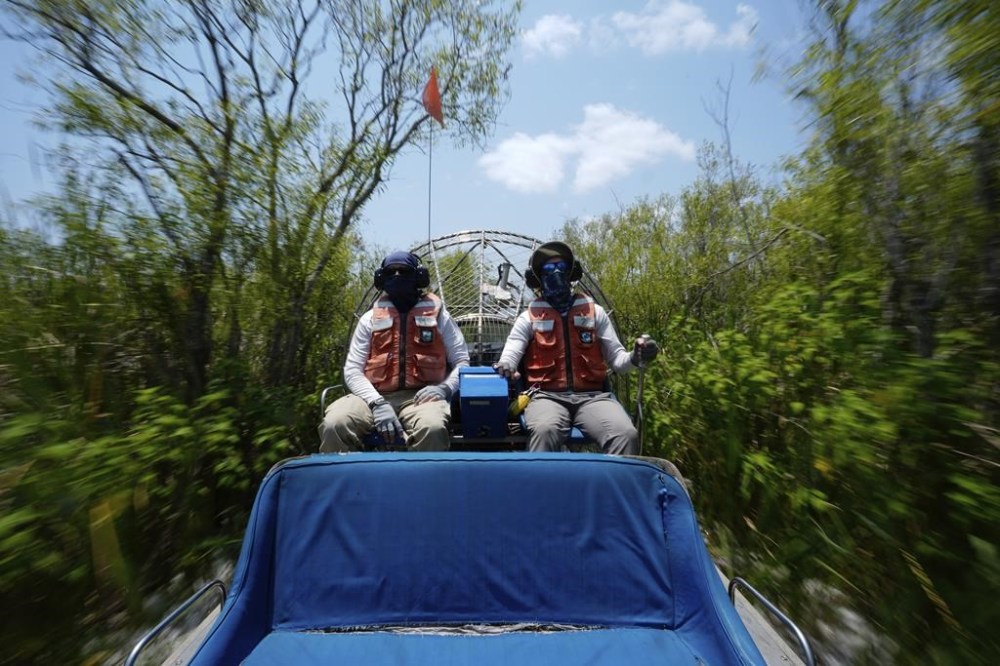
Florida International University professor John Kominoski, right, and research specialist Rafael Travieso travel by airboat through Shark River Slough after collecting water samples and maintaining their automatic sampling equipment in Florida's Everglades National Park, Tuesday, May 14, 2024. (AP Photo/Rebecca Blackwell)

Here are the highlights from the full story:

Record funding, unprecedented momentum and major projects underway

Since 2019, the South Florida Water Management District has completed, broken ground on, or celebrated other milestones on some 70 projects. This year, lawmakers earmarked $1.275 billion, the largest annual amount allocated for the next 12 months of restoration efforts. The water district said they anticipate 12 to 15 years of this pace of construction as long as there’s funding.

Deemed the flagship project by some is the Everglades Agricultural Area Reservoir Project, which includes a reservoir that will store excess water from Lake Okeechobee and an adjacent engineered wetland that will clean it before it’s discharged. But the reservoir is much smaller than originally planned, and some worry the project won’t be large or deep enough to significantly clean water.

The Western Everglades Restoration Project had its first groundbreaking in July after decades of advocacy from the Miccosukee Tribe of Indians of Florida. The project’s goal is to improve the quantity, quality, timing and distribution of water where the Miccosukee and Seminole tribal lands are.

Some signs of progress

Since sections of the Tamiami Trail started getting elevated, water flows are increasing in the wetlands surrounding the highway, built in 1928 to connect Tampa and Miami. The road cut through the Everglades, acting as a dam and holding back water from ecosystems dependent on it.

As parts of the Everglades are rehydrated and habitats reemerge, so are native species such as the wood stork. Wading bird colonies have returned to the Kissimmee River floodplain. Habitats in swamps or shallow lakes called sloughs are increasing in some areas. And flamingos blown in by Hurricane Idalia have stayed in the Everglades. Some scientists have said it is a sign restoration efforts are working.

Ongoing threats

Climate change, urban development and water quality are ongoing challenges in restoration efforts. Sea level rise and salt water intrusion pose threats to biodiversity, drinking water supply, habitats and more, and experts warn that rising temperatures will increase evapotranspiration and decrease water runoff.
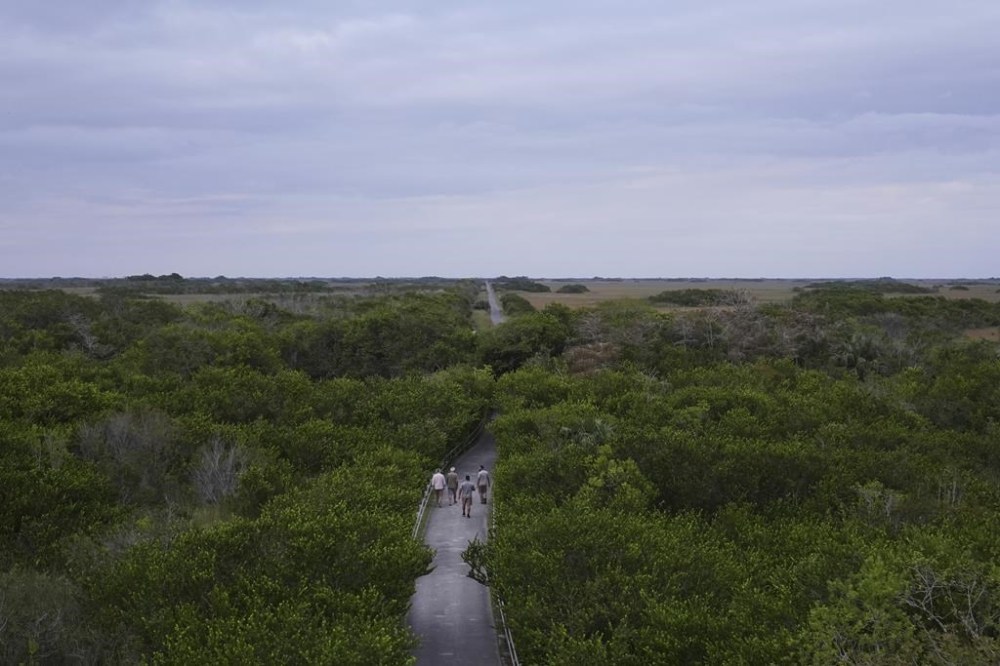
Visitors walk along a path in the Shark Valley area of Everglades National Park, Fla., Wednesday, Nov. 20, 2024. (AP Photo/Rebecca Blackwell)

In a recent report to Congress, a committee of experts acknowledged the enormous challenge of incorporating climate change impacts into restoration efforts. They recommended several actions, including developing a set of climate scenarios that are consistently used across all planning and implementation.

Water quality has improved, but pollution from phosphorous remains a concern. Too much has harmed the wilderness’ sensitive ecosystem, contributing to toxic algal blooms, oxygen depletion and excessive plant growth.

Then there’s the people. Florida has undergone decades of rapid population growth, becoming the nations’ fastest-growing state in 2022. Pressure to develop is high.

“This is the biggest, most complicated and most expensive ecosystem restoration project in the world,” said Eve Samples, executive director of Friends of the Everglades. “It’s really important that we get it right.”

___

The Associated Press receives support from the Walton Family Foundation for coverage of water and environmental policy. The AP is solely responsible for all content. For all of AP’s environmental coverage, visit https://apnews.com/hub/climate-and-environment


Report Error Submit a Tip

More Stories

Waiver wire pickup leads Jets to victory in Pittsburgh

Ken Wiebe 6 minute read Preview

Waiver wire pickup leads Jets to victory in Pittsburgh

Ken Wiebe 6 minute read Monday, Oct. 5, 2026

PITTSBURGH – Now that’s a positive first impression.

The Winnipeg Jets swept a two-game road trip, thanks in part to Clay (Mud) Stevenson making 30 saves in his debut with the team that claimed him off waivers one week earlier.

Stevenson was excellent in a 3-2 victory for the Jets over the Pittsburgh Penguins on Monday night at PPG Paints Arena.

“He obviously made some big big stops, right up to the end of the game there,” said Jets head coach Scott Arniel. “He was real solid and confident and looked comfortable. It was great to see a kid come in here like that, a new organization late in training camp. He came as advertised.”

Read
Monday, Oct. 5, 2026

Gov. Gen. Arbour embarks on first official visit to Manitoba

Chris Kitching 2 minute read Preview

Gov. Gen. Arbour embarks on first official visit to Manitoba

Chris Kitching 2 minute read Updated: 1:04 PM CDT

Gov. Gen. Louise Arbour began her first official visit to Manitoba on Wednesday with a welcoming ceremony before private meetings with Premier Wab Kinew, Indigenous leaders and others.

Arbour’s three-day stop in Winnipeg and Gimli will focus on activities related to civil engagement, youth and reconciliation while she also spends time meeting with cadets and members of the Royal Canadian Air Force, an official itinerary said.

Arbour was greeted by Lt.-Gov. Anita Neville, Premier Wab Kinew, Chief Justice Marianne Rivolan, Speaker Tom Lindsey and Mayor Scott Gillingham as she entered the Manitoba Legislative Building at 12:15 p.m., after meeting privately with Neville at Government House, the official residence of the lieutenant governor.

“Bienvenue au Manitoba,” Kinew said while welcoming Arbour.

Read
Updated: 1:04 PM CDT

This week’s silly geopolitical spat

Gwynne Dyer 4 minute read 2:01 AM CDT

“I would not like to call this an incident. Let’s say it’s a diplomatic misunderstanding,” said Ukrainian Foreign Affairs Minister Andrii Sybiha. But the South Korean president definitely sees it as a serious incident, and he has already gone public with it.

“If (Ukraine’s) refusal to acknowledge the facts and issue a public apology continues, we will take additional measures,” President Lee Jae-myung wrote on X. He probably means cutting the non-military aid South Korea gives to Ukraine. (There is no military aid, since the constitution bans Seoul from providing arms to a country actively involved in a war).

What monstrous misdeed did the Ukrainian government commit to deserve such harsh words from a country that is generally sympathetic to Ukraine’s struggle against its giant neighbour? Have the South Koreans discovered Ukrainian spies in the Blue House?

No, it’s what we professionals call a “spat.”

Estate of woman who died from local anesthetic injected into blood vessel sues Morden dentist, his business, clinic

Erik Pindera 4 minute read Preview

Estate of woman who died from local anesthetic injected into blood vessel sues Morden dentist, his business, clinic

Erik Pindera 4 minute read Monday, Oct. 5, 2026

The estate of a 23-year-old woman who died after receiving a local anesthetic during a wisdom tooth extraction at a Morden dental clinic has filed a lawsuit over her death.

Virginia Blatz never returned home after she went to Boundary Trails Dental Centre to have her wisdom teeth removed on Nov. 27, 2024. An autopsy later confirmed she died from local anesthetic systemic toxicity caused by an inadvertent injection into a blood vessel, her family has previously said.

Her father, Dulaney Blatz, filed a lawsuit in the Court of King’s Bench on behalf of her estate late last month, naming Ronald David Janz — the dentist who performed the procedure — his dental corporation and the dental corporation that operates the clinic as defendants.

None of the defendants have filed statements of defence in response to the claim, which has not yet been heard in court.

Read
Monday, Oct. 5, 2026

AI governance: Canada’s next structural test

Anne Thompson 4 minute read 2:00 AM CDT

Artificial intelligence is accelerating faster than the governance structures meant to contain it. Canada now faces a structural test — whether our institutions can protect autonomy, dignity, and continuity in an era when decision-making is increasingly mediated by systems we did not design, cannot fully audit, and do not yet constitutionally constrain.

This is not a technological problem. It is a governance problem.

AI systems influence how information flows, how institutions behave, and how decisions are made. They shape the conditions under which harm becomes predictable. They amplify both the strengths and weaknesses of the systems into which they are deployed. And they do all of this at a scale and speed that outpaces traditional regulatory tools.

Canada’s current approach to AI governance relies heavily on policy, guidelines, and sector-specific regulation. These are important, but they are not sufficient. What is missing is structural clarity — a constitutional-grade framework that defines authority, responsibility, accountability, and the minimum conditions under which AI systems may operate without undermining human dignity or institutional credibility.

Manitoba Federation of Labour calls for independent review of Workers Compensation Board

Gabrielle Piché 5 minute read Preview

Manitoba Federation of Labour calls for independent review of Workers Compensation Board

Gabrielle Piché 5 minute read Yesterday at 9:54 PM CDT

A major labour association is calling for an independent Workers Compensation Board review as Manitoba leads the country in workplace injury rates.

Last year, 2.5 employees in every 100 reported a workplace injury serious enough to take time off, WCB tracking shows. The number is higher than any other province — just as it has been for the past three years, according to the Manitoba Federation of Labour.

(In 2025, the next highest time loss injury rate was in British Columbia: 2.04 people for every 100.)

“Our prevention work in Manitoba is failing Manitobans,” said Kevin Rebeck, president of the Manitoba Federation of Labour. “We need an independent review to help shine a light on, ‘What is happening on the prevention front of WCB?’”

Read
Yesterday at 9:54 PM CDT