As warming climate hammers coffee crops, this rare bean may someday be your brew
Advertisement
Read this article for free:
or
Already have an account? Log in here »
To continue reading, please subscribe:

Digital Subscription
One year of digital access for only $205*
- Enjoy unlimited reading on winnipegfreepress.com
- Read the E-Edition, our digital replica newspaper
- Access News Break, our award-winning app
- Play interactive puzzles
*First annual payment billed as $205.00 + GST for one year. This annual subscription will automatically renew at $233.00 + GST every 52 weeks (10% off the regular annual price of $259.35). Offer available to new and qualified returning subscribers only. Cancel any time.
To continue reading, please subscribe:
Add Free Press access to your Brandon Sun subscription for only an additional
$1 for the first 4 weeks*
- Enjoy unlimited reading on winnipegfreepress.com
- Read the E-Edition, our digital replica newspaper
- Access News Break, our award-winning app
- Play interactive puzzles
*Your next Brandon Sun subscription payment will increase by $1.00 and you will be charged $17.95 plus GST for four weeks. After four weeks, your payment will increase to $24.95 plus GST every four weeks.
Read unlimited articles for free today:
or
Already have an account? Log in here »
Hey there, time traveller!
This article was published 02/03/2025 (577 days ago), so information in it may no longer be current.
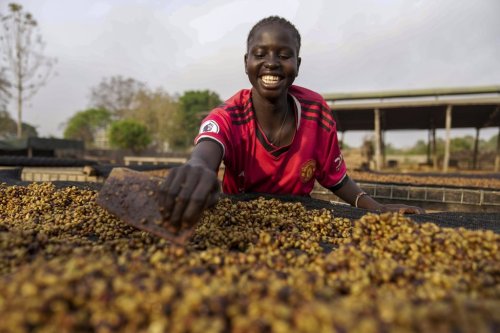
NZARA COUNTY, South Sudan (AP) — Catherine Bashiama runs her fingers along the branches of the coffee tree she’s raised from a seedling, searching anxiously for its first fruit buds since she planted it three years ago. When she grasps the small cherries, Bashiama beams.
The farmer had never grown coffee in her village in western South Sudan, but now hopes a rare, climate-resistant species will help pull her family from poverty. “I want to send my children to school so they can be the future generation,” said Bashiama, a mother of 12.
Discovered more than a century ago in South Sudan, excelsa coffee is exciting cash-strapped locals and drawing interest from the international community amid a global coffee crisis caused mainly by climate change. As leading coffee-producing countries struggle to grow crops in drier, less reliable weather, prices have soared to the highest in decades and the industry is scrambling for solutions.
Experts say estimates from drought-stricken Brazil, the world’s top coffee grower, are that this year’s harvest could be down by some 12%.
“What history shows us is that sometimes the world doesn’t give you a choice, and right now there are many coffee farmers suffering from climate change that are facing this predicament,” said Aaron Davis, head of coffee research at the Royal Botanic Gardens, Kew, in London. Davis and his team have been researching excelsa for almost a decade, and work with excelsa producers in several counties, notably Uganda.
Excelsa could play a key role in adapting.
Native to South Sudan and a handful of other African countries, including Congo, Central African Republic and Uganda, excelsa is also farmed in India, Indonesia and Vietnam. The tree’s deep roots, thick leathery leaves and big trunk allow it to thrive in extreme conditions such as drought and heat where other coffees cannot. It’s also resistant to many common coffee pests and diseases.
Yet it comprises less than 1% of the global market, well behind the arabica and robusta species that are the most consumed coffees in the world. Experts say excelsa will have to be shown to be practical at a much larger scale to bridge the gap in the market caused by climate change. For now, it’s mostly only available for purchase online.
Coffee’s history in South Sudan
Unlike neighboring Ethiopia or Uganda, oil-rich South Sudan has never been known as a coffee-producing nation.
Its British colonizers grew robusta and arabica, but much of that stopped during decades of conflict that forced people from their homes and made it hard to farm. Coffee trees require regular care such as pruning and weeding and take at least three years to yield fruit.
During a visit earlier this month to Nzara County in Western Equatoria state — regarded as the country’s breadbasket — residents reminisced to Associated Press reporters about their parents and grandparents growing coffee, yet much of the younger generation hadn’t done it themselves.
Many were familiar with excelsa, but didn’t realize how unique it was, or what it was called, referring to it as the big tree, typically taller than the arabica and robusta species that are usually pruned to be bush- or hedge-like. The excelsa trees can reach 15 meters (about 49 feet) in height, but may also be pruned much shorter for ease of harvesting.
Coffee made from excelsa tastes sweet — unlike robusta — with notes of chocolate, dark fruits and hazelnut. It’s more similar to arabica, but generally less bitter and may have less body.
“There’s so little known about this coffee, that we feel at the forefront to trying to unravel it and we’re learning every day,” said Ian Paterson, managing director of Equatoria Teak, a sustainable agro-forestry company that’s been operating in the country for more than a decade.
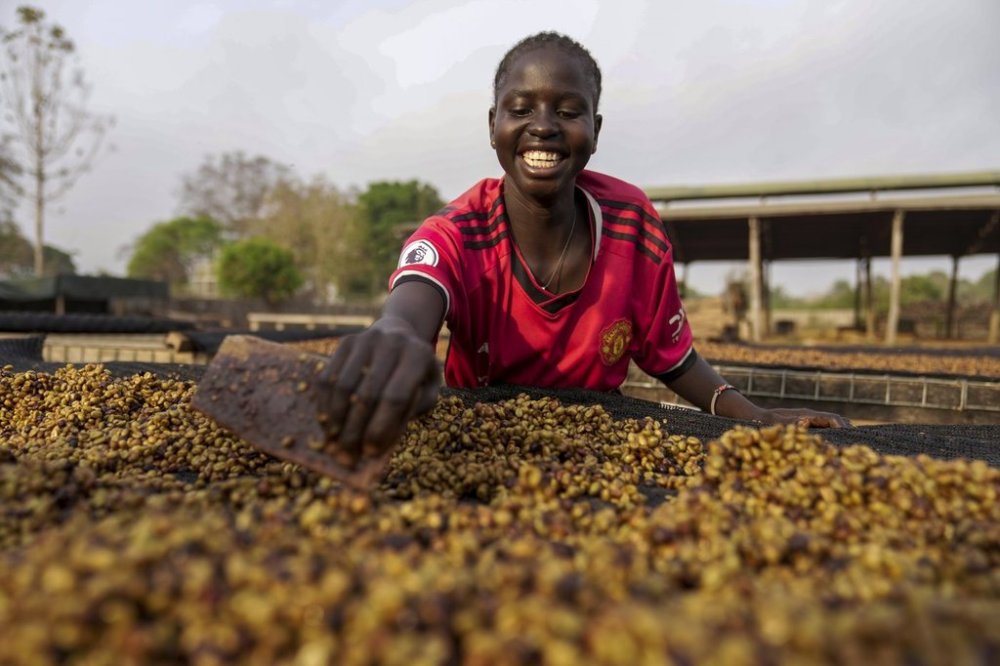
The company’s been doing trials on excelsa for years. Initial results are promising, with the trees able to withstand heat much better than other species, the company said. It’s also working with communities to revive the coffee industry and scale up production. Three years ago it gave seedlings and training to about 1,500 farmers, including Bashiama, to help them grow the coffee. The farmers can sell back to the company for processing and export.
Many of the trees started producing for the first time this year, and Paterson said he hopes to export the first batch of some 7 tons to specialty shops in Europe. By 2027, the coffee could inject some $2 million into the economy, with big buyers such as Nespresso expressing interest. But production needs to triple for it to be worthwhile for large buyers to invest, he said.
Challenges of growing an industry amid South Sudan’s instability
That could be challenging in South Sudan, where lack of infrastructure and insecurity make it hard to get the coffee out.
One truck of 30 tons of coffee has to travel some 1,800 miles (3,000 kilometers) to reach the port in Kenya to be shipped. The cost for the first leg of that trip, through Uganda, is more than $7,500, which is up to five times the cost in neighboring countries.
It’s also hard to attract investors.
Despite a peace deal in 2018 that ended a five-year civil war, pockets of fighting persist. Tensions in Western Equatoria are especially high after the president removed the governor in February, sparking anger among his supporters. When AP reporters visited Nzara, the main road to town was cut off one day because of gunshots and people were fleeing their villages, fearful of further violence.
The government says companies can operate safely, but warned them to focus on business.
“If I’m a businessman, dealing with my business, let me not mix with politics. Once you start mixing your business with politics, definitely you will end up in chaos,” said Alison Barnaba, the state’s minister of Agriculture, Forestry and Environment.
Barnaba said there are plans to rehabilitate old coffee plantations and build an agriculture school, but details are murky, including where the money will come from. South Sudan hasn’t paid its civil servants in more than a year, and a rupture of a crucial oil pipeline through neighboring Sudan has tanked oil revenue.
Growing the coffee isn’t always easy, either. Farmers have to contend with fires that spread quickly in the dry season and decimate their crops. Hunters use fires to scare and kill animals and residents use it to clear land for cultivation. But the fires can get out of control and there are few measures in place to hold people accountable, say residents.
Coffee as a way out of poverty
Still, for locals, the coffee represents a chance at a better future.
Bashiama said she started planting coffee after her husband was injured and unable to help cultivate enough of the maize and ground nuts that the family had lived on. Since his accident she hasn’t been able to send her children to school or buy enough food, she said.
Another farmer, 37-year-old Taban John, wants to use his coffee earnings to buy a bicycle so he can more easily sell his other crops, ground nuts and cassava, and other goods in town. He also wants to be able to afford school uniforms for his children.
Excelsa is an opportunity for the community to become more financially independent, say community leaders. People rely on the government or foreign aid, but when that doesn’t come through they’re not able to take care of their families, they say.
But for coffee to thrive in South Sudan, locals say there needs to be a long-term mentality, and that requires stability.
Elia Box lost half of his coffee crop to fire in early February. He plans to replace it, but was dispirited at the work it will require and the lack of law and order to hold people accountable.
“People aren’t thinking long-term like coffee crops, during war,” he said. “Coffee needs peace.”
___
The Associated Press’ climate and environmental coverage receives financial support from multiple private foundations. It receives financial support for global health and development coverage in Africa from the Gates Foundation. AP is solely responsible for all content. Find AP’s standards for working with philanthropies, a list of supporters and funded coverage areas at AP.org.