Big Tech’s soaring energy demands are making coal-fired power plant sites attractive
Advertisement
Read this article for free:
or
Already have an account? Log in here »
To continue reading, please subscribe:

Digital Subscription
One year of digital access for only $205*
- Enjoy unlimited reading on winnipegfreepress.com
- Read the E-Edition, our digital replica newspaper
- Access News Break, our award-winning app
- Play interactive puzzles
*First annual payment billed as $205.00 + GST for one year. This annual subscription will automatically renew at $233.00 + GST every 52 weeks (10% off the regular annual price of $259.35). Offer available to new and qualified returning subscribers only. Cancel any time.
To continue reading, please subscribe:
Add Free Press access to your Brandon Sun subscription for only an additional
$1 for the first 4 weeks*
- Enjoy unlimited reading on winnipegfreepress.com
- Read the E-Edition, our digital replica newspaper
- Access News Break, our award-winning app
- Play interactive puzzles
*Your next Brandon Sun subscription payment will increase by $1.00 and you will be charged $17.95 plus GST for four weeks. After four weeks, your payment will increase to $24.95 plus GST every four weeks.
Read unlimited articles for free today:
or
Already have an account? Log in here »
Hey there, time traveller!
This article was published 25/04/2025 (523 days ago), so information in it may no longer be current.
HARRISBURG, Pa. (AP) — Coal-fired power plants, long an increasingly money-losing proposition in the U.S., are becoming more valuable now that the suddenly strong demand for electricity to run Big Tech’s cloud computing and artificial intelligence applications has set off a full-on sprint to find new energy sources.
President Donald Trump — who has pushed for U.S. “energy dominance” in the global market and suggested that coal can help meet surging power demand — is wielding his emergency authority to entice utilities to keep older coal-fired plants online and producing electricity.
While some utilities were already delaying the retirement of coal-fired plants, the scores of coal-fired plants that have been shut down the past couple years — or will be shut down in the next couple years — are the object of growing interest from tech companies, venture capitalists, states and others competing for electricity.
That’s because they have a very attractive quality: high-voltage lines connecting to the electricity grid that they aren’t using anymore and that a new power plant could use.
That ready-to-go connection could enable a new generation of power plants — gas, nuclear, wind, solar or even battery storage — to help meet the demand for new power sources more quickly.
For years, the bureaucratic nightmare around building new high-voltage power lines has ensnared efforts to get permits for such interconnections for new power plants, said John Jacobs, an energy policy analyst for the Washington, D.C.-based Bipartisan Policy Center.
“They are very interested in the potential here. Everyone sort of sees the writing on the wall for the need for transmission infrastructure, the need for clean firm power, the difficulty with siting projects and the value of reusing brownfield sites,” Jacobs said.
Rising power demand, dying coal plants
Coincidentally, the pace of retirements of the nation’s aging coal-fired plants had been projected to accelerate at a time when electricity demand is rising for the first time in decades.
The Department of Energy, in a December report, said its strategy for meeting that demand includes re-using coal plants, which have been unable to compete with a flood of cheap natural gas while being burdened with tougher pollution regulations aimed at its comparatively heavy emissions of planet-warming greenhouse gases.
There are federal incentives, as well — such as tax credits and loan guarantees — that encourage the redevelopment of retired coal-fired plants into new energy sources.
Todd Snitchler, president and CEO of the Electric Power Supply Association, which represents independent power plant owners, said he expected Trump’s executive orders will mean some coal-fired plants run longer than they would have — but that they are still destined for retirement.
Surging demand means power plants are needed, fast
Time is of the essence in getting power plants online.
Data center developers are reporting a yearlong wait in some areas to connect to the regional electricity grid. Rights-of-way approvals to build power lines can also be difficult to secure, given objections by neighbors who may not want to live near them.
Stephen DeFrank, chairman of the Pennsylvania Public Utility Commission, said he believes rising energy demand has made retiring coal-fired plants far more valuable.
That’s especially true now that the operator of the congested mid-Atlantic power grid has re-configured its plans to favor sites like retired coal-fired plants as a shortcut to meet demand, DeFrank said.
“That’s going to make these properties more valuable because now, as long as I’m shovel ready, these power plants have that connection already established, I can go in and convert it to whatever,” DeFrank said.
Gas, solar and more at coal power sites
In Pennsylvania, the vast majority of conversions is likely to be natural gas because Pennsylvania sits atop the prolific Marcellus Shale reservoir, DeFrank said.
In states across the South, utilities are replacing retiring or retired coal units with gas. That includes a plant owned by the Tennessee Valley Authority; a Duke Energy project in North Carolina; and a Georgia Power plant.
The high-voltage lines at retired coal plants on the Atlantic Coast in New Jersey and Massachusetts were used to connect offshore wind turbines to electricity grids.
In Alabama, the site of a coal-fired plant, Plant Gorgas, shuttered in 2019, will become home to Alabama Power’s first utility-scale battery energy storage plant.
Texas-based Vistra, meanwhile, is in the process of installing solar panels and energy storage plants at a fleet of retired and still-operating coal-fired plants it owns in Illinois, thanks in part to state subsidies approved there in 2021.
Nuclear might be coming
Nuclear is also getting a hard look.
In Arizona, lawmakers are advancing legislation to make it easier for three utilities there — Arizona Public Service, Salt River Project and Tucson Electric Power — to put advanced nuclear reactors on the sites of retiring coal-fired plants.
At the behest of Indiana’s governor, Purdue University studied how the state could attract a new nuclear power industry. In its November report, it estimated that reusing a coal-fired plant site for a new nuclear power plant could reduce project costs by between 7% and 26%.
The Bipartisan Policy Center, in a 2023 study before electricity demand began spiking, estimated that nuclear plants could cut costs from 15% to 35% by building at a retiring coal plant site, compared to building at a new site.
Even building next to the coal plant could cut costs by 10% by utilizing transmission assets, roads and buildings while avoiding some permitting hurdles, the center said.
That interconnection was a major driver for Terrapower when it chose to start construction in Wyoming on a next-generation nuclear power plant next to PacifiCorp’s coal-fired Naughton Power Plant.
Jobs, towns left behind by coal
Kathryn Huff, a former U.S. assistant secretary for nuclear energy who is now an associate professor at the University of Illinois Urbana-Champaign, said the department analyzed how many sites might be suitable to advanced nuclear reactor plants.
A compelling factor is the workers from coal plants who can be trained for work at a nuclear plant, Huff said. Those include electricians, welders and steam turbine maintenance technicians.
In Homer City, the dread of losing its coal-fired plant — it shut down in 2023 after operating for 54 years — existed for years in the hills of western Pennsylvania’s coal country.
“It’s been a rough 20 years here for our area, maybe even longer than that, with the closing of the mines, and this was the final nail, with the closing of the power plant,” said Rob Nymick, Homer City’s manager. “It was like, ‘Oh my god, what do we do?’”
That is changing.

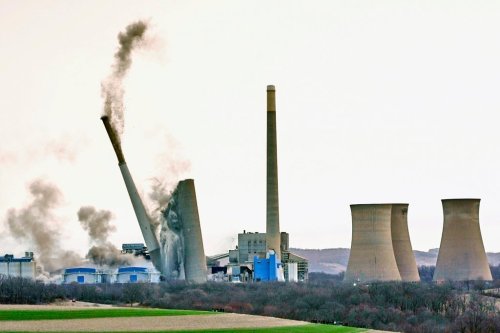
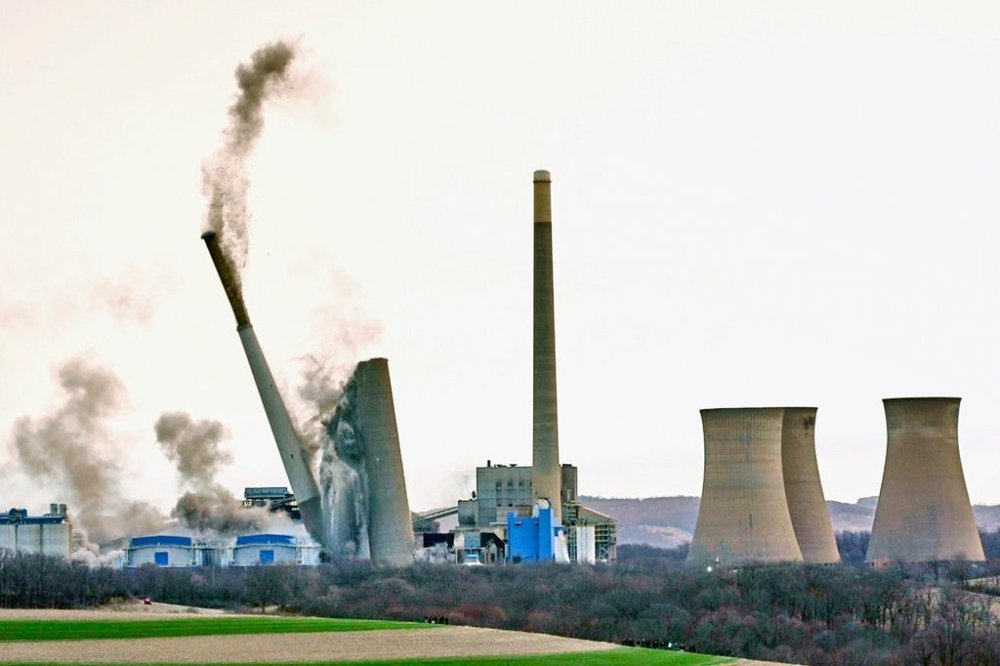
The plant’s owners in recent weeks demolished the smoke stacks and cooling towers at the Homer City Generating State and announced a $10 billion plan for a natural gas-powered data center campus.
It would be the nation’s third-largest power generator and that has sown some optimism locally.
“Maybe we will get some families moving in, it would help the school district with their enrollment, it would help us with our population,” Nymick said. “We’re a dying town and hopefully maybe we can get a restaurant or two to open up and start thriving again. We’re hoping.”
___
Follow Marc Levy on X at: https://x.com/timelywriter.