Midwest carbon dioxide pipeline could face new hurdle as some Iowa lawmakers question eminent domain

Advertisement

Advertise with us

DES MOINES, Iowa (AP) — A proposed carbon-capture pipeline that would traverse through several Midwestern states could face more hurdles in Iowa as a dozen Republican state senators try to force the issue to a vote.

Read this article for free:


or

Already have an account? Log in here »

To continue reading, please subscribe:

Subscribe and receive a limited-edition Free Press branded hat or tote.

Digital Subscription

One year of digital access for only $205*

  • Enjoy unlimited reading on winnipegfreepress.com
  • Read the E-Edition, our digital replica newspaper
  • Access News Break, our award-winning app
  • Play interactive puzzles

*First annual payment billed as $205.00 + GST for one year. This annual subscription will automatically renew at $233.00 + GST every 52 weeks (10% off the regular annual price of $259.35). Offer available to new and qualified returning subscribers only. Cancel any time.

To continue reading, please subscribe:

Add Free Press access to your Brandon Sun subscription for only an additional

$1 for the first 4 weeks*

  • Enjoy unlimited reading on winnipegfreepress.com
  • Read the E-Edition, our digital replica newspaper
  • Access News Break, our award-winning app
  • Play interactive puzzles
Start now

*Your next Brandon Sun subscription payment will increase by $1.00 and you will be charged $17.95 plus GST for four weeks. After four weeks, your payment will increase to $24.95 plus GST every four weeks.

Hey there, time traveller!
This article was published 01/05/2025 (523 days ago), so information in it may no longer be current.

DES MOINES, Iowa (AP) — A proposed carbon-capture pipeline that would traverse through several Midwestern states could face more hurdles in Iowa as a dozen Republican state senators try to force the issue to a vote.

Summit Carbon Solutions already will likely have to readjust plans for their estimated $8.9 billion, 2,500-mile (4,023-kilometer) project after South Dakota’s governor signed a ban on the use of eminent domain — the government seizure of private property with compensation — to acquire land for carbon dioxide pipelines.

Now, after several proposals advanced through the Republican-controlled Iowa House, 12 GOP state senators have told their Republican leaders that they will not vote on any budget, which the Legislature is constitutionally required to approve, until they bring a pipeline bill to the floor.
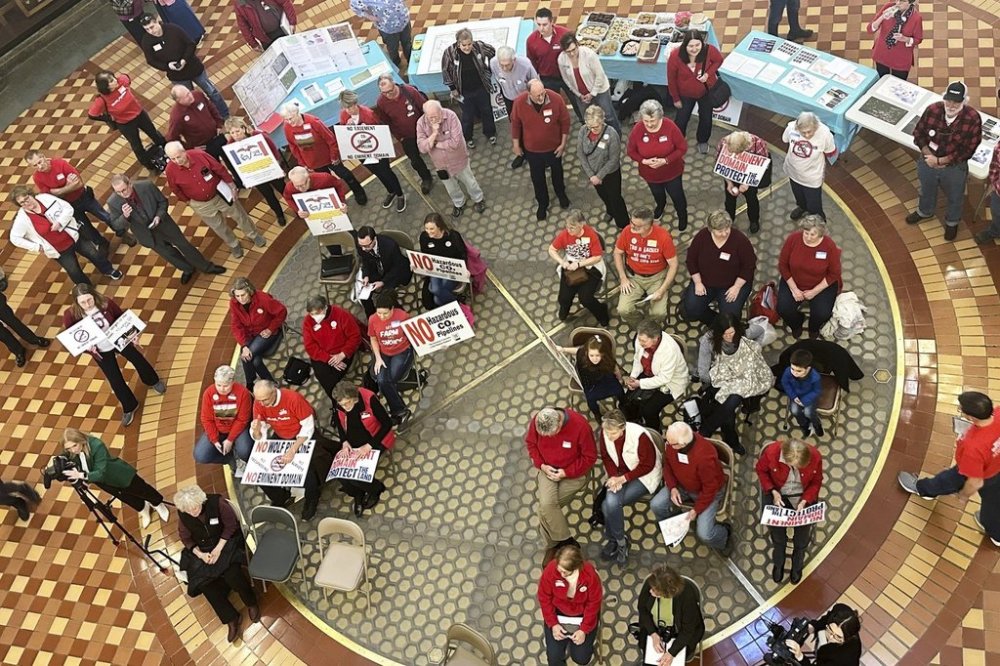
FILE - Opponents of Summit Carbon Solutions' proposed carbon dioxide pipeline gather at the state Capitol in Des Moines, Iowa, on Feb. 8, 2024. (AP Photo/Hannah Fingerhut, File)

“The people of South Dakota emphatically stated that eminent domain will never be granted for this pipeline to cross South Dakota, and it is past time for lowa to do the same,” the senators wrote in a joint letter, saying they believe “addressing eminent domain is more important than the budget or any other priority for the 2025 session.”

It’s unclear if the demands will be met or what a measure that passes the full chamber would look like, given the wide range of views on the issue among the 34 Senate Republicans, who hold a supermajority in the chamber.

The proposed 2,500-mile pipeline would carry carbon emissions from ethanol plants in Iowa, Minnesota, Nebraska, North Dakota and South Dakota to be stored underground permanently in North Dakota.

By lowering carbon emissions from the plants, the pipeline would lower their carbon intensity scores and make them more competitive in the renewable fuels market. The project would also allow ethanol producers and Summit to tap into federal tax credits.

The project received permit approvals in Iowa, Minnesota and North Dakota, but it does face various court challenges, and its application was rejected in South Dakota last month.

“Summit Carbon Solutions has invested four years and nearly $175 million on voluntary agreements in Iowa, signing agreements with more than 1,300 landowners and securing 75% of the Phase One route,” Summit spokesperson Sabrina Zenor said in a statement. “We are committed to building this project, committed to Iowa, and remain focused on working with legislators — including those with concerns.”

Some Midwest farmers, despite loyalty to the ethanol industry, have voiced strong opposition to the pipeline since its inception, objecting to its presence on or near their land and questioning the safety of having the pipeline in their backyards.

Then, a slew of eminent domain legal actions in South Dakota to obtain land provoked a groundswell of opposition in the state, sending the issue to the governor’s desk. Lee Enterprises and The Associated Press reviewed hundreds of cases, revealing the great legal lengths the company went to get the project built.

Iowa state Sen. Kevin Alons said the senators who are forcing the issue want an amendment to the bill that mimics South Dakota’s new law, but it remains to be seen what provisions, if any, would be included in a final version or whether Republican Gov. Kim Reynolds would give it her signature.

“A number of Republican Senators are working on policy surrounding eminent domain and pipeline issues and I am optimistic we will find a legislative solution,” Senate Majority Leader Jack Whitver said in a statement.

The Iowa House has sent several proposals to the Senate. During debate on the House floor, state Rep. Steven Holt expressed plenty of disappointment that the Senate had not taken up the issue in the past.

“Regardless of whether the Senate’s gonna pass it or not, we’re going to fight for it here because it’s the right thing to do,” Holt said.

“You chose to try to trample on the rights of citizens of Iowa and South Dakota,” he added of Summit, “and now the chickens are coming home to roost.”

___

Associated Press reporters Jack Dura in Bismarck, North Dakota, and Sarah Raza in Sioux Falls, South Dakota, contributed to this report.


Report Error Submit a Tip

More Stories

Stevenson set for first Jets start against Penguins

Ken Wiebe 5 minute read Preview

Stevenson set for first Jets start against Penguins

Ken Wiebe 5 minute read Sunday, Oct. 4, 2026

DETROIT — Clay Stevenson, the stage is yours.

As the Winnipeg Jets wrap up a two-game road trip on Monday against the Pittsburgh Penguins, the newest member of the team will be between the pipes after Stuart Skinner got the call in the first two outings of the campaign.

There will be an element of familiarity for Stevenson, as PPG Paints Arena is where he made his first NHL appearance with the Washington Capitals on April 17, 2025.

“There is some comfortability in that building,” said Stevenson, who made 33 saves in a 5-2 loss to the Penguins in that NHL debut. “It’s always a great challenge to play against (Sidney) Crosby and (Evgeni) Malkin and those guys. It’s an honour to get into the crease anytime.”

Read
Sunday, Oct. 4, 2026

Midwest carbon dioxide pipeline could face new hurdle as some Iowa lawmakers question eminent domain

Hannah Fingerhut, The Associated Press 4 minute read Preview

Midwest carbon dioxide pipeline could face new hurdle as some Iowa lawmakers question eminent domain

Hannah Fingerhut, The Associated Press 4 minute read Thursday, May. 1, 2025

DES MOINES, Iowa (AP) — A proposed carbon-capture pipeline that would traverse through several Midwestern states could face more hurdles in Iowa as a dozen Republican state senators try to force the issue to a vote.

Summit Carbon Solutions already will likely have to readjust plans for their estimated $8.9 billion, 2,500-mile (4,023-kilometer) project after South Dakota's governor signed a ban on the use of eminent domain — the government seizure of private property with compensation — to acquire land for carbon dioxide pipelines.

Now, after several proposals advanced through the Republican-controlled Iowa House, 12 GOP state senators have told their Republican leaders that they will not vote on any budget, which the Legislature is constitutionally required to approve, until they bring a pipeline bill to the floor.

“The people of South Dakota emphatically stated that eminent domain will never be granted for this pipeline to cross South Dakota, and it is past time for lowa to do the same,” the senators wrote in a joint letter, saying they believe “addressing eminent domain is more important than the budget or any other priority for the 2025 session.”

Read
Thursday, May. 1, 2025

Letters, Oct. 6

6 minute read 2:00 AM CDT

High road not so easy

Re: Khan should’ve taken high road: Goertzen (Oct. 3)

Politics is a tough game. Just ask former provincial Liberal leader Dougald Lamont. He got thrown under the bus by a prominent Manitoba/Canadian Liberal who advised people to vote NDP in the last provincial election.

As Lamont said when he lost the election, he is “human” and what happened to him “hurt.” Khan is also human. It is easy to criticize him for not taking the “high road.”

13 guns seized from West St. Paul homes

1 minute read Yesterday at 12:28 PM CDT

Two men have been charged with a number of firearms offences after an RCMP investigation into illegal weapons in West St. Paul yielded the seizure of more than a dozen firearms last month.

RCMP investigators from the Manitoba Integrated Law Enforcement Team, which probes organized and serious crime in the province, began looking into the two suspects on a tip from the Canada Border Services Agency.

Officers obtained warrants to search two homes, one on Pipeline Road and the other on Griffin Way, on Sept. 11.

Between the two houses, Mounties found 13 guns, including two that were sawed off, about 20,000 rounds of ammunition and several high-capacity magazines that had been altered to hold more ammunition than is legally allowed.

Seven Wilsons, one regional spirit

Hersh Seth 5 minute read Preview

Seven Wilsons, one regional spirit

Hersh Seth 5 minute read 2:00 AM CDT

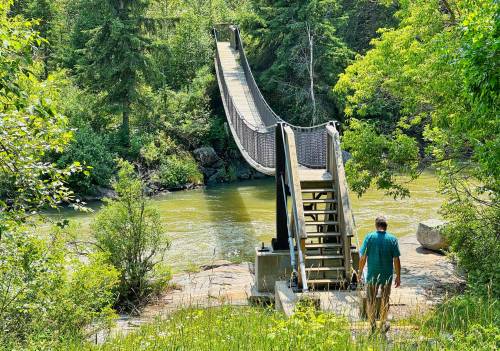
In Dryden, Ont., a 34-metre suspension bridge crosses the Wabigoon River rapids. It is named after a man who paid for a quarter of the bridge himself. A plaque recognizes Roy Wilson’s “many contributions to City Revitalization” and mentions his 40 years in the Rotary Club, whose motto is “service above self”.

My father sold business machines from the 1970s through the ’90s, during the shift from carbon copy machines and typewriters to photocopiers, fax machines, and early office computers and printers. His sales territory — which he covered mostly by car but also by propeller plane — was Saskatchewan, the Northwest Territories, Manitoba, and northwestern Ontario, though much of it really belonged to the Wilsons.

In business machines, selling the machine was only half the job — the other half was ensuring a technician would fix it in January. Wilson’s set the standard for dealers across most of my dad’s regions. My father worked with Roy’s son Greg (who would later go on to become mayor of Dryden) but really respected Roy for teaching Greg to run the company with the towns they served as the priority.

Wilson’s service routes went beyond where roads stopped. Even if customers lived north of the highway system, Wilson’s still found a way to help, using three company planes based at the Dryden airport. As a result, a stationery shop from a paper mill town served all of northwestern Ontario and later northern Manitoba. Imagine a photocopier strapped into a small plane, a technician beside it, and a gravel runway waiting at the other end.

Read
2:00 AM CDT

Real journalists matter in an AI world

Paul Deegan 4 minute read Preview

Real journalists matter in an AI world

Paul Deegan 4 minute read 2:00 AM CDT

An algorithm can decide what you see, but it doesn’t report the news. Nunatsiaq News, an award-winning newspaper in Nunavut, recently reported that a so-called “news” website was posting AI-generated articles about the north by stealing real news stories produced by real journalists.

The articles were supposedly written by Nunavut correspondent Leah Qammaniq — a fake journalist, with a fake photo and a fake bio.

Governor General Louise Arbour warned us of fake news in her installation speech in June. She said, “We must continue to protect the public space in which our national debates take place: from schools and universities to the media, political parties, unions and civil society organizations …With instant access to vast amounts of information, it is very tempting to pay little attention to the reliability of sources. The lines between knowledge and belief, between truth and falsehood, between facts and assumptions, are increasingly blurred. AI could be threatening not only the way we live and work, but also the control we exercise over our own destiny.”

The Government of Canada has recognized the problem as well. Its recent discussion paper, Enhancing trust in artificial intelligence through increased transparency, stated, “Canadians encounter news reporting, product reviews, and audio-visual content across the internet, often without any indication of whether it was written by a person, generated by an AI system, or produced through some combination of both … A particular concern within this broader landscape is that generative AI greatly enables the creation and dissemination of deceptive or misleading content.”

Read
2:00 AM CDT