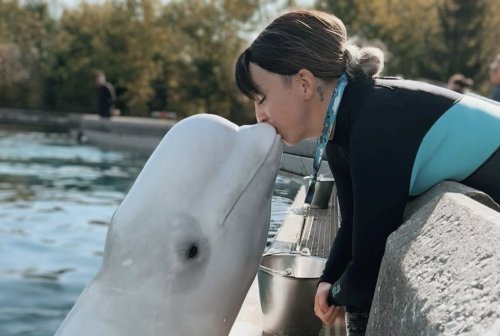
‘We need to get them out’: Beluga trainer fired by Marineland speaks out
Advertisement
Read this article for free:
or
Already have an account? Log in here »
To continue reading, please subscribe:
Digital Subscription
One year of digital access for only $1.44 a week*
- Enjoy unlimited reading on winnipegfreepress.com
- Read the E-Edition, our digital replica newspaper
- Access News Break, our award-winning app
- Play interactive puzzles
*Billed as $5.77 plus GST every four weeks. After 52 weeks, price increases to the regular rate of $19.95 plus GST every four weeks. Offer available to new and qualified returning subscribers only. Cancel any time.
To continue reading, please subscribe:
Add Free Press access to your Brandon Sun subscription for only an additional
$1 for the first 4 weeks*
- Enjoy unlimited reading on winnipegfreepress.com
- Read the E-Edition, our digital replica newspaper
- Access News Break, our award-winning app
- Play interactive puzzles
*Your next Brandon Sun subscription payment will increase by $1.00 and you will be charged $17.95 plus GST for four weeks. After four weeks, your payment will increase to $24.95 plus GST every four weeks.
Read unlimited articles for free today:
or
Already have an account? Log in here »
Hey there, time traveller!
This article was published 14/10/2025 (374 days ago), so information in it may no longer be current.
TORONTO – Marineland’s crumbling infrastructure, staffing shortage and lack of resources have created dangerous conditions for its belugas and they should be moved immediately, a fired beluga trainer says.
Kristy Burgess, who worked at the Niagara Falls, Ont., park when a young beluga was put down in February, said Marineland’s threat to euthanize all 30 of its remaining belugas if it doesn’t receive emergency funding is a “repulsive” tactic that uses the whales as leverage.
“We need to get them out,” Burgess said of the last captive whales in Canada. “Immediately.”
Burgess is speaking out for the first time about her experience at Marineland as the very whales she loved now face possible death.
Nineteen belugas, one dolphin and one killer whale have died at the park since 2019, according to a database created by The Canadian Press based on internal documents and official statements.
The belugas’ pools, Arctic Cove and Friendship Cove, are in desperate need of repair with their painted walls peeling and concrete chunks falling into the water, Burgess said.
“Whales have come in with paint chips on their tongues,” she said. “The pools are falling apart.”
Rocks from the pools’ decorative feature have crumbled into the tanks, providing some excitement for the whales as they like to play with them or try to eat them, she added.
“We’ve had people have to dive into the water and fish out really large, heavy rocks, probably the size of dinner plates,” Burgess said.
The water system has broken down regularly, Burgess said, affecting the park’s ability to drop and raise water, which is crucial to giving whales medical treatment. This has meant delays in treating whales or trainers taking extra risks to get into deeper water to provide care, she said.
Marineland did not respond to multiple requests for comment with detailed questions about Burgess’s allegations.
Once a tourist attraction, the park is now in crisis after the federal government denied export permits to move its 30 belugas to Chimelong Ocean Kingdom, a massive aquarium in China. The park said it is nearly broke and has no other viable options to rehome the whales.
Fisheries Minister Joanne Thompson said she denied the export request because she did not want to subject the belugas to a future performing in captivity, which is consistent with a federal law passed in 2019.
Marineland then wrote to the minister asking for emergency funds to feed and care for the whales, saying it is running out of money and would otherwise have to euthanize them.
Burgess said she wants Thompson to reconsider her decision. She believes the minister is detached from the reality of the situation.
“The minister and everyone keeps saying, ‘Well, they may not make it if they move to China,’ or that they’re going to perform or breed, but the reality is I would rather see them try and (if) they don’t make it and they pass, fine, but at least they tried,” she said.
“How is it a better plan to leave them at Marineland? They’ll either die slowly there or they’ll be euthanized because someone wants to make money off the land that they are sitting on.”
Thompson’s office said the minister has made it clear that the decision to deny the export permits was made in alignment with the law and “with the best interests of the belugas in mind.”
Thompson has urged Marineland to come up with a new plan and said she will consider any proposal quickly.
Marineland’s founder John Holer died in 2018 and his wife, Marie, ran the park until she died in 2024. The estate has been placed into a trust.
The animals have been an impediment to the sale of the park, though the sprawling property is worth hundreds of millions of dollars, perhaps more.
Marineland has become a political hot potato, with the federal and provincial governments pointing the finger at each other to help the belugas. Premier Doug Ford said Ottawa created this mess, while Thompson said the health and welfare of the whales is in the provincial purview.
Ontario is responsible for enforcing animal welfare laws and has conducted a sprawling, ongoing investigation into Marineland since 2020. Inspectors have visited the park more than 220 times and issued 33 orders for compliance.
The park’s water has long been an issue.
The province has four long-term outstanding orders against Marineland. They are focused on water quality, the maintenance and repair of the water system, proper record keeping for whales and dolphins and the condition of enclosures and enrichment level for dolphins, seals and sea lions, the Ministry of the Solicitor General has said.
In 2021, the province declared all marine mammals at Marineland in distress, citing poor water. Marineland disagreed, filed an appeal to an order, but then dropped its appeal.
Marineland has gone silent in recent days as last week’s deadline for its funding request came and went. The province confirmed Thursday the whales were still alive but provided no other details.
Until recently, Burgess was a lifelong Marineland fan. She remembers becoming smitten with the park when she visited as a seven year old. By the time she was 15, she had a job at the Hungry Bear, the park’s main restaurant, for two summers.
She applied for other jobs at Marineland and finally landed one in 2022. She started as a caregiver for the whales, which involved prepping meals of frozen fish. Herring, capelin and smelt make up the core of the belugas’ diet.
Burgess was soon promoted to assistant marine mammal caregiver. Then she became a beluga trainer.
The workload weighed on Burgess over time. She said the park was short staffed when she worked there and had 18 workers who covered both beluga pools. The whales need daily care so breaks, different shifts, time off and sickness meant that could work out to five to seven people doing hands-on animal care, she said.
“It’s not even close to enough,” she said.
During her three years at Marineland, seven belugas and the park’s lone killer whale, Kiska, died.
Burgess said the deaths took a toll on the trainers and caregivers at Marineland, who work year-round in all weather conditions over long, laborious hours.
“They’re tired, they’re carrying the weight of all the grief that they have seen over the years and they’re spread super thin, but they’re still showing up and doing their best,” she said. “And they get paid pennies.”
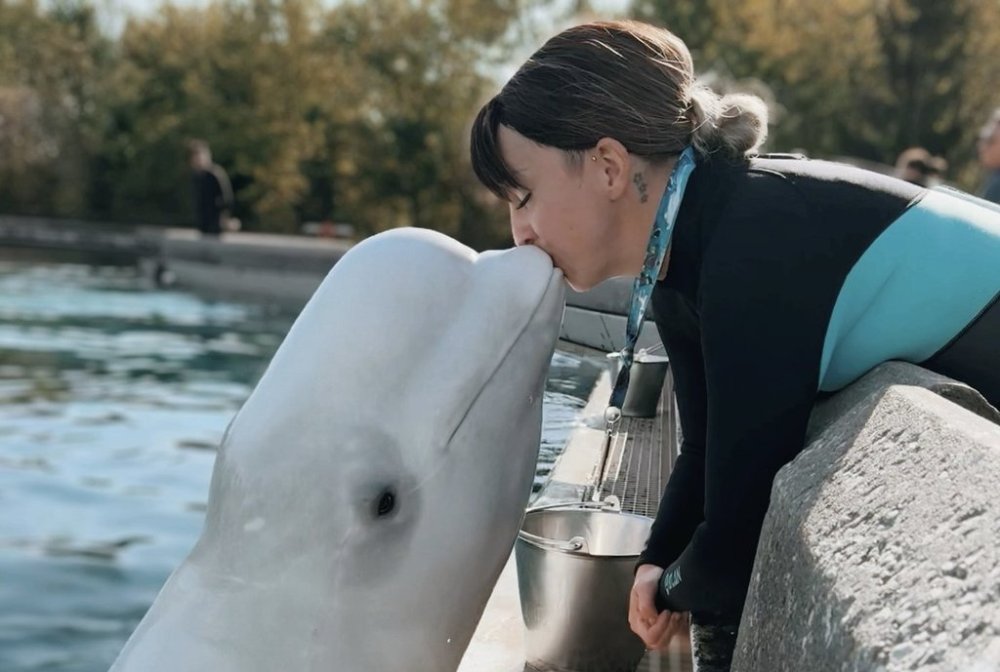
Burgess said she was paid $18.50 an hour as a full-time trainer, up from the $17.50 she earned as a caregiver. Some of the more senior trainers earn a touch more than $20 an hour, she said.
She wants the public to know more about the belugas that remain at Marineland.
There’s Xena, the matriarch of the pod.
“Her age doesn’t slow her down,” Burgess wrote in a Facebook post with a blurb about each whale. Xena is the mother of two born at the park: Eve, a more reserved beluga that “giggles” when she vocalizes, and Xavier, the “nerd” of the pod who is “extremely intelligent and loves to play with enrichment,” Burgess wrote.
Some belugas are more dominant and others are more submissive, she explained.
“They are very loving, they do show affection and form very close social bonds with each other,” she said.
Part of the 2019 law that banned captivity has had a deleterious effect on the whales, she said. Ottawa forbade breeding, so Marineland had to separate the males and females as beluga birth control doesn’t otherwise exist.
That has caused problems when beluga families are separated.
“The males, when they get hormonal, they get really aggressive with one another,” Burgess said, citing as an example the whales’ “raking” — scraping their teeth on other belugas that causes permanent scarring.
“There’s been raking to an extreme degree,” she said.
“The females are very skittish and nervous, whereas before, when the males were present, they were a lot more confident.”
Marineland’s threat to put down all of its whales landed like a bomb at the park, Burgess said, as she’s still close to many workers there.
But she said it’s not a credible threat.
“It’s repulsive, but the vets won’t do it, the caregivers won’t do it,” she said.
Mass euthanasia is “insane,” she said, and even if there were workers willing to do it, it would take days. Euthanasia is difficult on the workers, she said, even when it’s necessary – like in February.
Eos, a seven-year-old juvenile beluga, struggled at the time. The whale had been sick since birth and euthanizing her was the right decision, Burgess said.
Burgess had formed a deep connection with Eos, as she became one of her caregivers over the previous year. Eos struggled to eat, so Burgess spent hours trying different ways to get food into the whale.
Despite the workers’ efforts, life began to slip away from Eos.
“I wanted to be able to see her body so I had closure because previous whales, when they passed, I would come into work and they would just be gone and you just had to carry on,” Burgess said through tears.
She didn’t want that with Eos, so she pushed to be part of the process. “I was able to see her, give her a hug and say goodbye.”
Burgess said Marineland fired her in early March, shortly after The Canadian Press learned of Eos’s death from a source inside the park.
After The Canadian Press sent questions to Marineland, the park confirmed the whale’s death on social media.
But Marineland was furious with the leak and began interrogating employees, Burgess said. She said she was fired a few weeks later and initially given no reason.
Burgess said she was eventually told it was due to Marineland winding down its operations, though the park later posted her job on an employment site. Burgess provided a screenshot of the ad but The Canadian Press did not independently view it on the employment site.

She said she believes she was fired over the leak even though she wasn’t the source.
She tried for months to get her job back, but said Marineland refused.
Now she’s left trying to make sense of the whales’ current predicament. All levels of government have let down the whales at Marineland, she said, adding that she wants to make one point crystal clear.
“Marineland’s current desperation is a result of choices, not circumstance,” Burgess said.
This report by The Canadian Press was first published Oct. 14, 2025.
Related Articles
Marineland's belugas are alive after euthanasia deadline passes, Ontario says





Advertisement Advertise With Us
Advertisement Advertise With Us