Nova Scotia’s CarbonRun reaches carbon capture milestone with ‘river liming’ project
Advertisement
Read this article for free:
or
Already have an account? Log in here »
To continue reading, please subscribe:

Digital Subscription
One year of digital access for only $205*
- Enjoy unlimited reading on winnipegfreepress.com
- Read the E-Edition, our digital replica newspaper
- Access News Break, our award-winning app
- Play interactive puzzles
*First annual payment billed as $205.00 + GST for one year. This annual subscription will automatically renew at $233.00 + GST every 52 weeks (10% off the regular annual price of $259.35). Offer available to new and qualified returning subscribers only. Cancel any time.
To continue reading, please subscribe:
Add Free Press access to your Brandon Sun subscription for only an additional
$1 for the first 4 weeks*
- Enjoy unlimited reading on winnipegfreepress.com
- Read the E-Edition, our digital replica newspaper
- Access News Break, our award-winning app
- Play interactive puzzles
*Your next Brandon Sun subscription payment will increase by $1.00 and you will be charged $17.95 plus GST for four weeks. After four weeks, your payment will increase to $24.95 plus GST every four weeks.
Read unlimited articles for free today:
or
Already have an account? Log in here »
Hey there, time traveller!
This article was published 12/02/2026 (230 days ago), so information in it may no longer be current.
HALIFAX – A Nova Scotia-based company has accomplished a milestone in the world of carbon capture, with its project to store carbon dioxide in rivers using limestone.
CarbonRun, co-founded by Dalhousie University professor Shannon Sterling, says that by mixing crushed limestone into rivers, a process known as “river liming,” a significant amount of carbon dioxide — a greenhouse gas — can be prevented from entering the atmosphere.
“It’s a whole new strategy to use rivers. It’s adapting the land-to-ocean transfer of carbon,” Sterling said.
Sterling says that her company is the first in the world to earn carbon credits for river liming. A carbon credit is a representation of one metric tonne of carbon removed or diverted from the atmosphere. The credit is a transferable token that can be sold to offset emissions elsewhere.
Isometric, a registry based in New York and London that issues carbon credits, has verified CarbonRun’s data. It says Sterling’s project is indeed the first of its kind to earn carbon credits for river liming.
River liming has been used for years around the world to raise the pH — or lower acidity — of a river as a way to restore the ecosystem or support fish populations. Sterling’s team showed that done at scale, liming can have much wider impacts.
Carbon dioxide can enter river water in several ways, but a main source is through ground water. When it rains, water leaches from the soil into rivers, and brings carbon with it. When the limestone in a river reacts with dissolved carbon dioxide, it binds into carbonate and bicarbonate ions. Instead of the carbon dioxide evaporating into the atmosphere, those ions are carried along by the river currents and eventually deposited in the ocean, where Sterling says they’ll stay for tens of thousands of years.
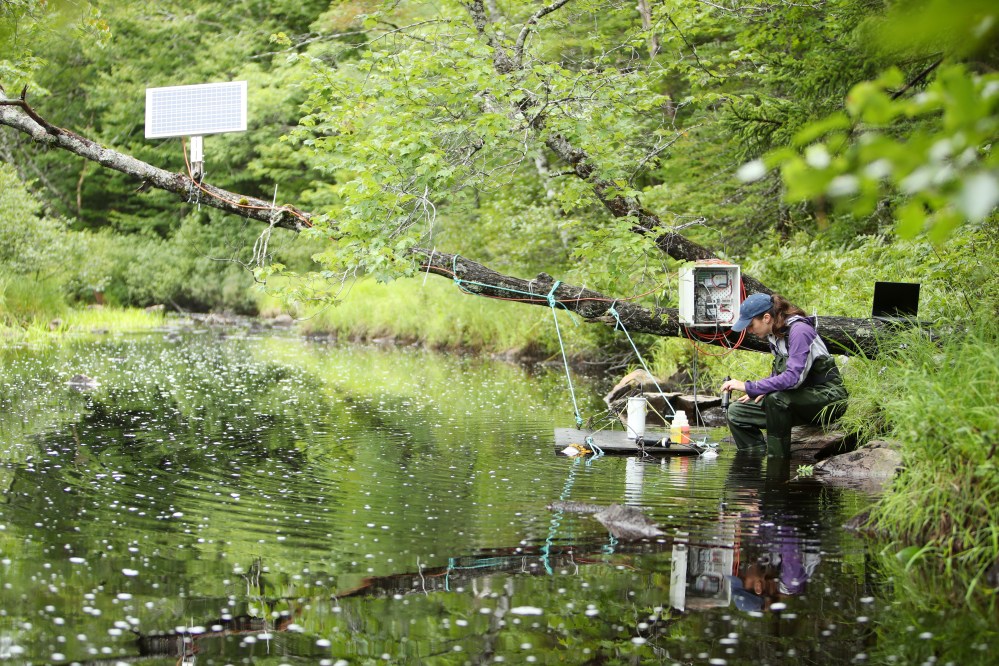
While liming a river is relatively simple, the water’s acidity and temperature must be continually monitored. The crushed limestone would be added as needed to keep those levels steady, rather than applied only once.
It’s fitting that a project with global implications would involve partners from across the world. Sterling’s team is based in Nova Scotia, but for this project, they worked at the Kvina River in southern Norway. Sterling says there are connections between the scientific communities of Nova Scotia and Norway because of shared work combating acid rain.
A Norwegian scientist was working on the Kvina River, trying to restore the salmon population, but having trouble funding the project. That’s when Sterling stepped in, tweaking the project’s focus to carbon storage and attracting commitments from buyers interested in the eventual carbon credits, opening up a new funding stream.
Isometric issued 76 carbon credits to CarbonRun for the company’s three-month trial period on the Kvina River. Altogether, CarbonRun is expected to remove roughly 55,000 tonnes of carbon dioxide from the atmosphere between 2025 and 2029. As the project scales up, Sterling says, more carbon credits will be issued and sold.
The project is exciting for Isometric, and not just because it’s the first of its kind. “It’s the co-benefit that you get for spawning salmon grounds and supporting river health,” said Stacy Kauk, chief science officer at Isometric.
“We’re solving two problems with one project, which is incredibly important when there are scarce resources today.”
Carbon capture is one piece of the puzzle when it comes to climate. But, as Kauk says, reducing the carbon emissions put out in the first place is always the primary goal. She says Isometric works with several companies on reducing their emissions, and looking to offset their carbon footprint in the meantime.
“These credits are being purchased to have the ability to influence climate without having to wait,” Kauk said. Isometric has sold carbon credits to companies like Shopify, JPMorganChase and Autodesk.
Measuring carbon capture in water is different, and in some ways simpler, than measuring carbon captured in soil. Accurately measuring carbon in soil comes with complications because soil is made up of so many different bits and pieces of plants, crushed bedrock and animal matter. “It’s inconsistent, and over the years it’s been tilled and had additives and all kinds of things happening to it,” Kauk said.
It’s hard to get consistency with soil, Sterling says. “You can take a sample, but it’s hard to know if it’s going to be (the same) two feet away.”
Rivers, on the other hand, are generally more consistent.
“A sample in one point will represent the river conditions there, and then what we do is … monitor downstream at several sites and track the carbon in real time,” Sterling said.
“The goal by 2030 is to have this technology fairly well understood so that … if we do need to scale up even more, it’s ready,” Sterling said.
This report by The Canadian Press was first published Feb. 12, 2026.