Alberta, Ottawa reach ‘agreement-in-principle’ on methane emissions
Advertisement
Read this article for free:
or
Already have an account? Log in here »
To continue reading, please subscribe:

Digital Subscription
One year of digital access for only $205*
- Enjoy unlimited reading on winnipegfreepress.com
- Read the E-Edition, our digital replica newspaper
- Access News Break, our award-winning app
- Play interactive puzzles
*First annual payment billed as $205.00 + GST for one year. This annual subscription will automatically renew at $233.00 + GST every 52 weeks (10% off the regular annual price of $259.35). Offer available to new and qualified returning subscribers only. Cancel any time.
To continue reading, please subscribe:
Add Free Press access to your Brandon Sun subscription for only an additional
$1 for the first 4 weeks*
- Enjoy unlimited reading on winnipegfreepress.com
- Read the E-Edition, our digital replica newspaper
- Access News Break, our award-winning app
- Play interactive puzzles
*Your next Brandon Sun subscription payment will increase by $1.00 and you will be charged $17.95 plus GST for four weeks. After four weeks, your payment will increase to $24.95 plus GST every four weeks.
Read unlimited articles for free today:
or
Already have an account? Log in here »
Hey there, time traveller!
This article was published 25/03/2026 (189 days ago), so information in it may no longer be current.
CALGARY – Alberta and Ottawa have reached an “agreement-in-principle” that puts the province in control of regulating its methane emissions, with final rules expected by the end of this year.
The federal and provincial governments inked a sweeping accord in November touching on several energy policy matters, including a plan to reach a methane equivalency agreement on or before April 1 aimed at eliminating the overlap between federal and provincial rules.
“Canada is strongest when we work together,” Prime Minister Mark Carney said in a news release Wednesday.
“By partnering with Alberta on a methane equivalency agreement, we will cut emissions while ensuring we protect Canadian jobs and build a more competitive and resilient energy sector.”
The two governments are to release a draft equivalency agreement later this year, which will be open for consultation for 60 days and finalized by year-end. The agreement says it is to take effect no later than Jan. 1, 2027 and last for 10 years.
The Alberta government says without an equivalency agreement, both federal and provincial rules would apply, increasing costs and creating duplication. Federal methane regulations would be stood down in Alberta, with equivalent provincial regulations in place, the agreement in principle says.
“Albertans have long known that responsible energy development and strong environmental performance go hand in hand,” said Premier Danielle Smith in a release.
“This agreement reflects that approach, keeps decision-making here in Alberta and builds on a system that is already delivering results.”
November’s MOU set out a goal of cutting emissions of the potent greenhouse gas by 75 per cent from 2014 levels by 2035. That’s five years later than earlier federal draft regulations had called for. At the time, that change drew dismay from environmental groups and qualified applause from the energy sector.
Methane is a greenhouse gas more than 80 times stronger than carbon dioxide over a 20-year span, but its lifetime in the atmosphere is up to a dozen years versus centuries for CO2. So targeting methane is often considered low-hanging fruit for near-term emissions reduction efforts.
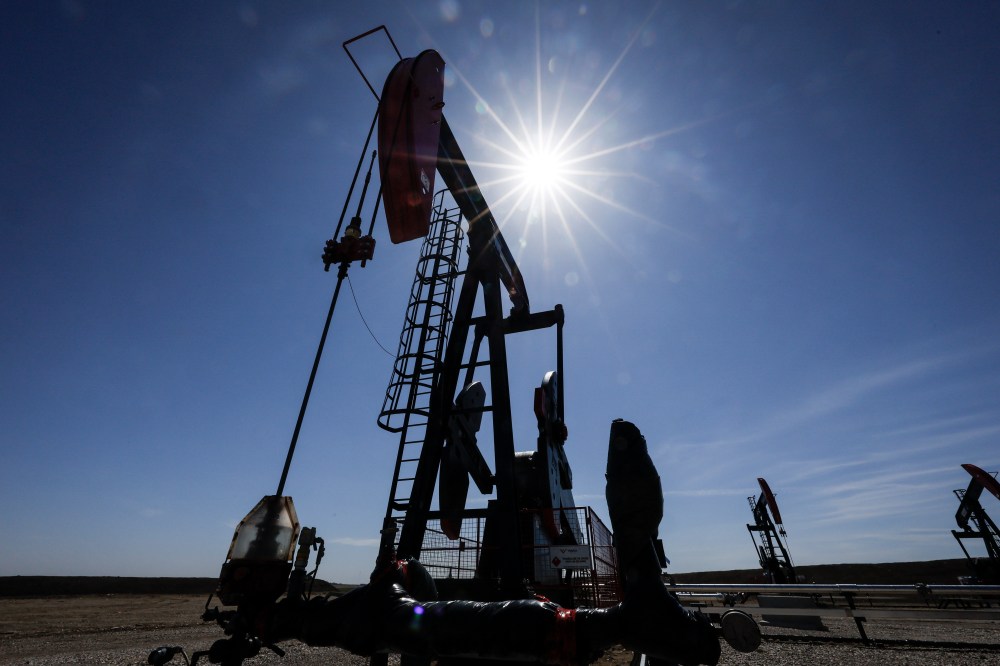
The oil and gas sector is Canada’s biggest emitter of methane, the main component of natural gas. The gas can escape into the atmosphere through intentional venting, unintentional leaks from equipment and through inefficient burning.
Pembina Institute, a clean energy think-tank, said the agreement gives industry more confidence to invest in methane mitigation work.
Amanda Bryant, manager of the institute’s oil and gas program, said it was also encouraging to see the agreement call for an independent third party to assess methane reduction results.
“We are pleased to see that this agreement-in-principle acknowledges that the self-reported industry estimates used by Alberta in the past are no longer adequate on their own,” she said in a release.
“Measurement studies have shown that Alberta’s methane emissions are almost twice as much as these estimates suggest.”
Conservative Opposition House leader Andrew Scheer said on social media that the methane agreement does nothing to address “anti-energy policies” introduced by the Liberal government in the past, like the West Coast tanker ban and environmental review legislation.
Three other items in the MOU came with an April 1 target. One was a co-operation agreement on streamlined project reviews, and the two governments announced an agreement-in-principle on that earlier this month. Still outstanding are deals around industrial carbon pricing and the massive Pathways carbon capture and storage proposal to be built in tandem with a new oilsands pipeline to the B.C. coast.
“We’re at a point now where the prime minister and I need to get together to just iron out our understanding of a couple of details around (carbon) pricing and stringency,” Smith said during an unrelated news conference on Wednesday.
“And I have impressed upon the prime minister that we’ve gotta do it for April 1st. It would be a great birthday present for me, and it won’t be a joke when we issue the release on that.”
This report by The Canadian Press was first published March 25, 2026.
— with files from Jack Farrell in Edmonton.