Enbridge’s plan to fund policing costs of pipeline reroute in U.S. raises concerns
Advertisement
Read this article for free:
or
Already have an account? Log in here »
To continue reading, please subscribe:

Digital Subscription
One year of digital access for only $205*
- Enjoy unlimited reading on winnipegfreepress.com
- Read the E-Edition, our digital replica newspaper
- Access News Break, our award-winning app
- Play interactive puzzles
*First annual payment billed as $205.00 + GST for one year. This annual subscription will automatically renew at $233.00 + GST every 52 weeks (10% off the regular annual price of $259.35). Offer available to new and qualified returning subscribers only. Cancel any time.
To continue reading, please subscribe:
Add Free Press access to your Brandon Sun subscription for only an additional
$1 for the first 4 weeks*
- Enjoy unlimited reading on winnipegfreepress.com
- Read the E-Edition, our digital replica newspaper
- Access News Break, our award-winning app
- Play interactive puzzles
*Your next Brandon Sun subscription payment will increase by $1.00 and you will be charged $17.95 plus GST for four weeks. After four weeks, your payment will increase to $24.95 plus GST every four weeks.
Read unlimited articles for free today:
or
Already have an account? Log in here »
Hey there, time traveller!
This article was published 26/03/2026 (193 days ago), so information in it may no longer be current.
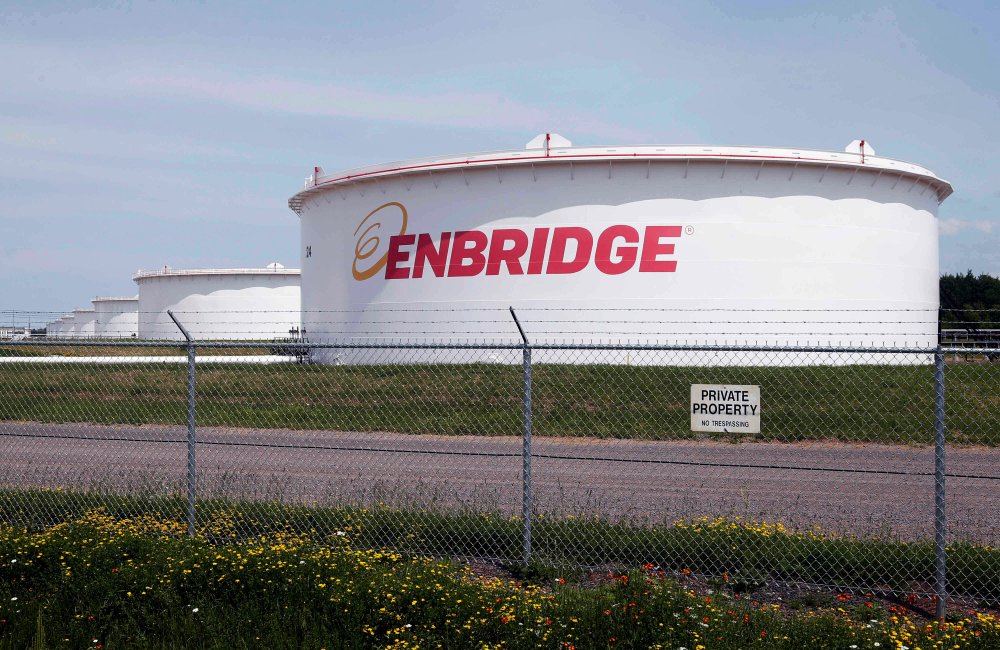
Enbridge has agreed to funnel money to U.S. law enforcement in anticipation of protests against its Line 5 pipeline reroute project, a move that has raised concerns about the depth of the company’s influence in policing issues.
The Calgary-based company says it volunteered the public safety fund to help governments in Wisconsin cover the extra costs related to the rerouting of the pipeline opposed by Indigenous communities.
The proposed deal has alarmed some local residents and observers in Canada who say it smacks of a conflict of interest and fear it could incentivize police to act as the company’s hired security.
“It’s hard to think that there’s not some kind of transactional benefit to paying the bills,” said Jeffrey Monaghan, a Carleton University sociologist who’s written extensively on the policing of protests.
Monaghan said while resource companies cultivate close relationships with police in Canada as a way to advance their projects or quell protests, this type of deal would likely be received poorly north of the border. That said, Canada has been influenced by U.S. criminal justice policy before, he says.
“I think it certainly could migrate up. I really hope it doesn’t,” he said.
Line 5, a conduit for much of Ontario and Quebec’s crude oil, moves around 540,000 barrels per day of western Canadian oil and natural gas liquids across the Great Lakes and the U.S.-Canada border to Sarnia, Ont.
Enbridge faced a court-ordered relocation of the pipeline in Wisconsin after it was found to have been trespassing on the land of a tribal nation that opposed the project over fears of an oil spill. The company began work last month on the US$450-million reroute of the pipeline around the reservation. The community opposes the project and says it threatens the watershed.
In anticipation of protests, Enbridge worked with local officials in Wisconsin on a deal to reimburse law enforcement for costs incurred to police the pipeline.
Law enforcement would be able to seek compensation for, among other things, daily patrols and crowd control at Enbridge’s construction sites, according to the deal’s draft text. Guns, vehicles and bulletproof vests are off limits, though police body armour could be reimbursable if it’s used at a protest, the deal suggests.
What police eventually seek reimbursement for is to be kept “highly confidential,” says the draft deal reviewed by local officials.
Enbridge will pay into a public safety escrow fund managed by the Wisconsin Counties Association, which represents the state’s local governments. A lawyer for the association told local officials there would be no time limit and no cap on how much Enbridge may contribute, suggesting the fund would contain millions of dollars. Local officials file reimbursement requests to a former Wisconsin county sheriff, appointed to review and decide the claims.
Officials in Ashland County, Wis., who backed the proposed deal in a narrow 10-7 vote at a meeting last month, suggested their already-constrained budget could buckle under expected policing costs. The same deal was offered to other Wisconsin counties along the pipeline route. One agreed, and another turned it down.
About a dozen residents spoke against it at the Ashland County meeting. They argued it would, in effect, turn their local sheriff’s office into Enbridge’s private security and provide a financial incentive to excessively police the pipeline project.
A lawyer for the association said the deal provides no guarantee of minimum service, which is up to sheriffs to decide.
“Like with any large-scale event, there is a cost for providing public safety and emergency response services,” Enbridge spokesperson Juli Kellner said in an email.
“Enbridge does not believe local communities and taxpayers should be saddled with these extra costs associated with Line 5 construction and offered a constructive solution.”
The pipeline cuts through the territory of the Bad River Band of Lake Superior Chippewa, a tribal nation that refused to renew the company’s right-of-way in 2013 over fears of an oil spill. Spring flooding has washed away large parts of the riverbank where Line 5 intersects with the Bad River, the watercourse through Indigenous territory that feeds Lake Superior and a complex network of ecologically sensitive wetlands.
At the same time, Indigenous communities have joined Michigan in fighting Enbridge’s plan to build a tunnel under the Straits of Mackinac, the passage between Lake Michigan and Lake Huron where the pipeline runs underwater between the state’s upper and lower peninsulas.
Ottawa argues the pipeline is an economic lifeline for Alberta, Saskatchewan, Ontario and Quebec, and has invoked a 1977 pipelines treaty ensuring the uninterrupted flow of oil and gas in transit between Canada and the United States. The Trump administration strongly supports the tunnel project and has worked to expedite it.
Enbridge has made similar deals in the past to reimburse U.S. law enforcement in anticipation of pipeline protests. The company provided millions to Minnesota agencies for costs related to a Line 3 expansion project between December 2020 and September 2021, according to multiple media reports. Hundreds of protesters were arrested.

Eriel Tchekwie Deranger, a member of the Athabasca Chipewyan First Nation near Alberta’s oilsands, said the Wisconsin deal suggests oil and gas companies are emboldened to openly flout democratic principles and suppress Indigenous resistance.
This crackdown, she said, targets Indigenous rights and values — from free, prior and informed consent to kinship with the natural world — precisely because they pose an alternative to fossil fuel extraction during a climate change crisis and widespread species die-offs.
“We’re already seeing the largest mass extinction that Earth has seen in millions of years, and so we have this cognitive dissonance to make the subject about eroding of democracy, or just about oil and gas or just about the climate crisis, when all of those things are interconnected,” said Deranger, the president of the Indigenous Climate Action organization.
“Indigenous Peoples are trying to say, ‘Hey, like, we have an alternative to these systems … but those alternatives really require us to reimagine what we centre in the system. Is it political-economic power, or is it kinship?'”
This report by The Canadian Press was first published March 26, 2026.