Poilievre: Carney should state what ‘leverage’ Canada has in trade talks

Advertisement

Advertise with us

TORONTO - Prime Minister Mark Carney should spell out to Canadians what leverage the country has over the United States in coming trade negotiations, Conservative Leader Pierre Poilievre asserted on Sunday.

Read this article for free:


or

Already have an account? Log in here »

To continue reading, please subscribe:

Subscribe and receive a limited-edition Free Press branded hat or tote.

Digital Subscription

One year of digital access for only $205*

  • Enjoy unlimited reading on winnipegfreepress.com
  • Read the E-Edition, our digital replica newspaper
  • Access News Break, our award-winning app
  • Play interactive puzzles

*First annual payment billed as $205.00 + GST for one year. This annual subscription will automatically renew at $233.00 + GST every 52 weeks (10% off the regular annual price of $259.35). Offer available to new and qualified returning subscribers only. Cancel any time.

To continue reading, please subscribe:

Add Free Press access to your Brandon Sun subscription for only an additional

$1 for the first 4 weeks*

  • Enjoy unlimited reading on winnipegfreepress.com
  • Read the E-Edition, our digital replica newspaper
  • Access News Break, our award-winning app
  • Play interactive puzzles
Start now

*Your next Brandon Sun subscription payment will increase by $1.00 and you will be charged $17.95 plus GST for four weeks. After four weeks, your payment will increase to $24.95 plus GST every four weeks.

TORONTO – Prime Minister Mark Carney should spell out to Canadians what leverage the country has over the United States in coming trade negotiations, Conservative Leader Pierre Poilievre asserted on Sunday.

That comes after Carney rejected characterizing energy and critical minerals as “leverage” in talks to renew the Canada-United States-Mexico Agreement, also known as CUSMA.

Poilievre said Carney should explain how he intends to secure an end to sectoral tariffs and a renewal of the free-trade pact.
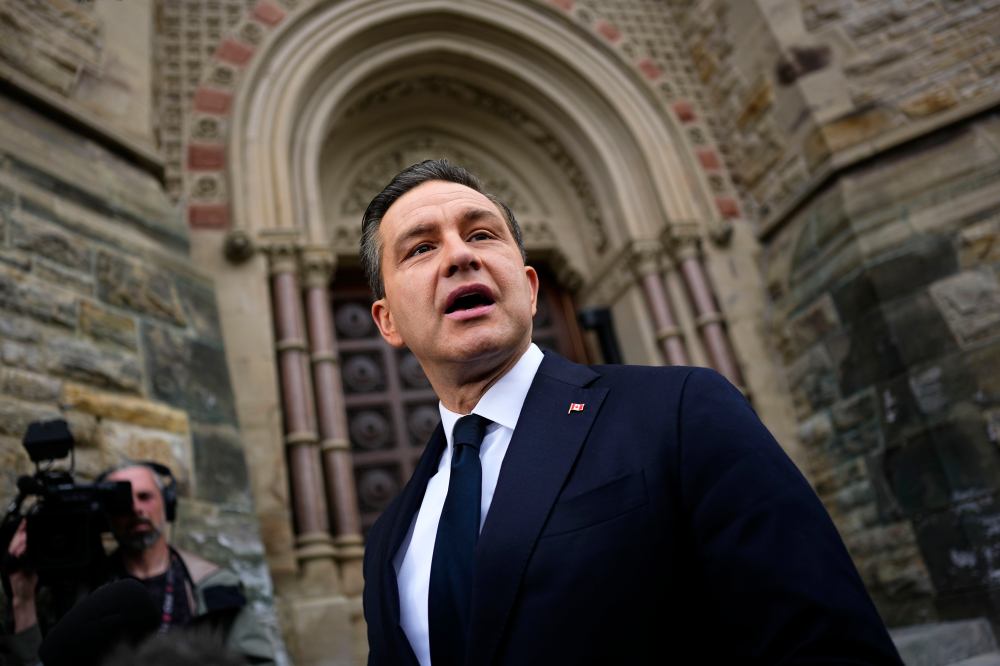
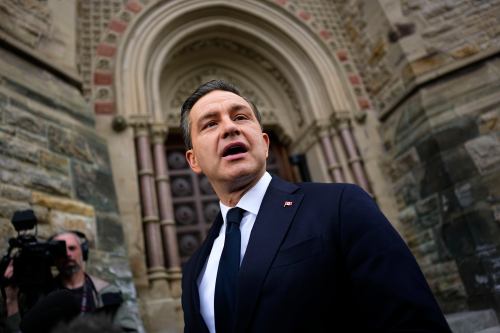
File photo -- Conservative Leader Pierre Poilievre participates in a media availability outside West Block on Parliament Hill in Ottawa, on Wednesday, April 29, 2026. THE CANADIAN PRESS/Justin Tang

“If energy and minerals are not going to be leveraged for Canada in these negotiations, what leverage does Mr. Carney claim to have?” Poilievre said while speaking with reporters at a press conference in Toronto.

“He can’t tell us what leverage we have, what demands he’s making, what tariffs he wants to get removed, and when and if he will even get a deal at all.”

Carney said in an interview with The Canadian Press on Friday that he simply views these sectors as future trade opportunities with the United States — or with other trading partners.

“Reclassifying that as leverage, I’m not sure that’s the way I look at that. I look it as trade,” Carney said. “It’s looking at, is it in our mutual interest to trade more? Where is it? And if it’s not there, we have other options.”

The prime minister said Canada is not about to halt any such trade with the U.S., but suggested further integration in those sectors remains up in the air amid the ongoing trade war.

“Should we be further integrating our energy markets with the United States at a time they view that as, quote, ‘leverage’?” Carney said.

United States Trade Representative Jamieson Greer cautioned a group of Canadian politicians in Washington on Wednesday that Ottawa shouldn’t try to use energy as leverage in the trade talks.

Sources who attended that meeting told The Canadian Press Greer said greater collaboration on energy shouldn’t come with the condition of U.S. concessions. Greer also said the Trump administration is not looking to disrupt the energy relationship between the two countries.

Natural Resources Minister Tim Hodgson said about a week ago that Canada’s energy and natural resources are “Canada’s strongest cards” in renegotiating the trade deal.

Poilievre said his strategy would be to “build up a massive strategic reserve of our energy and our minerals and use that as leverage to get tariff-free access to the United States economy.”

Negotiations between Canada and White House to remove American tariffs against Canada’s steel, aluminum, automotive and forestry sectors froze last fall. 

Talks stalled after Trump became angered by an Ontario advertising campaign that quoted former president Ronald Reagan criticizing tariffs.

The continental trade pact is meantime approaching a mandatory review, which is scheduled to start by this summer.

Greer has said the United States is unlikely to rubber-stamp the deal in July, suggesting longer negotiations are in store.

Last week, when Carney’s Canada-U.S. economic advisory council met for the first time, the federal government made clear it has no intentions of making any concessions before a broader negotiation on CUSMA renewal.

Carney said last month that America’s sectoral tariffs remain Canada’s greatest trade “irritant” to resolve.

The prime minister said in the Friday interview there normally would have been a broader discussion about a series of “technical” trade issues in the coming review.

He pointed to greater regulatory harmonization on “all aspects digital,” such as combating online harms, as one example.

“That’s not really on the table now,” Carney said.

The prime minister said Ottawa does desire greater integration and co-operation with the United States when it’s “absolutely recognized that it’s in both countries’ interests.”

But Canada must now be “careful, to a degree” on further integration in energy and other markets, as tariffs that violate the spirit of the agreement dig into key economic sectors.

“There’s a question about whether that alignment is still there,” Carney said. “Can we really rely, ultimately, on what’s written in the agreement, what’s in a dispute settlement mechanism? That’s a very different environment than was there previously.”

This report by The Canadian Press was first published May 3, 2026.

— With files from Kyle Duggan in Ottawa, Kathryn Mannie in Toronto and Kelly Geraldine Malone in Washington.

Report Error Submit a Tip

More Stories

New businesses start to creep up in former Winnipeg Slurpee shops

Tiago Resko 5 minute read Preview

New businesses start to creep up in former Winnipeg Slurpee shops

Tiago Resko 5 minute read Yesterday at 6:41 PM CDT

The remnants of 7-Eleven can still be seen as new businesses move into spaces where Slurpee machines and taquitos once ruled.

As fresh paint dries on several new ventures — such as a pizza place and a convenience store with a name that might make a customer do a double-take — holes across Winnipeg once occupied by the international convenience chain are slowly being filled.

Business at a Domino’s Pizza in Elmwood, formerly a 7-Eleven, has been booming since it opened June 1, the store manager said.

“The issues that 7-Eleven would have had might be different than what we would have. They were dealing with a lot of theft where people can just walk in and out, but Domino’s isn’t set up that way,” said Paul Hemmerling.

Read
Yesterday at 6:41 PM CDT

Letters, Aug. 28

7 minute read Preview

Letters, Aug. 28

7 minute read Updated: 8:10 AM CDT

It’s long past time for the City of Winnipeg to get its act together and provide the basic separated paths, infrastructure and, when necessary, properly marked detours — to keep everybody safe.

Read
Updated: 8:10 AM CDT

Treating symptoms, not the disease

Charles N. Bernstein 4 minute read 2:00 AM CDT

The backlog in emergency rooms in Manitoba stems from problems before and after the ER, not in the ER.

In Tom Brodbeck’s piece on the chronic and rising emergency room crisis in Winnipeg (Condition critical, Aug. 21) he quoted several experts who alluded to the backlog of accessible beds, beds needed so that acutely ill people can be moved out of the ER onto hospital wards.

This is a problem of an acute-care bed shortage in the acute-care hospitals and a long-term care bed shortage outside of the acute-care hospitals, where patients who no longer need acute care should be.

One major problem not addressed in Brodbeck’s article is the care required to reduce patients’ perceived or real need to come to the ER.

New Skyline: revolving restaurant to reopen atop Fort Garry Place

Aaron Epp 5 minute read Preview

New Skyline: revolving restaurant to reopen atop Fort Garry Place

Aaron Epp 5 minute read Wednesday, Aug. 26, 2026

Come fall, people will once again have the chance to dine more than two dozen storeys above Winnipeg’s downtown.

Alfonso Maury, former owner of Corrientes Argentine Pizzeria, is preparing to reopen the revolving restaurant on the 30th floor of Fort Garry Place. The venue, which has sat empty for the past six years, offers a panoramic view of the city.

Maury is aiming to open Dos Pampas Skyline Restaurant at the beginning of October. He plans to hire around 20 employees, who will prepare and serve an Argentinian-inspired menu he is currently putting together with head chef Norm Pastorin.

Dos Pampas will include seating for 120 customers, Maury said. Additionally, the restaurant will feature a lounge with couches and short tables where guests who have finished their meal but who aren’t ready to leave can enjoy dessert or another drink.

Read
Wednesday, Aug. 26, 2026

At the city’s busiest fire and paramedic hall, first responders face a relentless workload

Scott Billeck 24 minute read Preview

At the city’s busiest fire and paramedic hall, first responders face a relentless workload

Scott Billeck 24 minute read 6:00 AM CDT

As a soft rain begins to fall between the concrete walls of “Hope Alley,” little feels further away than the place’s namesake.

Winnipeg Fire Paramedic Service crews have been called to the narrow downtown passage, named by Al Wiebe, a formerly homeless man turned advocate. People regularly pass through here, moving between the shelters, drop-ins and resource centres clustered around Main Street between Logan and Higgins avenues.

Against a wall, as the sky switches into night mode, a man sits bleeding from his nose, seemingly unaware of how he ended up with blood running down his T-shirt.

His situation has already set Winnipeg’s emergency response network in motion.

Read
6:00 AM CDT

‘Last chance’ clearance U.S. booze punted from Liquor Marts

Carol Sanders 5 minute read Preview

‘Last chance’ clearance U.S. booze punted from Liquor Marts

Carol Sanders 5 minute read Updated: Yesterday at 7:51 PM CDT

American alcohol that returned to Manitoba Liquor Mart shelves in May as part of a “last chance” sale is headed back to storage or will be destroyed.

“We are removing U.S. liquor products from Liquor Mart shelves,” a spokesperson for Manitoba Liquor and Lotteries said Thursday. The Crown corporation had been pushing to off-load its stockpile of U.S. booze.

Premier Wab Kinew launched a provincewide boycott of American alcohol in March 2025 to fight back against tariffs imposed by U.S. President Donald Trump. Manitoba Liquor and Lotteries has not placed new orders since the boycott began, but it still had inventory.

As of early May, the U.S. inventory had a value of roughly $3.4 million, which is roughly one-third of what was removed from shelves and placed in storage, Manitoba Liquor and Lotteries has said. It was unable to provide an inventory update on Thursday.

Read
Updated: Yesterday at 7:51 PM CDT