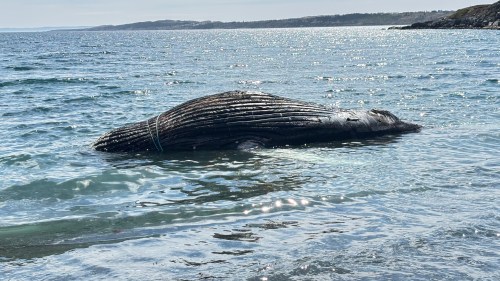
Dead humpback whale wrapped in rope washes ashore in eastern Newfoundland
Advertisement
Read this article for free:
or
Already have an account? Log in here »
To continue reading, please subscribe:

Digital Subscription
One year of digital access for only $205*
- Enjoy unlimited reading on winnipegfreepress.com
- Read the E-Edition, our digital replica newspaper
- Access News Break, our award-winning app
- Play interactive puzzles
*First annual payment billed as $205.00 + GST for one year. This annual subscription will automatically renew at $233.00 + GST every 52 weeks (10% off the regular annual price of $259.35). Offer available to new and qualified returning subscribers only. Cancel any time.
To continue reading, please subscribe:
Add Free Press access to your Brandon Sun subscription for only an additional
$1 for the first 4 weeks*
- Enjoy unlimited reading on winnipegfreepress.com
- Read the E-Edition, our digital replica newspaper
- Access News Break, our award-winning app
- Play interactive puzzles
*Your next Brandon Sun subscription payment will increase by $1.00 and you will be charged $17.95 plus GST for four weeks. After four weeks, your payment will increase to $24.95 plus GST every four weeks.
Read unlimited articles for free today:
or
Already have an account? Log in here »
ST. JOHN’S – An eastern Newfoundland town is figuring out what to do with a humpback whale carcass that washed up on a beach entangled in rope.
Tammy Oliver is the mayor of Spaniard’s Bay, a community of about 2,600 people about 40 kilometres west of St. John’s, across Conception Bay. She said the animal was not yet a full-grown adult, and it has rope wrapped around its mouth and tail.
The carcass is just steps away from homes, a school and the town’s recreation centre, Oliver said in an interview Friday.
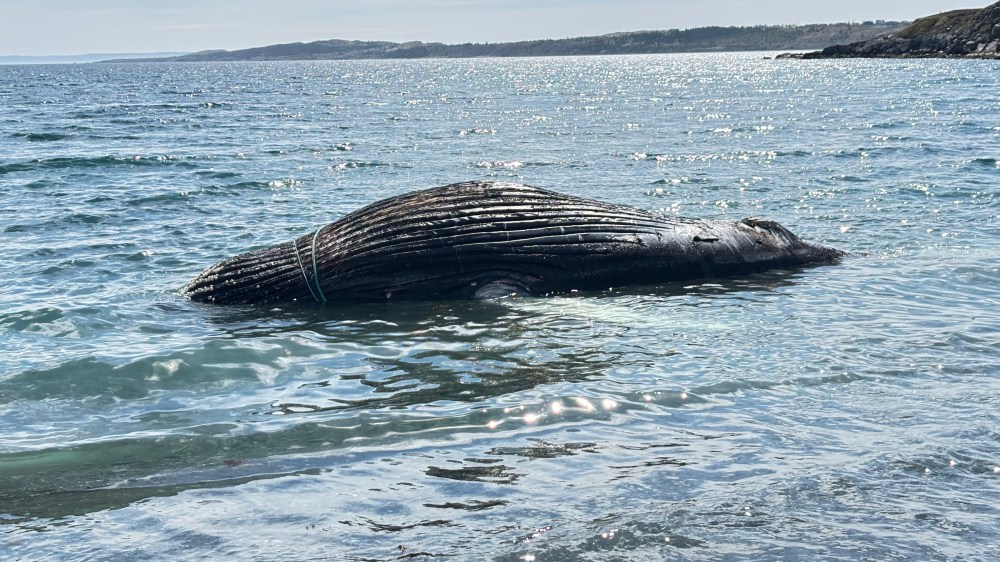
“There’s going to be quite a smell when it starts to decay,” she said. “There are a lot of homes directly impacted by that beach … we don’t want the rotten smell.”
Oliver and her team have been in touch with the federal and provincial governments for help. But ultimately, the responsibility for removal will fall on the town’s shoulders, she said.
Humpback whales are common in Newfoundland and Labrador waters, especially in the warmer months as they feast on krill and small fish. They often dazzle residents and tourists alike by leaping out of the water or slapping its surface with their fins and tails.
The whale carcass in Spaniard’s Bay was first spotted floating in the harbour on Thursday morning, said resident Mark Hayward in a Facebook message to The Canadian Press. The wind picked up throughout the day and blew the animal to shore.
Hayward figured it was about 12 metres long, though he said it was difficult to get a good estimate. Adult humpbacks can grow to be about 18 metres long, and weigh 36 tonnes — roughly the equivalent of 18 cars.
Fisheries and Oceans Canada said late Thursday that its staff would visit the site to gather more information. While whale entanglements in fishing gear are not uncommon, a spokesperson said officials can typically determine the type of equipment involved only after the rope is removed.
In the meantime, the town of Spaniard’s Bay is weighing its options, with guidance from provincial and federal officials.
A fisherman may be able to tow the whale out and sink it, though it wasn’t quite clear how to ensure the carcass stayed on the ocean floor, Oliver said. A floating whale carcass would be a hazard to other boats.
A skipper could also bring the animal to an uninhabited cove where it could decompose naturally, she said.
But if it seems the carcass will fall apart, it may have to be cut up, sealed tight and shipped to a landfill, Oliver said. That could cost tens of thousands of dollars.
“I’m hoping that (government officers) will give us some explanation and guide us through what needs to be done,” she said. “It’s unfortunate, but as a community, you deal with what you’re dealt, and you do the best you can.”
This report by The Canadian Press was first published June 12, 2026.