Climate change made Ontario, N.W.T. fire conditions roughly twice as likely: report

Advertisement

Advertise with us

The conditions underlying intense July wildfires in Ontario and Northwest Territories were made roughly twice as likely due to human-induced climate change, said a new report published Thursday. 

Read this article for free:


or

Already have an account? Log in here »

To continue reading, please subscribe:

Subscribe and receive a limited-edition Free Press branded hat or tote.

Digital Subscription

One year of digital access for only $205*

  • Enjoy unlimited reading on winnipegfreepress.com
  • Read the E-Edition, our digital replica newspaper
  • Access News Break, our award-winning app
  • Play interactive puzzles

*First annual payment billed as $205.00 + GST for one year. This annual subscription will automatically renew at $233.00 + GST every 52 weeks (10% off the regular annual price of $259.35). Offer available to new and qualified returning subscribers only. Cancel any time.

To continue reading, please subscribe:

Add Free Press access to your Brandon Sun subscription for only an additional

$1 for the first 4 weeks*

  • Enjoy unlimited reading on winnipegfreepress.com
  • Read the E-Edition, our digital replica newspaper
  • Access News Break, our award-winning app
  • Play interactive puzzles
Start now

*Your next Brandon Sun subscription payment will increase by $1.00 and you will be charged $17.95 plus GST for four weeks. After four weeks, your payment will increase to $24.95 plus GST every four weeks.

The conditions underlying intense July wildfires in Ontario and Northwest Territories were made roughly twice as likely due to human-induced climate change, said a new report published Thursday. 

The report by an international team of scientists says what were once rare fire conditions are now increasingly likely today due to climate change, driven by the burning of fossil fuels. 

“The geographic spread of these fires is scary and shows that despite preparedness from wildfire governance, adaptation alone is not enough,” said Theodore Keeping, a co-author and Imperial College London research associate.
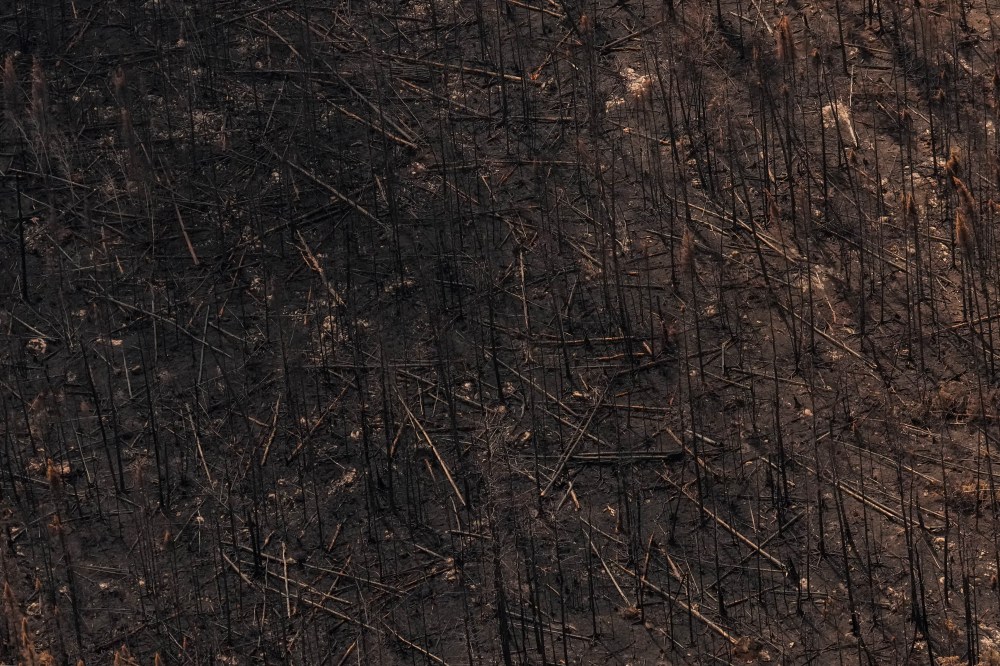
Wildfire damage is pictured from the air in the immediate area surrounding Collins First Nation, a small, remote Ojibwa community located in northwestern Ontario, about 250 km north of Thunder Bay, Ont., on Wednesday, July 22, 2026. THE CANADIAN PRESS/Chris Young

“We need to rapidly move away from fossil fuels to avoid events like this becoming even more of a reality.”

The World Weather Attribution report says early observations indicate the hot, dry and windy conditions fuelling fires in Northwest Territories could now be expected to occur every two to six years, and every six to 15 years in Ontario. 

In a world without human-caused climate change, the report suggests those conditions would have been much rarer, or less than once in 40 years. 

Early estimates suggest this is the worst wildfire season on record in Ontario and in Northwest Territories’ top 10, as measured by area burned. 

The study garnered the attention of the United Nations climate chief, who said the science backed up “what the people on the front lines already know.” 

“Humanity’s addiction to burning massive amounts of coal, oil and gas is heating our planet, turning more of Canada’s vast forests into tinderboxes, and spreading dangerous smoke far beyond the flames,” said Simon Stiell, the UN Climate Change Executive Secretary. 

The vast majority of Ontario’s wildfires burned during a few intense days in July, on the back of a scorching heat wave and intense lightning activity along a roughly 500-kilometre storm front over the province’s northern boreal forest. 

Thousands of evacuees from more than a dozen mostly First Nations communities fled their homes while noxious plumes of smoke deteriorated air quality for millions of people from Thunder Bay to the northeastern United States. 

Extreme fire weather has been more sustained in Northwest Territories, where fires have remained active and spread over a long period rather than being driven by a single week of explosive growth. 

Thursday’s report, whose co-authors included several scientists across the federal public service, highlighted the disproportionate impact of the wildfire season on First Nations and the importance of including those communities in risk assessments and preparedness plans.

Chief Russell Wesley of the Cat Lake First Nation in northwestern Ontario, one of evacuated communities, said this year’s fires were a “warning” that the province and Ottawa’s current approach is insufficient. 

In a news release, Wesley called for action on 11 priorities, including the creation of a First Nations wildfire authority and the expansion of Indigenous fire stewardship programs. Indigenous burning practices, the setting of small, low-intensity fires guided by traditional knowledge, were excluded for decades by governments but have been shown to boost diverse, fire-resistant landscapes and clear the forest of dead debris that could otherwise help fuel more intense flames.

“Maintaining healthy forests is not only an environmental responsibility; it is essential to our survival as First Nations peoples,” said Wesley. 

“Without healthy forests, our communities, cultures and future generations are at risk.” 

To come up with the results in Thursday’s report, scientists used observations and climate models focusing on the seven-day and 30-day periods of most extreme fire weather in Ontario and Northwest Territories. They then compared those conditions against what would have been expected in a world without fossil fuel emissions.

For both periods in Ontario, those conditions were made about twice as likely due to climate change, the report found. In N.W.T., the likelihood of the most intense seven-day period was five-hold, while the 30-day period was double. 

Adapting to a future with more intense wildfires could include supporting more fire-resistant tree species, strengthening early warning systems and steering new development away from high-risk areas, the report says.

But adaptation can only go so far. Fire is a natural part of the boreal ecosystem, but as climate change fuels more frequent, larger and more intense blazes, forest management becomes less effective and fires become harder to control, the report says. 

Canada has seen three consecutive intense fire seasons, going back to the record-breaking 2023 season. The same group behind Thursday’s report published a similar analysis of Quebec’s season that year, finding it was made seven times more likely due to climate change. 

“This time, we studied Canada, for the second time in three years. Less than a week ago, we looked at France and Spain. A few months ago, we were looking at Chile and Argentina,” said co-author Friederike Otto, climate science professor at Imperial College London and co-founder of World Weather Attribution. 

“What is going to be next?”

This report by The Canadian Press was first published Aug. 6, 2026. 

Report Error Submit a Tip

More Stories

Six high school hockey programs ceased operations following new Hockey Manitoba policy

Joshua Frey-Sam 7 minute read Preview

Six high school hockey programs ceased operations following new Hockey Manitoba policy

Joshua Frey-Sam 7 minute read Friday, Oct. 2, 2026

She lived the best of both worlds.

For the last three years, the 17-year-old wore a sweater for two different hockey programs — her high school team and AAA club in the Manitoba Female Hockey League — and was preparing to flourish in both colours again this winter.

Recently, however, the blue-liner was disappointed to learn she is no longer eligible to play her Grade 12 season with her school owing to a new policy imposed by Hockey Manitoba that bans players from participating in the Manitoba Women’s High School Hockey League if they are rostered on a U18 AAA team.

The rule applies to all athletes who play for both Winnipeg-based and rural AAA teams.

Read
Friday, Oct. 2, 2026

Letters, Oct. 3

7 minute read Yesterday at 2:01 AM CDT

A morning in the life …

My very first lesson does not start when I walk into that lecture hall, oh no — it starts long before. It begins when I walk to my car, check the estimated arrival time to the University of Manitoba and hope that Winnipeg traffic agrees with it.

A drive that appears completely manageable changes almost immediately when I’m greeted by a tsunami of orange pylons and a line of cars that appears to go on forever. Traffic moves by the inch, lanes magically disappear and the detour I took yesterday now has a detour of its own. These factors make me do a calculation that I have become all too familiar with. How late can I arrive and still find parking, run to my class across campus and get to class with enough time left to make it worth it?

I have grown used to people saying, “Why not just leave earlier?” I do. But when I’m already leaving for my 8:30 a.m. class at 7 a.m., there’s only so much I can do. This drive that some would think is relaxing is one that feels like an assignment that I didn’t know I had to complete and is due at 8:30 a.m.

Gordon Bell rings in a century

Maggie Macintosh 13 minute read Preview

Gordon Bell rings in a century

Maggie Macintosh 13 minute read Friday, Oct. 2, 2026

Mischka Valencia had gotten used to the hum of heavy machinery at Gordon Bell High School.

“Ever since I’ve been here, it’s all been under construction,” the Grade 12 student said, standing on the sidelines of the brightly painted revamped outdoor basketball court. “I had no idea this was a court.”

The Filipina teenager landed in Winnipeg several months after the inner-city campus had transformed into a construction site.

It was the fall of 2023 and Mischka’s priorities were fitting in, befriending classmates and learning a third language via first-period French.

Read
Friday, Oct. 2, 2026

Khan should’ve taken high road: Goertzen

Carol Sanders 5 minute read Preview

Khan should’ve taken high road: Goertzen

Carol Sanders 5 minute read Friday, Oct. 2, 2026

The veteran Progressive Conservative who championed Obby Khan’s leadership bid says the former Blue Bomber dropped the ball by dissing his Tory teammates before he stepped down.

“I wouldn’t recommend it, and I didn’t recommend it,” Kelvin Goertzen (Steinbach) said in an interview Friday.

Khan resigned as PC leader and quit the caucus Monday saying some members were secretly plotting his ouster, even after he won a confidence vote on Sept. 25.

On Tuesday, Khan lashed out in a CJOB interview, naming the alleged plotters, saying constituents deserved to know which of their elected representatives “lacked moral integrity.” Khan told the Free Press he was “deeply emotionally hurt,” and felt stabbed in the back.

Read
Friday, Oct. 2, 2026

Brandonmeat packer thriving on its own

Abiola Odutola 3 minute read Preview

Brandonmeat packer thriving on its own

Abiola Odutola 3 minute read Yesterday at 2:01 AM CDT

BRANDON — Canada Packers has strengthened its business and laid the foundation for future growth during its first year as an independent company, its president says.

The Brandon-based pork producer, separated from Maple Leaf Foods in October 2025, established its own leadership, strategy, systems, culture and identity while continuing operations across its hog production farms and regional hog barns in southern and eastern Manitoba.

The company’s first year was focused on building a successful standalone business while continuing to serve customers, communities and shareholders, president Dennis Organ said.

“Market conditions over the past year have been more challenging than we anticipated when we became a separate entity,” he said in an email. “Despite that, we continued to execute against our priorities, including increasing processing volumes, maintaining disciplined operations and strengthening the business.”

Read
Yesterday at 2:01 AM CDT

Mayoral candidate Vogiatzakis criticized for living outside Winnipeg

Malak Abas 4 minute read Preview

Mayoral candidate Vogiatzakis criticized for living outside Winnipeg

Malak Abas 4 minute read Friday, Oct. 2, 2026

A mayoral hopeful took heat from other candidates Friday for living outside Winnipeg while running in the civic election.

Mike Vogiatzakis’s primary residence is in the Rural Municipality of St. Andrews, about 25 kilometres north of Winnipeg — a community with its own mayor and councillors.

But the funeral director said he owns a home in Winnipeg where he divides his time, and he would move to the city full-time if elected mayor.

“It doesn’t matter where a person lives. Why are we dividing St. Andrews and Manitoba and Winnipeg? I’ve met the criteria to run for mayor,” Vogiatzakis said Friday morning.

Read
Friday, Oct. 2, 2026