Traditional plastic forks shed harmful microplastics. Plastic created from sugar is an alternative
Advertisement
Read this article for free:
or
Already have an account? Log in here »
To continue reading, please subscribe:

Digital Subscription
One year of digital access for only $205*
- Enjoy unlimited reading on winnipegfreepress.com
- Read the E-Edition, our digital replica newspaper
- Access News Break, our award-winning app
- Play interactive puzzles
*First annual payment billed as $205.00 + GST for one year. This annual subscription will automatically renew at $233.00 + GST every 52 weeks (10% off the regular annual price of $259.35). Offer available to new and qualified returning subscribers only. Cancel any time.
To continue reading, please subscribe:
Add Free Press access to your Brandon Sun subscription for only an additional
$1 for the first 4 weeks*
- Enjoy unlimited reading on winnipegfreepress.com
- Read the E-Edition, our digital replica newspaper
- Access News Break, our award-winning app
- Play interactive puzzles
*Your next Brandon Sun subscription payment will increase by $1.00 and you will be charged $17.95 plus GST for four weeks. After four weeks, your payment will increase to $24.95 plus GST every four weeks.
Read unlimited articles for free today:
or
Already have an account? Log in here »
WOBURN, Mass. (AP) — At a Massachusetts lab, pebble-sized pellets are transformed into forks and films that won’t leave persistent microplastics in the environment.
These are bioplastic pellets. CJ Biomaterials ferments sugar to make plant-based polymers that microbes will consume. These alternatives to traditional plastics made of fossil fuels are seen by some as one of many solutions needed to confront global plastic pollution.
At the company’s Woburn research facility, lab technicians recently poured pellets into a molding machine to make forks. The test forks were thin enough for home composting, though too bendy for stabbing a steak. Other batches have been rigid, similar to a typical plastic fork. The technicians melted pellets to roll out flexible films for food packaging, like a bag for baby carrots. The film was quite strong but not stretchy like cling wrap.
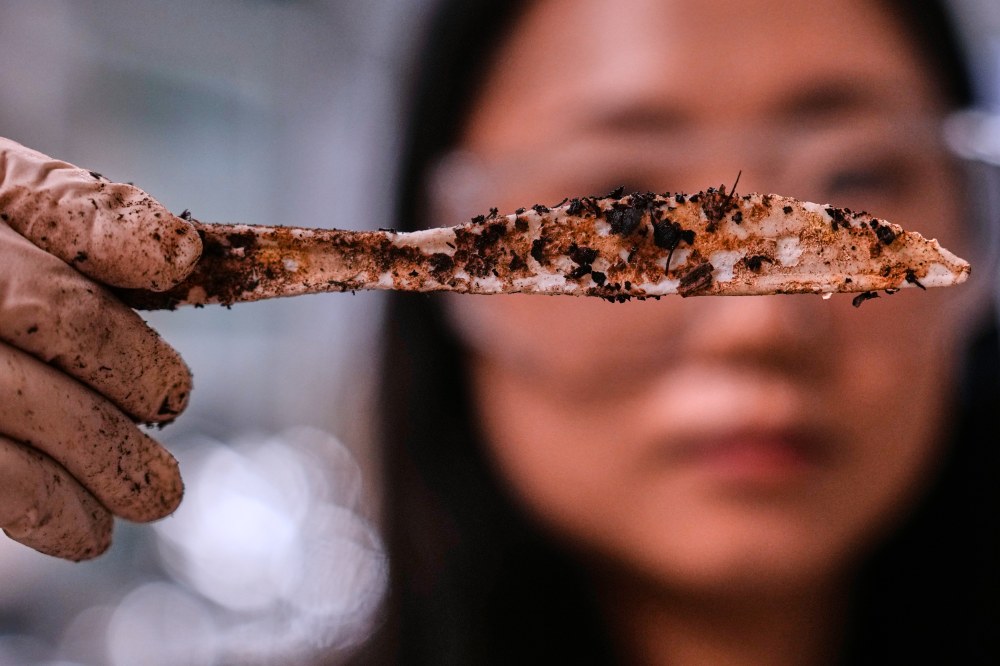
They are figuring out how their biopolymers can make products with attributes similar to conventional plastics, but that can go in a composting bin instead of a trash can. Forks and films are breaking down in the lab’s compost bin. Straws that were added are long gone. A recently tossed-in knife showed pitting on the surface as bacteria colonized it, starting to consume the material.
Plastics have never really fundamentally been disrupted. Now, interest in bioplastic is growing because of concern over microplastics. It’s the new “wild card” in this market, said the company’s marketing director Leah Ford.
“I’ve been doing this for a long time and the compostability has always been a really strong driver. But with the greater understanding of microplastics, I think, that’s going to change how people think about materials,” she said.
Traditional plastics last for decades or even centuries as they fragment into harmful microplastics and even smaller nanoplastics. Microplastics have been found in the ocean and the air, in our food and water, and in a wide range of body tissues. The Trump administration, while rolling back many environmental regulations, says it will address contamination from microplastics.
The most common use for bioplastics is packaging
Bioplastics are biobased, meaning they are made completely or partially from a renewable resource, commonly corn or sugar cane; or they are biodegradable, meaning that they break down completely via a natural process. They can also be both, like the polymers made by CJ Biomaterials. It’s a leader in manufacturing polyhydroxyalkanoates, or PHAs, as a polymer that is marine and soil biodegradable.
CJ Biomaterials is trying to replace conventional plastics that are single use or can’t be recycled when contaminated with food scraps. Food waste decomposing in landfills emits methane, a potent greenhouse gas that warms the planet. A container made of pellets from CJ Biomaterials with food scraps could be sent to a composter, unlike a traditional plastic container.
The Woburn lab’s shelves display the company’s successes: compostable cutlery; straws; coated cups for hot beverages and frozen food pouches used in the United States; sushi trays; ramen containers; and reusable paper towels. Lab employees dine with compostable cutlery, drink from compostable cups and make coffee with compostable pods. These products last on shelves because they are not exposed to microorganisms in water or soil.
CJ Biomaterials feeds sugar to microbes that convert it to PHA for energy. The company collects the PHA and turns it into granules. Pellets of this are then sold to other companies that can melt them down and mold them into products. These same bacteria will consume PHA in a compost pile, breaking it down within six months, Ford said.
CJ Biomaterials is part of the $32 billion South Korean conglomerate CJ Group. It has been producing PHA at a manufacturing facility in Pasuruan, Indonesia, since 2022.
One solution with potential to help address the plastic pollution crisis
World Wildlife Fund sees biobased plastics as part of a suite of solutions that are needed. They can reduce the world’s dependency on fossil fuels that cause climate change, said Erin Simon, a WWF vice president. She said the world needs to reduce the amount of plastic being produced, then make the rest sustainably.
Nations are trying to confront the spiraling plastic pollution crisis by crafting a landmark treaty. They have yet to agree on any effective methods to stop plastic pollution, though negotiators plan to meet again early next year.
U.S. Sen. Jeff Merkley has held congressional hearings on plastic pollution, including one exploring alternatives for single-use plastics. He also views bioplastics as one option with potential, among many that are needed. But, he said, more information is needed about how they break down and impact ecosystems and health.
Environmental groups, including the Global Alliance for Incinerator Alternatives, argue that bioplastics maintain the single-use paradigm and distract from real solutions. Some say farmland shouldn’t be used to grow crops for plastic instead of food.
Bioplastics are a small, but growing, share of the market
Globally, biobased plastics represent roughly 0.5% of the more than 400 million metric tons (440 million tons) of plastics produced annually, according to the industry group European Bioplastics. Production is projected to double by 2030 due to rising demand and the emergence of more advanced applications and products, it said.
China, Sweden and the United States are major exporters of natural polymers.
Large sports stadiums and major restaurant chains such as McDonald’s are experimenting with biobased packaging and utensils. The Tous les Jours bakery, part of the CJ Group, uses PHA straws.
There are obstacles to widespread adoption. Bioplastics typically cost more than conventional plastics. Major cities have municipal composting programs, but they are limited elsewhere. A growing number of composting facilities accept compostable bioplastic products, though some refuse out of concern about degraded soil quality. And because bioplastics and conventional plastics often look and feel identical, they can be mixed up and cause problems for composters.
Thirty minutes from the Woburn research lab, Black Earth Compost accepts certified compostable materials. On Monday, compostable cups, cutlery and bin liners were mixed in with a delivery of food scraps and lobster shells. Accepting bioplastics increases the amount of food scraps they receive because people can put an entire compostable container into an organics bin, instead of scraping food out.
Research organization tests biomaterials
The 5 Gyres Institute tested 22 items made of traditional plastic, biobased and biodegradable materials and other alternatives, such as paper and bamboo. Straws, utensils, thin film and bottles were put in different environments across Florida, California and Maine. By the end of the 64-week study, many of the biodegradable materials were gone, or were pitted and cracked as they fragmented. Traditional fossil fuel-based plastics persisted.

Marcus Eriksen, the institute’s co-founder and a researcher, said the synthetic plastic spoon was almost the same as when he first put it in the ocean, but little was left of the spoons made from biodegradable materials.
The California-based nonprofit released the results in 2023. It’s currently repeating the study to evaluate end-of-life scenarios for the new generation of packaging.
Eriksen thinks people should use biodegradable options, especially for packaging. Otherwise, he said, “we’re going to flood the entire biosphere with micro- and nanoplastics.”
___
The Associated Press’ climate and environmental coverage receives financial support from multiple private foundations. AP is solely responsible for all content. Find AP’s standards for working with philanthropies, a list of supporters and funded coverage areas at AP.org.