Canada’s new East Coast navy commander says people and training are his priority

Advertisement

Advertise with us

HALIFAX - The new commander of the Royal Canadian Navy on the East Coast says training and taking care of his people are among his top priorities. 

Read this article for free:


or

Already have an account? Log in here »

To continue reading, please subscribe:

Subscribe and receive a limited-edition Free Press branded hat or tote.

Digital Subscription

One year of digital access for only $205*

  • Enjoy unlimited reading on winnipegfreepress.com
  • Read the E-Edition, our digital replica newspaper
  • Access News Break, our award-winning app
  • Play interactive puzzles

*First annual payment billed as $205.00 + GST for one year. This annual subscription will automatically renew at $233.00 + GST every 52 weeks (10% off the regular annual price of $259.35). Offer available to new and qualified returning subscribers only. Cancel any time.

To continue reading, please subscribe:

Add Free Press access to your Brandon Sun subscription for only an additional

$1 for the first 4 weeks*

  • Enjoy unlimited reading on winnipegfreepress.com
  • Read the E-Edition, our digital replica newspaper
  • Access News Break, our award-winning app
  • Play interactive puzzles
Start now

*Your next Brandon Sun subscription payment will increase by $1.00 and you will be charged $17.95 plus GST for four weeks. After four weeks, your payment will increase to $24.95 plus GST every four weeks.

HALIFAX – The new commander of the Royal Canadian Navy on the East Coast says training and taking care of his people are among his top priorities. 

Rear Admiral Pascal Belhumeur was installed as the commander of Maritime Forces Atlantic and Joint Task Force Atlantic aboard HMCS William Hall in Halifax on Tuesday. Along with the navy, he’s also in charge of defending the Atlantic provinces from threats as well as search and rescue missions and leading the response of the armed forces when called upon during natural disasters. 

He replaced Rear Admiral Josée Kurtz who was appointed to the role in June 2023.
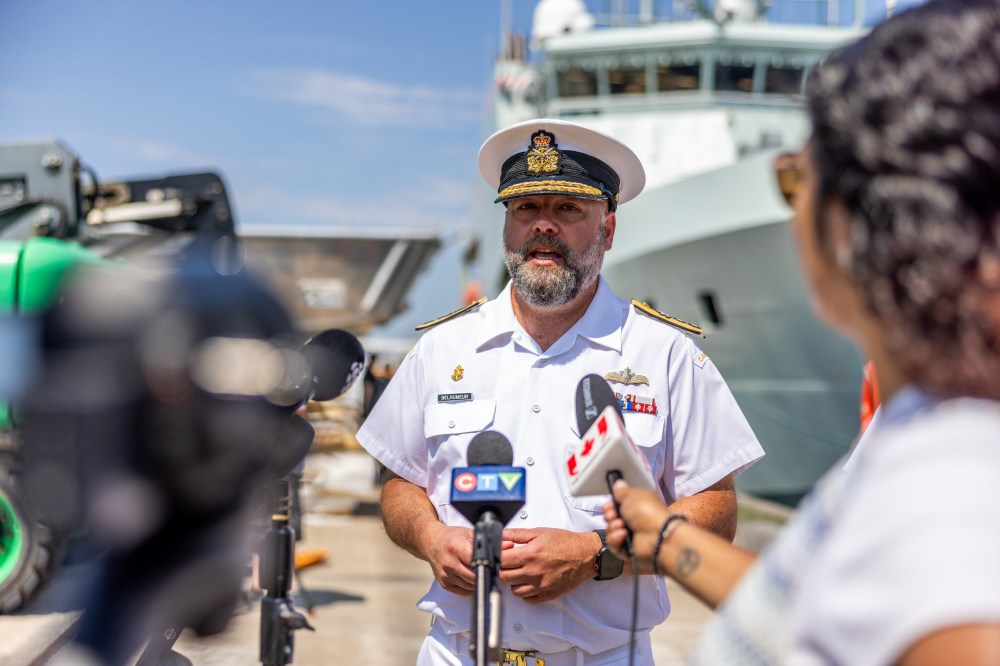
Rear Admiral Pascal Belhumeur, incoming commander of the Royal Canadian Navy on Canada's East Coast speaks to the media at HMC Dockyard in Halifax, Tuesday, Aug. 11, 2026. THE CANADIAN PRESS/Riley Smith

Belhumeur said recruitment has historically been a challenge, but the navy has actually surpassed its targets over the last couple years. Now he says the challenge is training up those new recruits, and the navy is making sure it provides opportunities every time it goes to sea.

“My priorities here are…our people, developing our people, taking care of our people, because people are our capability,” Belhumeur told reporters Tuesday.

Defence Minister David McGuinty said in April that the Canadian Armed Forces brought in 7,310 new members in the prior year, the highest recruitment level in 30 years. The military enrolled 1,400 permanent residents, the highest number since it started allowing them to join in 2022.

McGuinty said there were 44,000 applications to join the regular force, which was 62 per cent more than the year before. He credited a pay hike and changes to medical requirements for the turnaround.  

The numbers mark an improvement since 2024, when the previous defence minister, Bill Blair, said the forces were locked in a personnel “death spiral.”  

Canada has been making unprecedented investments in its armed forces as it ramps up spending as part of its NATO commitments. Belhumeur said the navy needs to be ready to use those new capabilities.

In March, Prime Minister Mark Carney announced $3 billion in infrastructure and defence spending for Nova Scotia and New Brunswick. In June, Halifax’s Irving Shipbuilding began construction on the first of Canada’s 15 new River-class destroyers. Total cost of the new destroyers is estimated between $60 billion and $80 billion. 

Carney was back in Halifax last month to announce German defence manufacturer TKMS as the preferred bidder to supply Canada’s next fleet of submarines, calling it the largest procurement in Canadian history. 

“I see all the investment that’s coming with the River-class destroyers and the submarines. I know the impact that (they) will continue to have for the community here, a community that has always supported the navy,” said Belhumeur.  

There are about 10,700 military and civilian personnel in the Maritime Forces Atlantic defence team.

This report by The Canadian Press was first published Aug. 11, 2026.
Report Error Submit a Tip

More Stories

Canada resorting to its tried and true playbook

Niigaan Sinclair 5 minute read Preview

Canada resorting to its tried and true playbook

Niigaan Sinclair 5 minute read Yesterday at 6:00 AM CDT

In 1846, Britain faced an emergency influenced by the Irish famine, so leaders repealed the country’s “Corn Laws” and restrictions on imported food and grain, transitioning to a system of free trade.

This created a crisis in the then Province of Canada, which had relied on British “preferential” status to prop up its agricultural and resource industries.

As a result, Canada looked south for new markets and eventually negotiated a free trade agreement with the United States.

This required land to be acquired and converted for industrial use quickly, so Canada quickly dispatched Commissioner William Robinson to negotiate with Indigenous communities along Lake Huron and Lake Superior for land.

Read
Yesterday at 6:00 AM CDT

Port of Churchill signs agreement with Dutch port

Aaron Epp 2 minute read Preview

Port of Churchill signs agreement with Dutch port

Aaron Epp 2 minute read 4:40 PM CDT

Arctic Gateway Group, operator of the Port of Churchill, has signed an agreement with the Port of Rotterdam in the Netherlands to attract business and strengthen supply chains linking Western Canada and Europe.

The agreement enables the two ports to work together to develop new trade in critical minerals and energy products, connect Canadian producers with European buyers, and identify opportunities to improve the supply chain from Western Canadian resource projects through Churchill and into European markets.

The Port of Rotterdam is Europe’s largest port and home to more than 3,000 businesses across its industrial complex, serving as a major gateway for critical raw materials and energy.

Meanwhile, the Port of Churchill has been identified as a transformative national strategy for Canada and is emerging as a northern trade corridor connecting Western Canada’s resources to global markets.

Read
4:40 PM CDT

Wab Kinew as ‘communicator in chief’

Paul G. Thomas 6 minute read Preview

Wab Kinew as ‘communicator in chief’

Paul G. Thomas 6 minute read Yesterday at 2:00 AM CDT

Premier Wab Kinew and his party have been riding high in the polls longer than normal for a government one year or less away from its first re-election contest. One reason is his ubiquitous, dominating communications presence as NDP leader and premier.

The argument here is that Kinew has supplemented his prerogatives as premier and party leader (such as appointing cabinet ministers and approving party nominations) with the skilful use of communications to advance his policy agenda, boost his personal popularity and maintain the competitive advantage of his party over the opposition Progressive Conservatives.

Communications has always been a significant part of politics and policy making. However, in the contemporary political and media environments, communications considerations have moved from the background to the foreground of decision-making by political parties, including when they are performing in the role of government. Campaigning and governing now overlap in what has been described as a permanent election campaign.

Political parties use communications strategies for several purposes: to establish an image of the leader which makes a positive emotional connection with voters; to promote a coherent message and to keep party members on message; and to gain favourable media coverage for its policies and other actions on almost a daily basis.

Read
Yesterday at 2:00 AM CDT

Jets defenceman spent whole summer working on getting to the next level

Ken Wiebe 8 minute read Preview

Jets defenceman spent whole summer working on getting to the next level

Ken Wiebe 8 minute read Updated: Yesterday at 1:57 PM CDT

Tyrel Bauer makes no apologies for the pugilistic piece of his path.

The Winnipeg Jets defenceman is ready to drop the gloves and throw down when the situation calls for it and he takes great pride in protecting his teammates.

It’s a big part of the reason Bauer will be among the 23 players submitted by the Jets on the opening-day roster on Monday.

“I’ve fought and clawed, both metaphorically and literally and now I just want to show that I can play as well,” Bauer said during a chat with the Free Press during training camp. “(Toughness) is always something that I have, it’s always something in my back pocket and something that I take a lot of pride in doing, for my teammates, for the city and the people who invest in this hockey club. That will never change.

Read
Updated: Yesterday at 1:57 PM CDT

Khan cites infighting, quits as Tory leader

Carol Sanders 5 minute read Preview

Khan cites infighting, quits as Tory leader

Carol Sanders 5 minute read Updated: 9:56 AM CDT

Manitoba’s Leader of the Opposition is stepping down.

Progressive Conservative Leader Obby Khan announced late Monday afternoon he is quitting caucus and will sit in the legislature as an independent MLA, effective today.

He cited internal party fighting for his decision.

The former Winnipeg Blue Bombers offensive lineman survived a caucus confidence vote Friday. He said there were 13 votes for him to remain and six against, with one person absent.

Read
Updated: 9:56 AM CDT

Expert urges food, drink makers to look to foreign markets

Gabrielle Piché 5 minute read Preview

Expert urges food, drink makers to look to foreign markets

Gabrielle Piché 5 minute read 5:04 PM CDT

Canada’s slowing population growth could restrict business expansion, a top economist for Farm Credit Canada warned Manitoba manufacturers.

Craig Johnston, the federal Crown corporation’s chief economist, addressed Prairie businesses at Farm Credit Canada’s Food and Beverage Summit Tuesday.

“There could be some modest growth in Canadian consumption of food and beverage,” Johnston said, relaying population numbers inside a Victoria Inn Hotel conference room.

Still, per-person spending on food is “stagnant, if not somewhat rising,” Johnson later told reporters.

Read
5:04 PM CDT