Florida shows how to adapt as coastal cities face growing threats from sea level rise and storms
Advertisement
Read this article for free:
or
Already have an account? Log in here »
To continue reading, please subscribe:

Digital Subscription
One year of digital access for only $205*
- Enjoy unlimited reading on winnipegfreepress.com
- Read the E-Edition, our digital replica newspaper
- Access News Break, our award-winning app
- Play interactive puzzles
*First annual payment billed as $205.00 + GST for one year. This annual subscription will automatically renew at $233.00 + GST every 52 weeks (10% off the regular annual price of $259.35). Offer available to new and qualified returning subscribers only. Cancel any time.
To continue reading, please subscribe:
Add Free Press access to your Brandon Sun subscription for only an additional
$1 for the first 4 weeks*
- Enjoy unlimited reading on winnipegfreepress.com
- Read the E-Edition, our digital replica newspaper
- Access News Break, our award-winning app
- Play interactive puzzles
*Your next Brandon Sun subscription payment will increase by $1.00 and you will be charged $17.95 plus GST for four weeks. After four weeks, your payment will increase to $24.95 plus GST every four weeks.
Read unlimited articles for free today:
or
Already have an account? Log in here »
One day there was a roof. The next morning it was gone.
Jeffrey Huber still remembers the day some 34 years ago when Hurricane Andrew blew off the roof of his childhood home, one of tens of thousands damaged and destroyed across southern Florida. For days, first responders couldn’t get to them. For a month and a half, they relied on food donations. For more than a year, he lived with his family in a trailer.
“It wasn’t just about the storm itself, but it was about the aftermath of that storm and how we begin to design for those aspects,” said Huber, a landscape architect and professor who was 12 in 1992 when the Category 5 hurricane hit. “We are seeing extreme storms, extreme scenarios like this that are becoming much more common.”
Some 129 million people — nearly 40% of the U.S. population — live in coastal counties. Recent research shows that a rise in sea level driven by humans has increased the frequency of extreme coastal flooding around the world.
As climate change threatens communities, Florida is showing how to build to adapt. Throughout the state, architects and designers are merging infrastructure with urban design to create residential buildings, parks and more. The goal is to better withstand rising waters, worsening storms, saltwater intrusion, heat heaves and other climate impacts.
“In places like Miami, we’re dealing with a combination of tidal flooding, storm surge and long-term sea level rise,” said Huber, professor in the School of Architecture at Florida Atlantic University. “So the question isn’t about how we stop water, but it’s how we live on, with and over it.”
Seawalls that double as reefs
As global average temperatures climb because of fossil fuel emissions, so do sea levels, making low-lying coastal cities vulnerable to flooding.
Frequent flooding and intensifying storm surges got so bad in Miami Beach that when it rained, Anya Freeman rushed home to move her car because her street filled with knee-deep water and she couldn’t get car insurance for flooding.
“But nobody was doing anything practical about it,” she said. So in 2024, she left behind her career as a lawyer to launch Kind Designs, a startup creating 3D-printed living seawalls to protect shorelines from flooding.
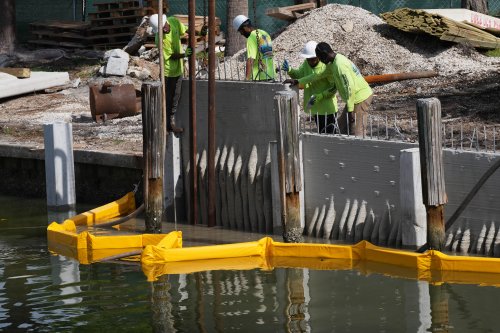
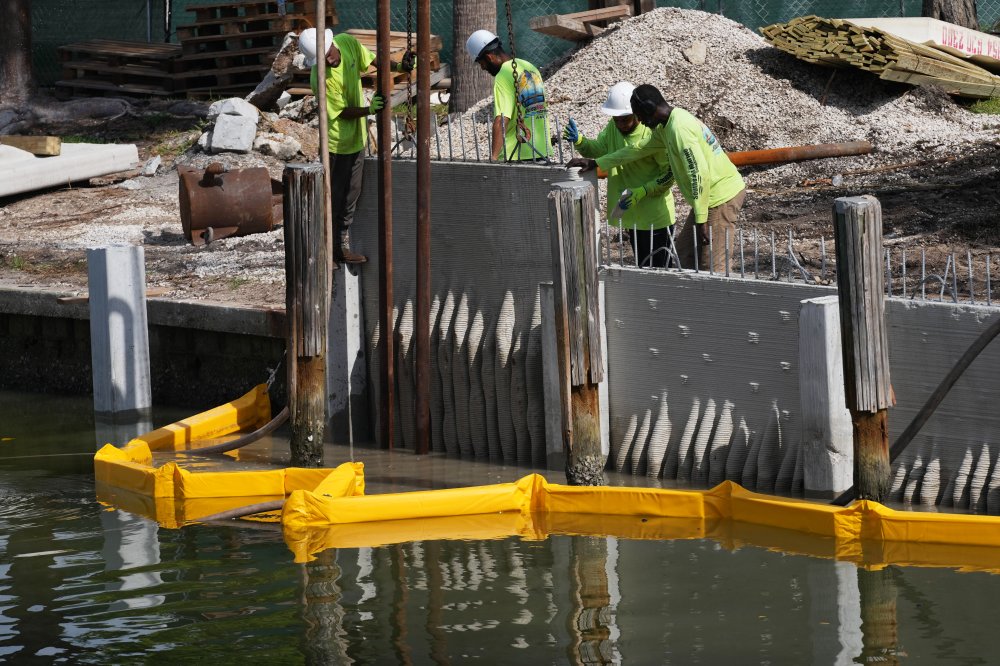
These seawalls are meant to be affordable so they can be scaled, and also serve as marine habitat. They’re made faster and with a nontoxic concrete mixture and can be custom shaped for the ecosystems where they’re installed. On a recent August day, workers in neon-green shirts and yellow construction hats installed one mimicking mangroves at a waterfront church in Fort Lauderdale, north of Miami.
Traditional seawalls are flat, but theirs can be designed to mimic natural coastal features like the mangrove roots you’d find in Miami or barnacle clusters in New York.
“We have a whole library of designs for different marine habitats, and the point is to attract the native species… create caves where they can hide from predators and also to dissipate waves,” she said.
Their technology dissipates at least 45% of wave energy, making it more resilient to overtopping and erosion. On one wall, researchers from Florida International University identified 51 species living in it one year after installation, including filter feeders like oysters and tubeworms that clean water.
They’ve since installed 16 living seawalls across Florida for residential, commercial and government clients, she said. Soon they’ll put their first ones in California and New York and will be fortifying coastal bases for the U.S. Navy.
Affordable housing project and park
The Vista Breeze affordable senior housing project in Miami Beach by the architectural firm Brooks Scarpa Huber is a real-world application of how to live with the threats of water.
The 119-unit, two-building complex is elevated 10 feet (3.05 meters) from sea level and is designed to withstand storm surges of up to 20 feet (6.10 meters). Concrete is mixed with a crystalline, water-proof powder that blocks water from penetrating into it, protecting structures and extending their life. Rebar coated in zinc shields it from rust and corrosion.
They’re “some of the most simple, easy steps and they don’t cost that much,” said Huber, the project’s principal architect. “But they’re going to make our buildings more resilient starting up front.”
From a heat-mitigation standpoint, the buildings are oriented southeast to the prevailing breezes, passively cooling themselves.
There are also community rooms, courtyards and terraces to promote socializing. The elevators are hidden, and the stairs made prominent to encourage their use.
About 30 miles north, a former parking lot was transformed into a public space that doubles as flood infrastructure. DC Alexander Park in Fort Lauderdale has a 25-foot artistic overlook that provides shade on hot days.
Along the park’s perimeter, a native maritime forest absorbs rainfall and saltwater flooding while providing recreational opportunities and species habitat.
These designs build on Huber’s research on adapting coastal cities to rising seas, which he wrote about in his 2024 design manual “Salty Urbanism.”
Miami, he said, is a testing ground for it.
“The ideas that we’re working on here… designing for, you know, these extreme scenarios like 5, 9 feet of sea level rise are going to become increasingly relevant to any coastal cities around the world,” he said.
Visions for the future
Financing, policy and community support are just some of the challenges architects and urban planners face with implementation.
About a decade ago, architectural designer, urban planner and Future Vision Studios founder Aaron DeMayo began developing The Coastline, a regional resilience master plan proposal to protect Southern Florida from storm surge and sea level rise.
Funding it will have a large price tag, but “the need and the urgency I think merits this type of infrastructure solution,” he said.
“We have a massive amount of low-lying property and property that could be impacted from storm surge,” he said. “And what we’re presenting here is going to have a very large return on investment because we’re protecting hundreds of miles of direct waterfront property, as well as property behind that waterfront property.”
At the University of Miami’s Center for Urban and Community Design — founded after the 1992 hurricane that damaged Huber’s home — designer, architect and the center’s director Thomas Klein is working to address a problem: a lack of assistance to help lower-income communities afford climate resilient projects.
They’re putting together a community design fund that would do a call out for project proposals, work with communities to identify which would have the most impact, then bring in university experts to help develop them with residents.
For Klein, funding scarcity for climate resilient infrastructure is an opportunity to build in a way that provides multiple services.
“In 2026, is it acceptable to just build a road to move cars? Or does the road need to also move bicyclists and have a bus rapid transit lane, but also manage stormwater and ameliorate for heat island issues?” he said. This fall, they’re also launching an initiative to conceptualize and design “sponge parks” in South Florida that use green and other infrastructure to absorb rain and manage stormwater.
Florida is a challenging regulatory environment, he added, but the solutions evolving there are “uniquely replicable” to other states. “Because we have to rely on a narrower band of potential approaches to actualizing solutions for resilience in our cities, that those solutions might be a little bit more, I guess, resilient.”
___
The Associated Press receives support from the Walton Family Foundation for coverage of water and environmental policy. The AP is solely responsible for all content. For all of AP’s environmental coverage, visit https://apnews.com/hub/climate-and-environment