Malaysia declares emergency in Sarawak town as haze reaches critical level
Advertisement
Read this article for free:
or
Already have an account? Log in here »
To continue reading, please subscribe:

Digital Subscription
One year of digital access for only $205*
- Enjoy unlimited reading on winnipegfreepress.com
- Read the E-Edition, our digital replica newspaper
- Access News Break, our award-winning app
- Play interactive puzzles
*First annual payment billed as $205.00 + GST for one year. This annual subscription will automatically renew at $233.00 + GST every 52 weeks (10% off the regular annual price of $259.35). Offer available to new and qualified returning subscribers only. Cancel any time.
To continue reading, please subscribe:
Add Free Press access to your Brandon Sun subscription for only an additional
$1 for the first 4 weeks*
- Enjoy unlimited reading on winnipegfreepress.com
- Read the E-Edition, our digital replica newspaper
- Access News Break, our award-winning app
- Play interactive puzzles
*Your next Brandon Sun subscription payment will increase by $1.00 and you will be charged $17.95 plus GST for four weeks. After four weeks, your payment will increase to $24.95 plus GST every four weeks.
Read unlimited articles for free today:
or
Already have an account? Log in here »
KUALA LUMPUR, Malaysia (AP) — Malaysia declared an emergency Friday in a town in Sarawak state on Borneo Island after air pollution breached the country’s emergency-level threshold linked to fires in neighboring Indonesia.
The Air Pollutant Index in Serian, a small agricultural town of just under 90,000 near the border of Indonesia’s Kalimantan province, surged to 521 on Friday, according to Malaysia’s environment department. Sarawak’s much-larger capital, Kuching, also showed a hazardous reading of 311.
Malaysia’s King Sultan Ibrahim Iskandar has consented to the declaration of an emergency in Serian, which would allow more effective measures to be taken, Prime Minister Anwar Ibrahim’s office said in a statement. It didn’t provide details but officials have said a reading above 500 could provide for nonessential work and outdoor activities to be halted. Schools are already shut if the index is above 200.
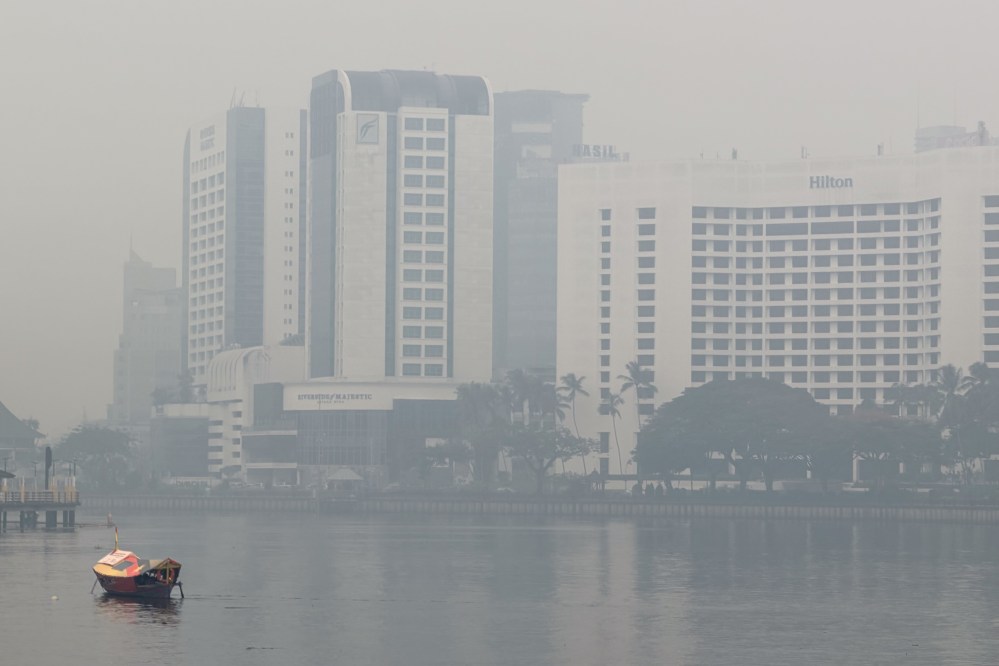
Sarawak has been the worst-hit Malaysian state by the haze, with several areas having hazardous air levels in the past few days.
Haze is a recurring seasonal problem in Southeast Asia, where smoke from forest and peat fires in Indonesia can travel across national borders and affect neighboring Malaysia, Brunei and Singapore.
The haze this year has been particularly severe, with elevated fire activity in several provinces in Indonesia, including Kalimantan, and prolonged dry conditions contributing to worsening pollution that has spread across the region.
It has also hit the Philippines, where President Ferdinand Marcos Jr. ordered the suspension of classes in all levels in the capital region, metropolitan Manila, and more than a dozen northern provinces on Friday, a government statement said.
The Philippine Department of Environment and Natural Resources has also advised people to minimize prolonged outdoor activities and wear protective masks in visibly affected areas.
Satellite data from Indonesia’s Forestry Ministry on Friday detected 717 hot spots nationwide likely caused by forest fires since Aug. 1. The data showed 103 active hot spots in the past 24 hours alone.
Indonesian authorities have deployed firefighting resources and attempted to induce rain.
Indonesian police announced Friday that they have arrested 112 people suspected of starting the recent forest and peatland fires in 10 provinces on Sumatra and Borneo islands. The suspects were local farmers accused of deliberately burning land to clear areas at lower cost.
Indonesia has also suspended the business licenses of five companies over alleged forest and land fires within their concessions in the Kalimantan province.
Pipit Subiyanto, a senior police official at Indonesia’s National Police criminal investigation agency, said authorities are investigating 167 cases involving the deliberate burning of some 4,700 hectares (11,700 acres) of land across nine provinces.