Sea level rise is reshaping a California beach town and threatening a key rail line

Advertisement

Advertise with us

SAN CLEMENTE, Calif. (AP) — For years, residents of this Southern California beach town could walk a mile along a stretch of cream-colored sand and dip their toes in the waves lapping ashore.

Read this article for free:


or

Already have an account? Log in here »

To continue reading, please subscribe:

Subscribe and receive a limited-edition Free Press branded hat or tote.

Digital Subscription

One year of digital access for only $205*

  • Enjoy unlimited reading on winnipegfreepress.com
  • Read the E-Edition, our digital replica newspaper
  • Access News Break, our award-winning app
  • Play interactive puzzles

*First annual payment billed as $205.00 + GST for one year. This annual subscription will automatically renew at $233.00 + GST every 52 weeks (10% off the regular annual price of $259.35). Offer available to new and qualified returning subscribers only. Cancel any time.

To continue reading, please subscribe:

Add Free Press access to your Brandon Sun subscription for only an additional

$1 for the first 4 weeks*

  • Enjoy unlimited reading on winnipegfreepress.com
  • Read the E-Edition, our digital replica newspaper
  • Access News Break, our award-winning app
  • Play interactive puzzles
Start now

*Your next Brandon Sun subscription payment will increase by $1.00 and you will be charged $17.95 plus GST for four weeks. After four weeks, your payment will increase to $24.95 plus GST every four weeks.

SAN CLEMENTE, Calif. (AP) — For years, residents of this Southern California beach town could walk a mile along a stretch of cream-colored sand and dip their toes in the waves lapping ashore.

That trip has been cut short.

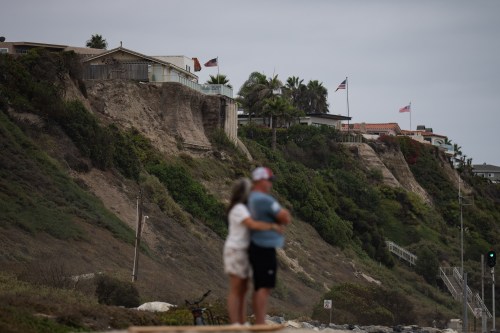
Coastal erosion has been eating away at the beach in San Clemente, known for nearly a century as a “Spanish village by the sea.” The rising sea and crashing waves have pushed the shoreline landward, splitting the city’s picturesque North Beach. Crumbling seaside bluffs have damaged oceanfront homes and forced the repeated closure of a passenger rail line considered the second busiest in the country.
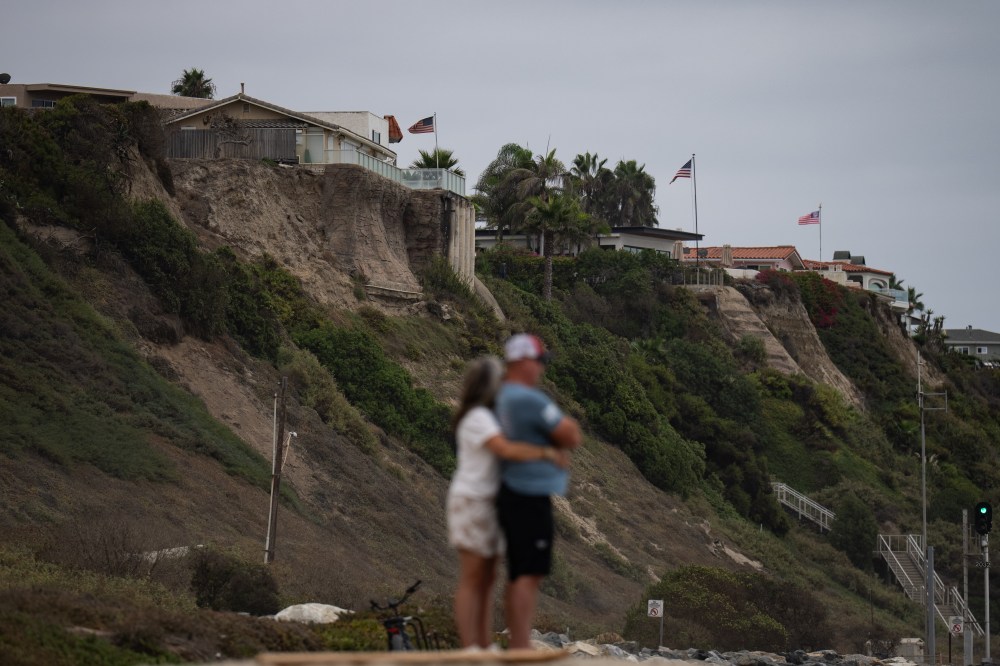
A couple hug at North Beach as crumbling seaside bluffs are seen behind them in San Clemente, Calif., Friday, Sept. 18, 2026. (AP Photo/Jae C. Hong)

It’s one of many California coastal communities grappling with the effects of sea level rise. Nearly a decade ago, scientists forecast that more than half of Southern California’s beaches could significantly erode by 2100, radically altering how people live and recreate along the state’s famed coast.

“The constant pressure is sea level rise,” said Sean Vitousek, research oceanographer with the U.S. Geological Survey. “It is going to keep rising, and rising, and the beaches will retreat landward.”

After years of erosion, California is bracing for flooding and landslides ahead of this year’s expected super El Niño, a temporary warming in parts of the equatorial Pacific known to warp weather worldwide. Already this year, the town of Pacifica south of San Francisco shuttered its cracked concrete pier, and seawater flooded homes in Long Beach near Los Angeles during a hurricane-driven storm surge. A recent study showed that El Niño events are getting stronger because of human-caused climate change.

In San Clemente, a town of 62,000 people, urban development has slowed the flow of sediment that once nourished the city’s beaches, and warmer ocean waters have pushed waves higher and further ashore. It’s become so challenging that residents of the largely Republican city are considering taxing themselves to raise money for beach restoration. A measure to add a 1% sales tax to fund wildfire protection and sand replenishment in San Clemente is on the November ballot.

Crumbling hillsides disrupt seaside rail

Over the past five years, the rail line that has operated along the coast for more than a century has faced repeated closures due to encroaching surf on one side and fragile bluffs on the other. The 7-mile (11-kilometer) segment is part of a 351-mile (565-kilometer) passenger rail corridor that links San Diego with Los Angeles County’s huge port complex and San Luis Obispo. It’s also used by freight and the military.

Transportation officials have shored up the tracks to ensure passenger safety by laying down rock. But as waves slam against the rocks, they sweep more sand offshore and speed up erosion that will eventually threaten the rail line again.

Locals say the erosion is dramatically altering their community.

“We’ve lost our walkable beach,” said Cameron Cosgrove, a San Clemente resident who wrote the tax measure. “It used to be you could come to North Beach, walk the beach trail, or on the beach to the pier and actually all the way down to the south end of town. Can’t do either anymore.”

City and transit officials agree more sand is needed and note that coastal communities, including surf hub Huntington Beach, have nourished their beaches for years. Opponents of the measure want sand — but not the tax — and argue San Clemente should work with other communities on a regional approach.

“Fighting Mother Nature is very expensive,” said City Councilman Zhen Wu, who opposes the measure.

City Manager Andy Hall said San Clemente faces a sand deficit of about 3 million cubic yards. Getting that much sand to the beach is no easy task, he said, adding that trucking it would require 300,000 trips.

Darrell Johnson, chief executive of the Orange County Transportation Authority, said a challenge has been getting state permits for more sand. He hopes California’s recent emergency declaration ahead of El Niño will speed up the process. In the long run, Johnson said officials will study moving trains inland — an idea previously deemed too costly. A third option is to halt the line, he said.

“If we can’t figure out how to shore up properly in a way that is long-term in nature, and we can’t figure out how to relocate, I think that is a question that’s going to have to be asked,” Johnson said. “’What happens to passenger rail? What happens to freight?’”

More sand will also shape wave breaks

Further south, transportation officials have been working to stabilize coastal bluffs to shore up the rail line in the community of Del Mar. The plan is to eventually move the tracks, but officials have not decided where.

Charlie Fox, a 56-year-old San Clemente resident and marine meteorologist, said sand provides a critical buffer between whatever structures — train tracks, homes, lifeguard headquarters — are built along the coast. The lifelong surfer said sand also helps waves roll gently onshore, creating a steady wave break for surfing.

On a recent morning, surfers bobbed in the water off North Beach, not far from the rocky structure shoring up the train tracks by the sea.

“When you see those rocks, that’s them attempting to fight the ocean,” Fox said. “That is a futile endeavor.”

“The ocean wins,” he added. “Ocean always eventually wins.”

Report Error Submit a Tip

More Stories

Morning-show veteran swaps microphone for macchiatos at new Corydon café

David Sanderson 9 minute read Preview

Morning-show veteran swaps microphone for macchiatos at new Corydon café

David Sanderson 9 minute read Yesterday at 2:00 AM CDT

Good news if you were used to having your morning coffee with Terri Gale, who earlier this summer signed off from CTV Your Morning, after 15 years on the job.

Gale, the three-hour program’s longtime weather expert, and her husband Rob Gale, the ex-head soccer coach of Valour FC and co-founder of the Northern Super League’s new Winnipeg franchise, are the owners of Golden Hour Café and Bar at 775 Corydon Ave.

Gale (formerly Apostle) nods when she is asked who would know more about caffeinated beverages than a person who, for the last decade and a half, set her alarm to go off in the wee small hours.

“I do love coffee and take mine black. Except because I hate burning my tongue — not a good thing when you speak for a living — I got into the habit of throwing a couple of ice cubes in my cup, to be on the safe side,” Gale says, seated on the second level of their attractive, 2,100-square-foot premises, which officially opened in mid-September.

Read
Yesterday at 2:00 AM CDT

Sea level rise is reshaping a California beach town and threatening a key rail line

Amy Taxin, The Associated Press 5 minute read Preview

Sea level rise is reshaping a California beach town and threatening a key rail line

Amy Taxin, The Associated Press 5 minute read Sunday, Sep. 27, 2026

SAN CLEMENTE, Calif. (AP) — For years, residents of this Southern California beach town could walk a mile along a stretch of cream-colored sand and dip their toes in the waves lapping ashore.

That trip has been cut short.

Coastal erosion has been eating away at the beach in San Clemente, known for nearly a century as a “Spanish village by the sea.” The rising sea and crashing waves have pushed the shoreline landward, splitting the city's picturesque North Beach. Crumbling seaside bluffs have damaged oceanfront homes and forced the repeated closure of a passenger rail line considered the second busiest in the country.

It's one of many California coastal communities grappling with the effects of sea level rise. Nearly a decade ago, scientists forecast that more than half of Southern California’s beaches could significantly erode by 2100, radically altering how people live and recreate along the state’s famed coast.

Read
Sunday, Sep. 27, 2026

Broadening prediction-market gambling a bad idea

Editorial 4 minute read Preview

Broadening prediction-market gambling a bad idea

Editorial 4 minute read Yesterday at 2:01 AM CDT

Let’s make a prediction: sooner or later, when Canadian governments find a way to take their own cut of the action, prediction-contract gambling on everything from sports to entertainment to political decisions is going to come to Canada.

And that’s a horrible, dangerous, pernicious idea.

Unless you have particular access to information — either inside information or strategic information based on skills or education — you’re not likely to make money at it. In fact, structurally, you’re likely to lose. In prediction markets, you basically pay an amount, plus fees from the company involved, to bet on whether something will or will not happen within a certain time frame. The amount you pay for your contract depends on how other people are also betting.

As Wealthsimple describes it, “You buy whichever side you think is right. Prices move with demand, so if the market leans towards one outcome, the more that side costs. If a lot of people are backing the TSX to finish above 38,000, yes gets more expensive and no gets cheaper.”

Read
Yesterday at 2:01 AM CDT

’Disgusting’ posters being investigated by police

Morgan Modjeski 4 minute read Yesterday at 2:22 PM CDT

The Winnipeg Police Service major crimes unit is investigating what some have labelled offensive and hateful posters on full-display at a Winnipeg home.

One of the people irked by the display is Gracie Garrett. She’s has lived on Ashburn Street in Winnipeg’s Minto neighbourhood for almost ten years. She’s never felt unsafe in the neighbourhood before, but now, a set of posters plastered on a nearby house are making her feel uneasy.

The five signs, posted facing the street prominently on a front window, contain a slur, refer to Nazis as “heroes” and call Muslims, Christians and other groups “evil.”

Learning of the signs Friday, Garrett said she’ll be reporting the posters to police, as she worries they incite and promote violence.

The election of our discontent: City at a crumbling crossroads, grumbling residents say in poll

Matthew Frank 7 minute read Preview

The election of our discontent: City at a crumbling crossroads, grumbling residents say in poll

Matthew Frank 7 minute read 2:37 PM CDT

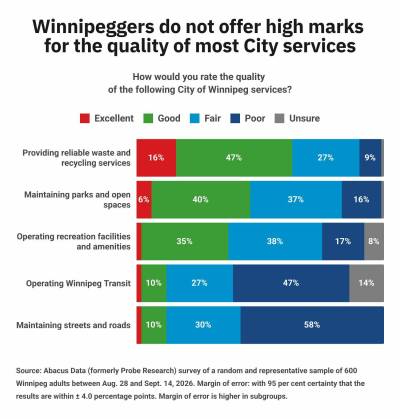
There’s an undercurrent of unhappiness running through the Winnipeg electorate as the municipal election day approaches.

One-half of Winnipeggers believe the city is heading in the wrong direction, according to a new Abacus Data poll, with nearly one-third unsure if Winnipeg is regressing or progressing.

Only 21 per cent of residents believe the city is on the right track, the Free Press-commissioned poll found.

That discontentment extends to how the city spends its tax dollars, with four in 10 Winnipeggers believing they receive poor value for what they pay in property taxes.

Read
2:37 PM CDT

Six high school hockey programs ceased operations following new Hockey Manitoba policy

Joshua Frey-Sam 7 minute read Preview

Six high school hockey programs ceased operations following new Hockey Manitoba policy

Joshua Frey-Sam 7 minute read Friday, Oct. 2, 2026

She lived the best of both worlds.

For the last three years, the 17-year-old wore a sweater for two different hockey programs — her high school team and AAA club in the Manitoba Female Hockey League — and was preparing to flourish in both colours again this winter.

Recently, however, the blue-liner was disappointed to learn she is no longer eligible to play her Grade 12 season with her school owing to a new policy imposed by Hockey Manitoba that bans players from participating in the Manitoba Women’s High School Hockey League if they are rostered on a U18 AAA team.

The rule applies to all athletes who play for both Winnipeg-based and rural AAA teams.

Read
Friday, Oct. 2, 2026