Indonesian villagers on Borneo struggle for water as El Niño intensifies peatland fires
Advertisement
Read this article for free:
or
Already have an account? Log in here »
To continue reading, please subscribe:

Digital Subscription
One year of digital access for only $205*
- Enjoy unlimited reading on winnipegfreepress.com
- Read the E-Edition, our digital replica newspaper
- Access News Break, our award-winning app
- Play interactive puzzles
*First annual payment billed as $205.00 + GST for one year. This annual subscription will automatically renew at $233.00 + GST every 52 weeks (10% off the regular annual price of $259.35). Offer available to new and qualified returning subscribers only. Cancel any time.
To continue reading, please subscribe:
Add Free Press access to your Brandon Sun subscription for only an additional
$1 for the first 4 weeks*
- Enjoy unlimited reading on winnipegfreepress.com
- Read the E-Edition, our digital replica newspaper
- Access News Break, our award-winning app
- Play interactive puzzles
*Your next Brandon Sun subscription payment will increase by $1.00 and you will be charged $17.95 plus GST for four weeks. After four weeks, your payment will increase to $24.95 plus GST every four weeks.
Read unlimited articles for free today:
or
Already have an account? Log in here »
PENYELADI, Indonesia (AP) — After three months with no rain, Sriwati, a shopkeeper and mother of three children living in Penyeladi village on the tropical island of Borneo, can no longer depend on the river for her needs.
Experts say communities like Sriwati’s are facing a severe water crisis as this year’s super El Niño, combined with decades of degradation of the island’s ecologically vital peatlands — ancient wetlands that are critical for carbon storage, water regulation and pollution control — has created the perfect storm exacerbating human-caused climate change.
The Kapuas, Indonesia’s longest river that over 3 million people rely on, has extremely receded in the area near her home. All that’s left is a shallow stream of muddy water that’s not safe to drink or wash the rice she cooks to feed her children. She now has to buy water, adding to her monthly expenses.
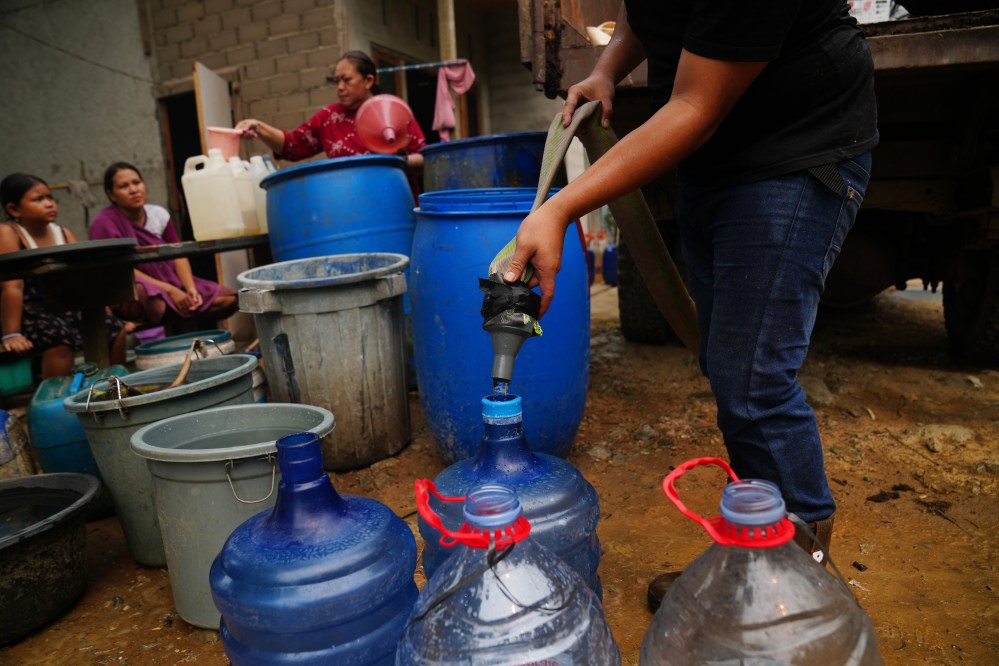
“The water shortage affects us, especially when it comes to drinking water,” Sriwati, who like many Indonesians uses only one name, told The Associated Press from her small, concrete home.
El Niño and peatland degradation create crisis
El Niño is part of a natural climate cycle of warming ocean temperatures, but this year’s is expected to reach new extremes of drought, heat waves, flooding and other climate-related disruptions across the globe.
Meteorologists forecast it could exceed a record El Niño that began in 1997 and helped trigger billions of dollars in damage from heat waves, floods, droughts, tornadoes and wildfires.
In Borneo, experts say that because vast peatlands have been destroyed by land conversion, the effects of El Niño are already being more acutely felt.
“In Kalimantan, something like 60% of the peatland areas have been drained to make way for palm oil plantations and for pulp and paper concessions,” said Amanda Hurowitz, a senior director at international environmental organization Mighty Earth, using the name for the Indonesia-controlled part of Borneo.
“That means the water is not where it should be. There are all these canals, and because the canals are blocked, the water table goes low,” she continued. “Because it’s so dry, the water has just disappeared.”
In a written statement to the AP, Indonesia’s Ministry of Forestry acknowledged the negative impact of drained peatlands, while insisting that specific causes and liabilities must be determined by evidence rather than attributed automatically to El Niño or the presence of businesses.
They added that the government aims to prevent future peatland degradation through ecosystem restoration and strict enforcement of concession holders’ obligations.
“The government’s long-term agenda focuses on preserving and restoring peatland hydrological functions, improving landscape and water management, strengthening fire prevention, and ensuring that all parties managing land fulfill their responsibilities,” they said.
Fires continue to burn across Borneo as water supplies dwindle
Experts say the hot, dry conditions caused by El Niño coupled with peatland degradation have contributed to the enormous fires spreading across Borneo.
Dried peat is highly flammable, allowing fires to easily spread in drained areas. Because the fires often spread underground, they’re difficult to extinguish and can easily reoccur, according to the Borneo Nature Foundation.
The dwindling water supply in the area has slowed down firefighting efforts, while Japan has deployed firefighting assistance to the island.
Toxic thick haze blankets the sky. The smoke has drifted as far as the Philippines, more than 800 kilometers (500 miles) away, and breached Malaysia’s emergency-level threshold for air pollution, forcing authorities to declare an emergency last week in a town in Sarawak state on Borneo.
In a written statement to the AP, Indonesia’s Ministry of Forestry said the government is shifting its forest and land fire policy toward prevention by strengthening cross-sectoral coordination, enforcing laws against burning-based land clearing, expanding patrols and early detection systems, promoting risk-based monitoring and peatland restoration, and requiring permit holders and communities to take responsibility for fire control.
“Ultimately, controlling forest and land fires is not the task of a single ministry or institution,” they said. “Prevention requires collaborative effort.”
Indonesia’s Forestry Ministry recorded more than 202,000 hectares (499,000 acres) of burned land between January and July, almost three times the size of Singapore.
Communities continue to bear the burden
As the fires continue to burn and water remains scarce, communities continue to suffer.
In Sungai Malaya village in West Kalimantan, fires have burned for over a month, with residents remaining tense around the clock, as fires have sometimes suddenly worsened at night.
Fires have decimated the vacant lots where Rumsiyeh, a 45-year-old mother of five children, and her husband picked ferns to sell at the market.
“Everything’s gone. We can’t make a living anymore,” she said.
Boaters, fishers and others who rely on the river have had their livelihoods impacted, as extremely low water levels mean it’s impossible to fish or travel on the Kapuas. In the areas where there’s enough water for boats to operate, the thick haze hampers visibility, making it dangerous to operate, fisherman Abiansah, 39, said.
And the national economic impact remains unmeasured: Large metal barges that usually carry oil palm tree kernels for processing downriver currently lie aground on the sand, as children swing from their untied mooring lines.
Some relief has come from private and government water donations, but residents still fear what the future holds.
“I’m worried about this prolonged dry spell. It’s reached the point where just going about our daily activities — going anywhere at all — has become difficult. We’re facing water shortages, too,” said Sriwati. “I’m at a loss for words to describe it.”
___
Milko reported from Islamabad.
___
The Associated Press’ climate and environmental coverage receives financial support from multiple private foundations. AP is solely responsible for all content. Find AP’s standards for working with philanthropies, a list of supporters and funded coverage areas at AP.org.