Military could begin Arctic sensor installations next summer

Advertisement

Advertise with us

OTTAWA - National Defence plans to install 47 sensor stations across the North starting as early as next summer to bolster Norad’s surveillance and early warning abilities, according to recently published regulatory filings.

Read this article for free:


By clicking the button above, an account will be created and you will begin to receive some of our recommended newsletters. You may opt out of any newsletter by visiting your Email and Communication Preferences page or by clicking "unsubscribe" at the bottom of any email.

or

Already have an account? Log in here »

To continue reading, please subscribe:

Digital Subscription

One year of digital access for only $1.44 a week*

  • Enjoy unlimited reading on winnipegfreepress.com
  • Read the E-Edition, our digital replica newspaper
  • Access News Break, our award-winning app
  • Play interactive puzzles

*Billed as $5.77 plus GST every four weeks. After 52 weeks, price increases to the regular rate of $19.95 plus GST every four weeks. Offer available to new and qualified returning subscribers only. Cancel any time.

To continue reading, please subscribe:

Add Free Press access to your Brandon Sun subscription for only an additional

$1 for the first 4 weeks*

  • Enjoy unlimited reading on winnipegfreepress.com
  • Read the E-Edition, our digital replica newspaper
  • Access News Break, our award-winning app
  • Play interactive puzzles
Start now

*Your next Brandon Sun subscription payment will increase by $1.00 and you will be charged $17.95 plus GST for four weeks. After four weeks, your payment will increase to $24.95 plus GST every four weeks.

OTTAWA – National Defence plans to install 47 sensor stations across the North starting as early as next summer to bolster Norad’s surveillance and early warning abilities, according to recently published regulatory filings.

The planned installations would start in Yukon near the Alaskan border and follow along the Arctic coast across the Northwest Territories, reaching as far out as Alert, Nunavut, the most northern inhabited point in the world.

Called Project Crossbow, the plan involves using Hercules aircraft and Chinook helicopters to airlift passive sensor installations, which resemble large shipping containers that stand on metal legs.
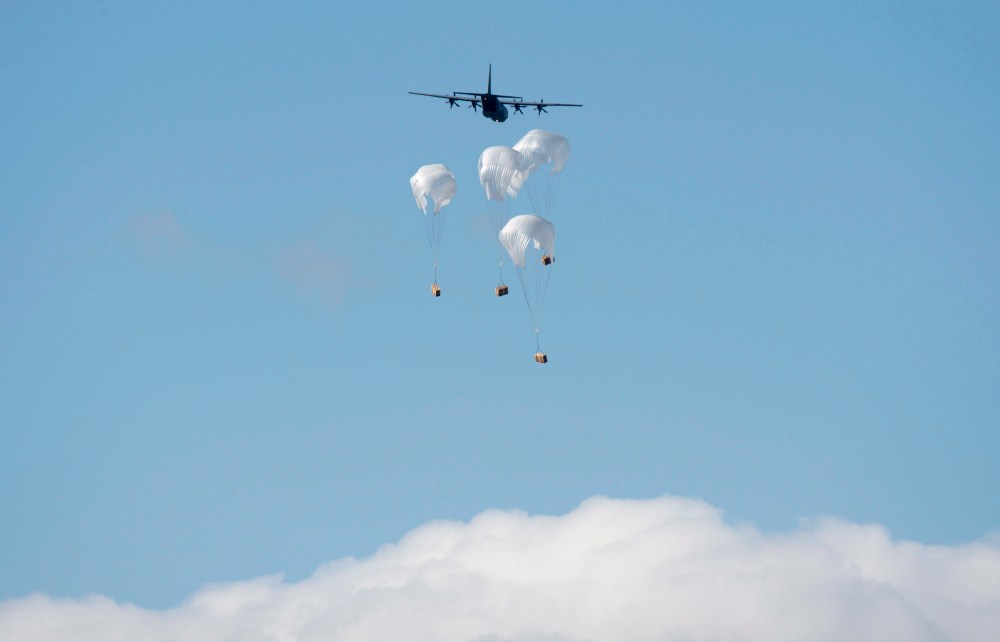
A Canadian Forces Hercules drops supplies for troops during Operation Nanook on Tuesday, Aug. 26, 2014, on Baffin Island. THE CANADIAN PRESS/Adrian Wyld

The initial deployments could begin as soon as next summer with initial operating capability coming online in 2029, said Royal Canadian Air Force spokesperson Lt.-Cmdr. Melanie Aqiqi.

She said in an emailed statement that Crossbow is “part of a broader network of capabilities supporting northern air domain awareness.”

The container stations will run on solar and wind power, according to a series of National Defence documents filed with a Nunavut regulatory board.

Aside from some temporary deployments required to set them up and an annual maintenance cycle, the installations will remain unstaffed throughout the year.

“This defence capability (surveillance sensors) will operate within self-powered, autonomous, ruggedized power-generating container systems designed for continuous operations in austere environments and extreme Arctic conditions,” one of the documents said.

The federal government is investing billions of dollars in a broader effort to modernize Norad’s equipment.

The project was announced in 2022 by then-defence minister Anita Anand under the Northern Approaches Surveillance system, which includes the over-the-horizon radar project.

Anand said at the time the capabilities of the joint Canada-U.S. project are classified but the new network would add “another layer of detection” to Norad.

An information package submitted to the Nunavut Planning Commission said the project is of “national significance” and the “proposed sites are required for overall system network operation.”

The sites mapped out in some of the filed plans include two in Quttinirpaaq National Park on Ellesmere Island and four within a migratory bird sanctuary on Banks Island. The documents state the project is expected to have little to no impact on wildlife.

Two sensor systems are already stationed in Alert, Nunavut and Sachs Harbour, Northwest Territories, one of the documents said.

The sites were chosen so that National Defence can easily airlift the containers in just a few days — although the exact rationale for site selection remains classified.

The sensor project is expected to be complete by 2032. Once fully deployed, the project is expected to run another 20 years.

This report by The Canadian Press was first published Oct. 22, 2026.

— With files from Nick Murray

Report Error Submit a Tip

More Stories

Frustration on menu as St. James construction drags on

Kelly-Anne Riess 4 minute read Preview

Frustration on menu as St. James construction drags on

Kelly-Anne Riess 4 minute read Updated: 11:18 AM CDT

Nearly four months of construction outside the front door of a longtime Portage Avenue restaurant has driven away customers and left its owner struggling to cover operating expenses.

Read
Updated: 11:18 AM CDT

October perfect time to put on a sweater, drink something warm and crack open a book

Arts & Life staff 9 minute read Preview

October perfect time to put on a sweater, drink something warm and crack open a book

Arts & Life staff 9 minute read 8:22 PM CDT

With Halloween around the corner, spooky season is in full effect.

But October is more than ghosts, goblins, Jack-o-lanterns and other things that go bump in the night. Not entirely, anyway. October is also a time of harvest, of change and renewal.

Pull on a sweater, pour something warm to drink and follow along as the Free Press arts and life team presents a literary tour through October Country…

Something Wicked This Way Comes, by Ray BradburyFew authors write so frequently, so passionately about October as Ray Bradbury did. From his earliest work throughout the rest of his career, Bradbury returned again and again to the October Country as the settings of short stories, poems and novels.

Read
8:22 PM CDT

Henderson crosswalk has glaring safety gap, say researchers months after pedestrian killed

Maggie Macintosh 5 minute read Preview

Henderson crosswalk has glaring safety gap, say researchers months after pedestrian killed

Maggie Macintosh 5 minute read Yesterday at 2:00 AM CDT

Six months after a fatal collision at a crosswalk on Henderson Highway, two traffic safety researchers question why the intersection remains an outlier that is missing key flashing lights.

The City of Winnipeg is being urged to install “backflashers” to better protect road users moving in all directions at the intersection where a 32-year-old father died in the spring.

“It’s these little, mundane, non-sexy engineering problems that can cause everything right up to fatality,” said Curt Pankratz, an associate professor at the University of Winnipeg who studies traffic engineering and policymaking.

On April 19, shortly before sunrise, Gabe Beardy was struck when he was crossing the six-lane thoroughfare at Neil Avenue.

Read
Yesterday at 2:00 AM CDT

Mayor Gillingham poised for repeat

Chris Kitching 7 minute read Preview

Mayor Gillingham poised for repeat

Chris Kitching 7 minute read Updated: 8:29 PM CDT

Incumbent mayoral candidate Scott Gillingham remains in the lead among decided voters in a new poll that suggests a majority of Winnipeggers want change ahead of Wednesday’s election.

Gillingham was backed by 36 per cent of decided voters in an Abacus Data survey released Friday, followed by candidates Kevin Klein (19 per cent) and Mike Vogiatzakis and a surging Noah Redden, who were tied for third (both at 14 per cent).

While a majority of respondents expressed a desire for a new mayor, Curtis Brown, a vice-president with Abacus, said “none of the other candidates has convincingly made the case that they represent the best change.”

“In the absence of that, Scott Gillingham definitely has the advantage. He looks likely to be able to win,” Brown said.

Read
Updated: 8:29 PM CDT

Winnipegger soprano, Iranian composer exhibit tremendous talent at WSO show

Holly Harris 5 minute read Preview

Winnipegger soprano, Iranian composer exhibit tremendous talent at WSO show

Holly Harris 5 minute read 5:31 PM CDT

The Winnipeg Symphony Orchestra launched its newly renamed Thursday night series, Symphonic Sessions, by showcasing one of the world’s finest sopranos hailing from our fair city, Andriana Chuchman.

The 75-minute concert (sans intermission), titled Berlioz’s Les Nuits d’été and Schubert’s Symphony No. 4, also featured the auspicious Canadian debut of Iranian conductor Hossein Pishkar, who led the program ranging from lush lyricism to tempestuous Sturm und Drang for a small audience of 660.

Chuchman’s artistry just seems to grow more luminous with each passing year, as the Ukrainian-Canadian singer continues to light up stages throughout North America and in Europe.

Her eagerly anticipated concert performances include shows at Ottawa’s National Arts Centre, the National Symphony at Kennedy Center and Lincoln Center’s White Lights Festival, to name a few, as well as appearances with the Manitoba Chamber Orchestra and, particularly near and dear to the singer’s heart, Winnipeg’s Hoosli Ukrainian Male Chorus.

Read
5:31 PM CDT

Outbreak should never have happened

Editorial 4 minute read Preview

Outbreak should never have happened

Editorial 4 minute read Yesterday at 2:00 AM CDT

The headline offered a vague sense that something had been accomplished, but it most certainly did not describe anything worth celebrating:

“Manitoba declares measles outbreak over.”

The news item in the Oct. 17 Free Press noted provincial public health officials had confirmed Manitoba’s last laboratory-confirmed case of measles was identified in August, and that the absence of any new cases since had allowed for the aforementioned declaration.

The end of the outbreak — which began in February 2025 and included a significant stretch this year during which Manitoba experienced more measles cases than any other province — is certainly worth noting. But it bears reminding that the real story here is that this province, and others across Canada, experienced a resurgence of this highly communicable but successfully eradicated disease in the first place.

Read
Yesterday at 2:00 AM CDT