Researchers hope discovery helps cure genetic disorder
Advertisement
Read this article for free:
or
Already have an account? Log in here »
To continue reading, please subscribe:

Digital Subscription
One year of digital access for only $205*
- Enjoy unlimited reading on winnipegfreepress.com
- Read the E-Edition, our digital replica newspaper
- Access News Break, our award-winning app
- Play interactive puzzles
*First annual payment billed as $205.00 + GST for one year. This annual subscription will automatically renew at $233.00 + GST every 52 weeks (10% off the regular annual price of $259.35). Offer available to new and qualified returning subscribers only. Cancel any time.
To continue reading, please subscribe:
Add Free Press access to your Brandon Sun subscription for only an additional
$1 for the first 4 weeks*
- Enjoy unlimited reading on winnipegfreepress.com
- Read the E-Edition, our digital replica newspaper
- Access News Break, our award-winning app
- Play interactive puzzles
*Your next Brandon Sun subscription payment will increase by $1.00 and you will be charged $17.95 plus GST for four weeks. After four weeks, your payment will increase to $24.95 plus GST every four weeks.
Read unlimited articles for free today:
or
Already have an account? Log in here »
Hey there, time traveller!
This article was published 29/05/2009 (6334 days ago), so information in it may no longer be current.
Local medical researchers hope they’ve found the key to unlocking a cure for a rare genetic disorder that affects Hutterite babies.
Scientists at the University of Manitoba and the Manitoba Institute of Child Health have discovered that a small change in a gene involved in cell growth, called EMG1, is the cause of Bowen-Conradi syndrome.
Children born with BCS are very small, have small heads, don’t gain weight very easily, have severe restriction of the joints and don’t hit development milestones, such as smiling and sitting. Many of them die at birth, and those that do make it home from the hospital rarely live longer than six months.
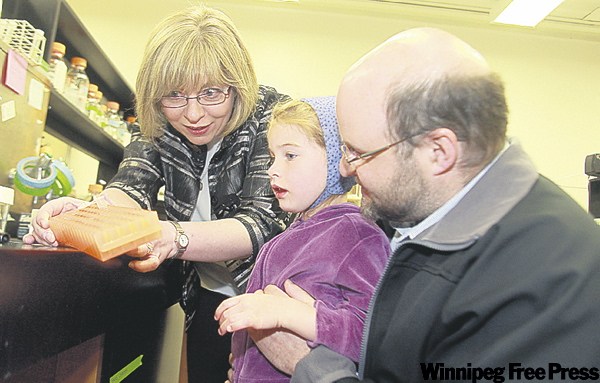
Dr. Cheryl Rockman-Greenberg, one of the lead researchers, said doctors have historically diagnosed BCS based on these physical characteristics but now a diagnostic test will eliminate any doubt. She was quick to note the findings, which discovered a protein decrease in the gene, do not mean that a cure, or even treatment, is imminent.
"Our next step is to find out how the protein decrease ultimately leads to the signs and symptoms we see. Then we can develop strategies to try to increase the protein. We want to increase production of the protein so it will allow these children to grow and develop normally," she said, noting the genetic findings will likely help identify similar abnormalities in non-Hutterite children that have remained unexplained to date.
Rockman-Greenberg said the team was able to identify the gene by comparing the DNA of Hutterite families who carry BCS with healthy DNA. Many Hutterite families who have lost children to BCS participated in the study.
She said the relatively small gene pool of Hutterite colonies played a role in BCS being limited to its populations in Manitoba, Saskatchewan, Alberta and the northwest U.S.
"The Hutterite people who came to North America were descendants of a limited number of families," she said.
Karl Kleinsasser, a member of the Crystal Spring Hutterite colony in Ste. Agathe, said participating families want to do what they can so future parents can avoid the heartbreak of losing a baby.
His son, Adam, was born in October 2005 but succumbed to BCS six months later.
"We found out when he was three days old. For the first two days, you wouldn’t have known there were any problems," he said.
His family dealt with the devastating news on a day-by-day basis, he said.

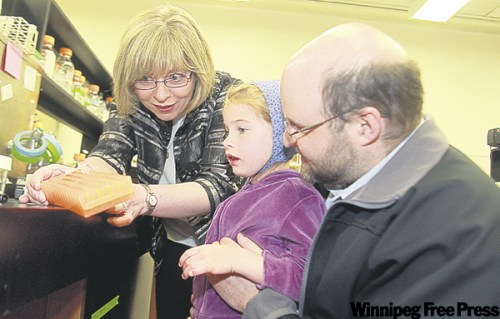
"Any parent with a sick child, you do what you have to do. You adjust. It’s your child. You just cope," he said, flanked by his five-year-old daughter, Kenzie.
Kleinsasser said because he and his wife both carry the gene, their offspring have a 50 per cent chance of being born with BCS. Still, they chose to increase the size of their family — and have had two healthy children since Adam’s death.
"You’ve lost a child but you’d like to replace that ache somehow. You’re starting to play with numbers. Do you want to risk having more children? It’s Russian roulette but not with your own life. The child will be doing most of the suffering," he said.
geoff.kirbyson@freepress.mb.ca