Older people need to talk comfortably with their MD
Advertisement
Read this article for free:
or
Already have an account? Log in here »
To continue reading, please subscribe:

Digital Subscription
One year of digital access for only $205*
- Enjoy unlimited reading on winnipegfreepress.com
- Read the E-Edition, our digital replica newspaper
- Access News Break, our award-winning app
- Play interactive puzzles
*First annual payment billed as $205.00 + GST for one year. This annual subscription will automatically renew at $233.00 + GST every 52 weeks (10% off the regular annual price of $259.35). Offer available to new and qualified returning subscribers only. Cancel any time.
To continue reading, please subscribe:
Add Free Press access to your Brandon Sun subscription for only an additional
$1 for the first 4 weeks*
- Enjoy unlimited reading on winnipegfreepress.com
- Read the E-Edition, our digital replica newspaper
- Access News Break, our award-winning app
- Play interactive puzzles
*Your next Brandon Sun subscription payment will increase by $1.00 and you will be charged $17.95 plus GST for four weeks. After four weeks, your payment will increase to $24.95 plus GST every four weeks.
Read unlimited articles for free today:
or
Already have an account? Log in here »
Hey there, time traveller!
This article was published 07/11/2009 (6171 days ago), so information in it may no longer be current.
CHANGING physicians can be wrenching for older patients. My mother never got over it when her longtime doctor retired. The "new" doctor took care of Mom for more than 15 years, but she would still tell him what she thought he wanted to hear. Ironically, the frailer Mom grew, the less forthright she became.
Now, my 70-something aunt, who has diabetes and Parkinson’s disease, is going through a similar change. Her longtime physician is shifting to an endocrinology-only practice and has asked patients to find another primary care doctor.
As is widely recommended, she brought to her first appointment a list of all the medications she’s taking. But she also brought a sheet of paper on which she briefly described her youth, marriage, motherhood and other seminal life events, things essential to her personhood that she wanted her new physician to know.
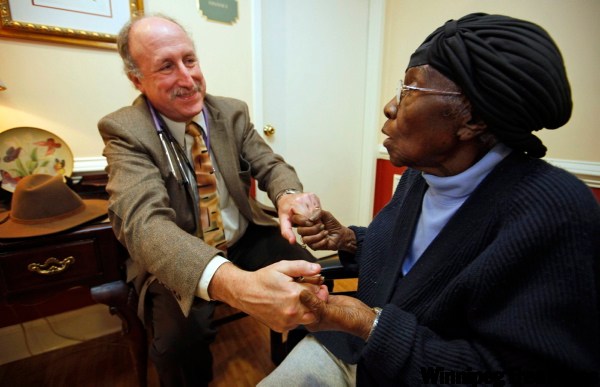
Did my aunt talk about her fear that she’ll become progressively disabled because of her Parkinson’s? I suspect not. That’s a hard thing to share with a total stranger, even one who has a thick file containing your medical history on her desk.
For others going through something similar, the National Institute on Aging has a helpful publication, "Talking With Your Doctor: A Guide for Older People." (For an online version: www.nia.nih.gov/HealthInformation/Publications/TalkingWithYourDoctor.) The aging institute is part of the National Institutes of Health.
The guide’s fundamental message is clear: "When you’re older, it becomes even more important to talk often and comfortably with your doctor."
Don’t be rushed: It’s up to you to intervene if you feel a physician is rushing through an appointment without really taking the time to address your concerns. The guide has a script that an older person can use: "I know you have many patients to see, but I’m really worried about this. I’d feel much better if we could talk about it a little more."
Discuss medications: Too often older patients don’t talk about their medications, even when they feel the drugs aren’t working. A 2007 study in the Journal of General Internal Medicine found that 27 per cent of seniors who decided to skip doses or stop taking a drug because of side effects hadn’t discussed the matter with their physicians.
The report also found that 24 per cent of seniors with three or more chronic medical conditions hadn’t talked about their complicated drug regimens with physicians. And older patients who discuss prescription drugs with doctors are more likely to be switched to low-cost generic versions, the research found.
— Chicago Tribune
Take checklist with you
What are the common side effects? What should I pay attention to?
When will the medicine begin to work?
What should I do if I miss a dose?
Do I take it at meals or between meals? Do I need to drink a glass of water with it?
Are there foods, drugs or activities I should avoid while taking this medicine?
Source: Talking With Your Doctor, from the National Institute on Aging