Singh would use federal money to ‘encourage’ provinces on health services

Advertisement

Advertise with us

WELLAND, Ont. - The billions of dollars the federal government transfers to provinces for health care give Ottawa leverage that NDP Leader Jagmeet Singh says he'd use to push for better local services.

Read this article for free:


or

Already have an account? Log in here »

To continue reading, please subscribe:

Subscribe and receive a limited-edition Free Press branded hat or tote.

Digital Subscription

One year of digital access for only $205*

  • Enjoy unlimited reading on winnipegfreepress.com
  • Read the E-Edition, our digital replica newspaper
  • Access News Break, our award-winning app
  • Play interactive puzzles

*First annual payment billed as $205.00 + GST for one year. This annual subscription will automatically renew at $233.00 + GST every 52 weeks (10% off the regular annual price of $259.35). Offer available to new and qualified returning subscribers only. Cancel any time.

To continue reading, please subscribe:

Add Free Press access to your Brandon Sun subscription for only an additional

$1 for the first 4 weeks*

  • Enjoy unlimited reading on winnipegfreepress.com
  • Read the E-Edition, our digital replica newspaper
  • Access News Break, our award-winning app
  • Play interactive puzzles
Start now

*Your next Brandon Sun subscription payment will increase by $1.00 and you will be charged $17.95 plus GST for four weeks. After four weeks, your payment will increase to $24.95 plus GST every four weeks.

Hey there, time traveller!
This article was published 17/10/2019 (2544 days ago), so information in it may no longer be current.

WELLAND, Ont. – The billions of dollars the federal government transfers to provinces for health care give Ottawa leverage that NDP Leader Jagmeet Singh says he’d use to push for better local services.

Earlier this week, Singh told the Winnipeg Free Press he would push for a particular emergency room in that city to be re-opened. He also kicked off his campaign by promising to get a new hospital built in Brampton, Ont.

But health care is a provincial responsibility and decisions about hospital operations and services are made by provincial governments, not federal leaders.
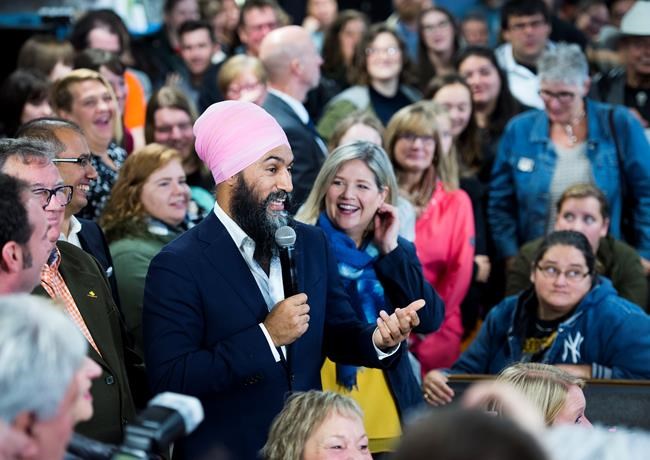
NDP leader Jagmeet Singh, left, and provincial NDP leader Andrea Horwath, right, speak to supporters at the Blue Star diner during a campaign stop in Welland Ont., on Thursday, October 17, 2019. THE CANADIAN PRESS/Nathan Denette

“We don’t have the power to force anything, but we have the power to be persuasive. We have the power to encourage things,” Singh told reporters during a campaign stop in Welland, Ont.

“When we negotiate things like universal pharmacare and dental care … we can sit down with provinces and talk about when we’re increasing investments, we want to see better health care services.”

A number of Singh’s signature platform promises would require provincial buy-in, including his pledge to implement a national pharmacare program by 2020 and to ensure all families in Canada have access to quality, affordable child care.

Singh has admitted he hasn’t spoken to any premiers during the campaign to see how he could make these plans work, but notes three of his key campaign promises can be implemented without provincial co-operation. For example, his pledge to make dental care coverage public could be enacted though a program like employment insurance, Singh said, and his plan to lower cell phone bills through a price cap imposed by the Canadian Radio-television and Telecommunications Commission (CRTC).

While it’s not unusual or unprecedented for the federal government to attach conditions to federal transfers to the provinces, getting as specific as re-opening an ER or building a hospital is unusual, says Gerald Baier, an associate professor of political science at the University of British Columbia who specializes in intergovernmental relations.

“(Those are) not the kinds of conditions normally imposed,” he said, noting they are usually “much more general, historically, though they may be targeted to specific programs or services.”

Meanwhile, when it comes to the provincial jurisdiction of Quebec over its controversial secularism law, Singh has tried to give that a wide berth.

Known as Bill 21, the law bans civil servants in positions of authority from wearing religious symbols and is popular in Quebec.

Every time he’s been pressed to say whether that means he’d seek intervener status in a court challenge of this law, so the federal government could make arguments, Singh has said he doesn’t want to “interfere.”

Fareed Khan, founder of Canadians United Against Hate told The Canadian Press last week he has been “gobsmacked” at Singh’s lack of conviction to go after the bill.

“Of all the people, I would think he would be the one who would be leading the charge to say not only is this wrong but were I to become prime minister I would immediately take action legally,” said Khan, referring to the fact Singh wears a turban and a kirpan as symbols of his Sikh faith. Singh would be personally affected by the law if he tried to work as a teacher, for example, in Quebec.

When asked about why he’s willing to get involved in provincial matters of health services while staying away from Bill 21, Singh sidestepped the question.

“I think (that) speaks entirely to a strategy not to offend or challenge Quebec voters who support the secularism law,” Baier said.

“No other good reason.”

Although the law only affects Quebec, the stances federal leaders are taking on whether they would use federal powers to challenge it as discriminatory have become an issue both within and outside Quebec in the federal campaign, a test for how far federal leaders are willing to go to support minority rights.

Campaigning in Quebec on Thursday, Liberal Leader Justin Trudeau did not answer a direct question about whether he thinks Bill 21 is discriminatory, instead saying a re-elected Liberal government is open to intervening later.

“We have Quebecers taking their government to court right now to challenge a law that they feel is unjust,” Trudeau said at a campaign stop in Trois-Rivieres, Que.

“We are not going to intervene in this step of the process, but as I’ve said, a federal government always needs to be ready to defend fundamental rights, whether it be women’s rights, LGBT rights, rights of minorities or rights of francophone communities outside of Quebec,” he said.

Earlier this week in Quebec City, Conservative Leader Andrew Scheer was also asked directly whether he thinks Bill 21 is discriminatory. He, like Trudeau, sidestepped, and repeated a previous commitment that he wouldn’t intervene.

Singh spent his day campaigning in key swing ridings outside Toronto that polls suggest are still too close to call.

He drew the party’s biggest crowd of the campaign in an evening rally in Brampton East — a seat without an incumbent after Liberal MP Raj Grewal, who took a leave from federal politics to deal with gambling problem, decided not to re-offer.

The New Democratic leader told the crowd he felt the economy has been “rigged” against ordinary people and pledged to “tax the rich” to rectify this imbalance.

This report by The Canadian Press was first published Oct. 17, 2019.

—With files from Joanna Smith in Trois-Rivieres

Report Error Submit a Tip

More Stories

Living the dream

Ken Wiebe 7 minute read Preview

Living the dream

Ken Wiebe 7 minute read Yesterday at 4:48 PM CDT

DETROIT – As Tyrel Bauer took a left turn out of the tunnel from the Winnipeg Jets dressing room and into the stands, he was met with a hearty round of applause from the 25 friends and family members who had made the trek from various points around North America.

Bauer had just realized a childhood dream and the significance of the moment was not lost on some of his biggest supporters.

“It was a special walk, for sure. A special walk,” Bauer said on Saturday afternoon before the Jets departed for a two-game road trip that begins on Sunday in Detroit against the Red Wings. “Those people who came – and many more that weren’t there and were cheering on from afar – they’ve always been there.

“I wanted that for my family, maybe even more than I wanted it for me. They’ve been through thick and thin. I’ve stressed mom out quite a bit over the years doing my job. That meant a lot for them and I’m really happy they could be there for it.”

Read
Yesterday at 4:48 PM CDT

Winnipeggers witness unveiling of Japanese Canadian monument in B.C.

Morgan Modjeski 6 minute read Preview

Winnipeggers witness unveiling of Japanese Canadian monument in B.C.

Morgan Modjeski 6 minute read Yesterday at 8:39 PM CDT

As Miki Stewart gathered with her family at the Japanese Cultural Association of Manitoba on Saturday afternoon, she was thinking of her parents, Yoshimaru and Yoshi Abe.

Both Stewart, 80, and her sister Yumi Falk, 81, alongside an older brother, were born in the Tashme internment camp in British Columbia. They were among more than 2,600 Japanese Canadians who were forcefully removed and interred at the camp following the bombing of Pearl Harbour and Canada’s declaration of war on Japan in 1941.

“They didn’t talk much about how they suffered,” Stewart said of her parents. “But they did.”

She was amongst a group of more than 150 people who gathered at the association’s McPhillips headquarters on Saturday afternoon to watch the unveiling of the Japanese Canadian Monument in Victoria B.C.

Read
Yesterday at 8:39 PM CDT

A day on the campaign trail: Winnipeg's mayor, seeking a second term, does double duty

Malak Abas 12 minute read Preview

A day on the campaign trail: Winnipeg's mayor, seeking a second term, does double duty

Malak Abas 12 minute read Friday, Oct. 2, 2026

In the weeks leading up to the civic election, Scott Gillingham has been performing a juggling act: he’s running to be Winnipeg’s 45th mayor, while still serving as its 44th.

“If someone asks me about the campaign, I’m going to answer them. But I think for most people, I’m the mayor of Winnipeg, even if I’m showing up as a candidate,” Gillingham, 58, says. “I try to do all I can to maintain that distinction.”

The Free Press joined Gillingham on a recent rainy September Saturday on the campaign trail, where he served in both roles during an event-laden day. City council’s final meeting before the Oct. 28 election was days earlier.

In Winnipeg, it’s rare for an incumbent to be defeated. But Gillingham knows his win in 2022 wasn’t exactly a landslide — he won with 27.5 per cent of the vote — and he’s been thinking about his second term ever since.

Read
Friday, Oct. 2, 2026

Moving drama at MTYP gives voice to boy who changed law

Holly Harris 5 minute read Preview

Moving drama at MTYP gives voice to boy who changed law

Holly Harris 5 minute read Yesterday at 2:37 PM CDT

The heroic true tale of Norway House Cree Nation-born Jordan River Anderson came home Friday night, as Manitoba Theatre for Young People presented Yvette Nolan’s Jordan.

The touring production, a collaboration with Geordie Theatre, runs weekends through Oct. 11, with additional stops in Toronto, Vancouver and Ottawa’s National Arts Centre.

Having several of Anderson’s family members witness the local première underscored the evening with poignancy. Elder and Pine Creek First Nation member Barbara Nepinak added her own dignified presence and prayers following MTYP artistic director Pablo Felices-Luna’s welcoming remarks.

The season-opener also marks the Winnipeg-raised playwright’s homecoming; the Algonquin playwright, director, dramaturg, actor and educator was a fixture in our local theatre community for many years before going on to serve as artistic director for Native Earth Performing Arts from 2003 to ‘11, among other contributions.

Read
Yesterday at 2:37 PM CDT

Broadening prediction-market gambling a bad idea

Editorial 4 minute read Preview

Broadening prediction-market gambling a bad idea

Editorial 4 minute read Yesterday at 2:01 AM CDT

Let’s make a prediction: sooner or later, when Canadian governments find a way to take their own cut of the action, prediction-contract gambling on everything from sports to entertainment to political decisions is going to come to Canada.

And that’s a horrible, dangerous, pernicious idea.

Unless you have particular access to information — either inside information or strategic information based on skills or education — you’re not likely to make money at it. In fact, structurally, you’re likely to lose. In prediction markets, you basically pay an amount, plus fees from the company involved, to bet on whether something will or will not happen within a certain time frame. The amount you pay for your contract depends on how other people are also betting.

As Wealthsimple describes it, “You buy whichever side you think is right. Prices move with demand, so if the market leans towards one outcome, the more that side costs. If a lot of people are backing the TSX to finish above 38,000, yes gets more expensive and no gets cheaper.”

Read
Yesterday at 2:01 AM CDT

Mayoral candidate Vogiatzakis criticized for living outside Winnipeg

Malak Abas 4 minute read Preview

Mayoral candidate Vogiatzakis criticized for living outside Winnipeg

Malak Abas 4 minute read Friday, Oct. 2, 2026

A mayoral hopeful took heat from other candidates Friday for living outside Winnipeg while running in the civic election.

Mike Vogiatzakis’s primary residence is in the Rural Municipality of St. Andrews, about 25 kilometres north of Winnipeg — a community with its own mayor and councillors.

But the funeral director said he owns a home in Winnipeg where he divides his time, and he would move to the city full-time if elected mayor.

“It doesn’t matter where a person lives. Why are we dividing St. Andrews and Manitoba and Winnipeg? I’ve met the criteria to run for mayor,” Vogiatzakis said Friday morning.

Read
Friday, Oct. 2, 2026