Ontario making bars and restaurants close earlier, shuts down strip clubs

Advertisement

Advertise with us

TORONTO - Bars and restaurants across Ontario will shut down earlier and all strip clubs will close, Premier Doug Ford announced Friday, saying the new rules were needed to fight a surge in COVID-19 cases.

Read this article for free:


or

Already have an account? Log in here »

To continue reading, please subscribe:

Subscribe and receive a limited-edition Free Press branded hat or tote.

Digital Subscription

One year of digital access for only $205*

  • Enjoy unlimited reading on winnipegfreepress.com
  • Read the E-Edition, our digital replica newspaper
  • Access News Break, our award-winning app
  • Play interactive puzzles

*First annual payment billed as $205.00 + GST for one year. This annual subscription will automatically renew at $233.00 + GST every 52 weeks (10% off the regular annual price of $259.35). Offer available to new and qualified returning subscribers only. Cancel any time.

To continue reading, please subscribe:

Add Free Press access to your Brandon Sun subscription for only an additional

$1 for the first 4 weeks*

  • Enjoy unlimited reading on winnipegfreepress.com
  • Read the E-Edition, our digital replica newspaper
  • Access News Break, our award-winning app
  • Play interactive puzzles
Start now

*Your next Brandon Sun subscription payment will increase by $1.00 and you will be charged $17.95 plus GST for four weeks. After four weeks, your payment will increase to $24.95 plus GST every four weeks.

Hey there, time traveller!
This article was published 25/09/2020 (2172 days ago), so information in it may no longer be current.

TORONTO – Bars and restaurants across Ontario will shut down earlier and all strip clubs will close, Premier Doug Ford announced Friday, saying the new rules were needed to fight a surge in COVID-19 cases.

Ford said the latest restrictions would help reduce transmission in high-risk businesses.

Bars and restaurants will now be required to close at midnight, except for takeout and delivery, and will have to stop serving alcohol by 11 p.m.
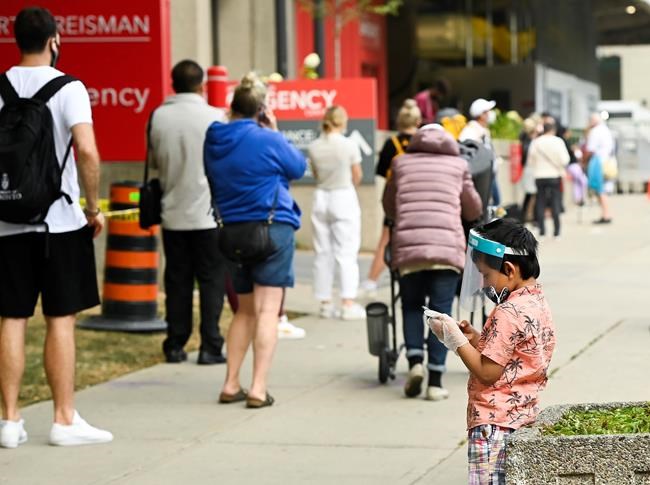
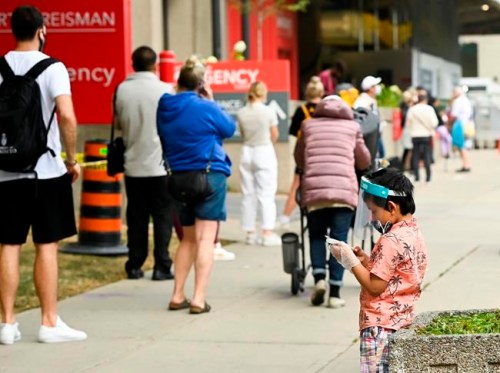
A young boy plays on a phone as he waits in line at a COVID assessment centre at Mount Sinai Hospital during the COVID-19 pandemic in Toronto on Thursday, September 24, 2020. THE CANADIAN PRESS/Nathan Denette

“We’ve seen doubling in cases in a very short period of time and it’s very, very concerning,” Ford said. “There’s been outbreaks and … we just can’t chance it.”

Some mayors in the Greater Toronto Area had requested similar measures for weeks, and Ford had initially resisted taking action, saying municipalities had the power to impose restrictions on businesses under public health regulations if they wanted to.

On Friday, however, Ford said a change was necessary.

“We just can’t have these places open until three o’clock in the morning,” he said. “But we’re being very balanced, I feel.”

The new rules follow a decision by the province last week to change limits on social gatherings, lowering the number of people permitted at outdoor events to 25 and indoor events to 10.

A spokesman for Restaurants Canada said Friday that the government had not shown that organization any data to backup the restrictions, but the businesses will continue to do their part to fight the pandemic.

James Rilett, the group’s vice-president of Central Canada, said the new restrictions would have a detrimental impact on night clubs and bars, many of which are already struggling to survive.

“It will have an incredibly bad impact on some restaurants at a time where you have historic debt loads and you’re starting to close down outdoor patios,” he said.

Green party Leader Mike Schreiner said with the new restrictions on bars and restaurants in place the province must offer some financial support.

“I feel for owners and employees who will be affected by these new restrictions,” he said in a statement. “(They) must be accompanied by help for small businesses to stay afloat during a second wave.”

NDP Leader Andrea Horwath said the Ford government has let COVID-19 infections rise by delaying putting new public health measures in place.

“We are teetering on another health and economic disaster because this government has not been listening, and not been acting,” she said in a statement.

Ford also announced Friday that the province will spend an additional $741 million to help clear a backlog of surgeries that has developed at Ontario hospitals during the pandemic.

Health Minister Christine Elliott said the funds will help the health-care system to build more capacity to manage surges in COVID-19 cases and outbreaks.

“We are working directly with our health-care partners to ensure our … system is ready to respond to the challenges that we face with future waves of COVID-19,” she said.

The president of the Ontario Hospital Association warned Friday that the pandemic is straining health-care resources across the province and further action will be needed to respond to rising case rates.

Anthony Dale said currently hospitals are running assessment centres, processing COVID-19 tests, helping manage some long-term care homes, working to cut the surgical backlogs and handling their normal operations.
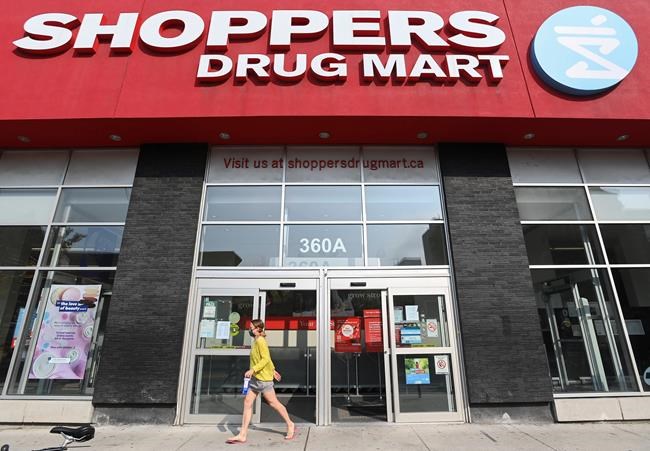
A woman leaves a Shoppers Drug Mart store where they are providing COVID-19 testing by appointment only during the COVID-19 pandemic in Toronto on Friday, September 25, 2020. THE CANADIAN PRESS/Nathan Denette

“Any serious wave of COVID-19 means that it will be impossible for hospitals to continue all those roles at once, full stop,” he said. “And the only way to keep hospitals functioning in the way that the public wants and expects is to help stop the spread of COVID-19.”

Dale urged people across the province to follow basic health guidelines like practising physical distancing, hand-washing and wearing a mask to stop the rise in case numbers.

“I think it’s about helping people understand that things have changed, and change very quickly, in just a little under two weeks,” he said. “And we don’t have much time at all.”

Ontario reported 409 new cases of COVID-19 on Friday, and one new death related to the virus.

The province said it processed 41,865 tests over the previous day, with another 65,227 under investigation.

Meanwhile, Toronto’s top public health official ordered four hospitality businesses to close on Friday.

The businesses were flouting public health protocols and evading investigators, Dr. Eileen de Villa said, adding that some were pressuring staff to work, even when sick.

The businesses, whose names she did not share because the operation to shut them down was not yet complete, will be allowed to reopen once the city is satisfied they’ll follow the rules.

Also in Toronto, officials declared an outbreak at Glen Park Public School in North York — the city’s first school-based outbreak — after two students tested positive for the virus.

Two class cohorts — one with 17 children and the other with 18 — were sent home to self-isolate for 14 days, as was one staff member, de Villa said.

“All steps have been followed as expected in a situation of this nature,” she said.

“One of the realities of living in a world with COVID-19 is that there will be cases in schools. Today’s news is expected. I expect there will be similar announcements in future and you can be confident the steps developed to manage the situation and reduce the risk of spread will be followed.”

This report by The Canadian Press was first published Sept. 25, 2020.
Report Error Submit a Tip

More Stories

Agriculture sector wary of ‘strong headwind’ from south

Laura Rance-Unger 5 minute read Yesterday at 2:01 AM CDT

Industry analysts talked in circles on a recent webinar as they discussed the implications for agriculture of Canada’s deteriorating relationship with its largest trading partner.

On one hand, panellists for the hastily convened Canadian AgriFood Policy Institute event acknowledged the futility of negotiating on quicksand: a deal made today with the United States might be sucked into the muck tomorrow.

But on the other, webinar panellists speculated with varying degrees of optimism over what it will take to get negotiators back to bargaining.

This disconnect isn’t unique to this cluster of analysts. However, it underscores the difficulty of coming to terms with the seismic shift in America’s attitudes towards Canada.

For newcomer pizza purveyors, it’s all about crafting solid foundations

David Sanderson 7 minute read Preview

For newcomer pizza purveyors, it’s all about crafting solid foundations

David Sanderson 7 minute read Yesterday at 2:00 AM CDT

A recent poll conducted by an Internet-based market-research firm determined that close to 20 per cent of people eschew their leftover pizza crust.

Some argued that the residual crust lacks flavour. Others submitted that it’s too hard or crunchy to enjoy sans toppings. Given that information, what are we to make of Crusty Craft Pizza, a five-month-old takeout spot whose owners are so confident in their European-style pizza crust that they’ve chosen to highlight it in their business moniker?

Whenever somebody informs them they don’t like pizza crust, their response is, well, they haven’t tried theirs, says Oleksii Samokvhal, who together with his wife, Iryna Mehedyn, opened Crusty Craft Pizza in early April, at 1311 Day St. in Transcona.

“It’s thin in the middle, with raised edges we hand-form ourselves,” says Mehedyn, a native of Ukraine who, like her Kyiv-born husband, relocated to Winnipeg to escape the conflict in their home country.

Read
Yesterday at 2:00 AM CDT

NDP minister needs lesson in political civility

Dan Lett 5 minute read Preview

NDP minister needs lesson in political civility

Dan Lett 5 minute read Friday, Sep. 4, 2026

Families Minister Nahanni Fontaine’s decision to intercede in Winnipeg’s mayoral election may be surprising to some political observers. To others, however, it is entirely on brand.

On Tuesday, Fontaine posted a video on social media in which she expressed concern that former city councillor and Progressive Conservative cabinet minister Kevin Klein was entering the race to challenge incumbent Mayor Scott Gillingham.

The caption on the video was blunt: “I mean, really, who chooses to work for Count Dracula?”

“Kevin Klein once worked for Peter Nygard. Peter Nygard is Canada’s equivalent to (American sex offender) Jeffrey Epstein — had his own little island, did unspeakable, disgusting things to women and girls … anyways, I just thought that Winnipeggers would want to know that Kevin Klein, at one point, worked for Peter Nygard,” she says in the video.

Read
Friday, Sep. 4, 2026

Letters, Sept. 5

7 minute read Yesterday at 2:01 AM CDT

Clearing the airRe: QDoc patients in middle of billing dispute (Sept. 4)

QDoc has been fortunate to have a genuine partner in the Manitoba government over the past several years. Premier Wab Kinew and Health Minister Uzoma Asagwara have been consistently clear that no Manitoban should go without care because of where they live, and that commitment is exactly why virtual care exists as a permanent, publicly available option today. We built MediNav, the province’s online appointment booking system, together with Manitoba Health, and that same collaborative spirit has helped make more than 350,000 patient visits possible through our platform — many of them evenings, overnights and weekends, reaching rural and underserviced communities that need it most.

We want to be direct with the people who rely on us: QDoc is not going anywhere. We continue to see patients today, and we will keep doing so tomorrow. The issue reported this week is a technical billing matter, not a service disruption, and we are actively working with the province to resolve it quickly, so we can keep growing our capacity to serve Manitobans rather than limiting it.

We also want to take responsibility for our part in the recent confusion. Our Aug. 24 message to a small subset of our patients was meant to keep our community informed, but its tone left some people more worried than they needed to be, and for that we apologize. That was never our intention.

Dynacare labs quickly reach capacity ahead of strike

Nicole Buffie 5 minute read Preview

Dynacare labs quickly reach capacity ahead of strike

Nicole Buffie 5 minute read Yesterday at 3:06 PM CDT

Patients were being turned away from several Dynacare locations Saturday morning as people packed the labs in hopes of getting their blood collection done before workers strike.

By 10:30 a.m. the lobby at the Dynacare at 1581 Regent Ave. was standing-room only and walk-up patients were being turned away as the wait time for those lucky enough to get in creeped past two hours.

One woman got in right before workers cut off walk-ins at 10 a.m. after travelling to two other locations.

“I was driving by at 7:15 this morning and there was already a line-up to the road, so I was like ‘nope, not going there’ so I went to the one on Sterling Lyon (Parkway) and it was closed, and then I went to the one at St. Vital Mall and there had a line zig-zagging all the way through the corridors so I gave up and came back,” said Joanna, who declined to give her last name.

Read
Yesterday at 3:06 PM CDT

Smith’s pretzel logic confuses

Editorial 4 minute read Preview

Smith’s pretzel logic confuses

Editorial 4 minute read Yesterday at 2:01 AM CDT

Alberta Premier Danielle Smith had both sides of her mouth working overtime on Aug. 30, when she spoke at an event in Calgary to commemorate Alberta Day, the annual celebration of the province’s entry into Confederation in 1905 (officially Sept. 1, it was celebrated on the weekend).

Smith’s comments — and the things she did not say — revealed a lot about the political tightrope the premier is trying to walk over the challenges currently faced by her province. At the top of that list of challenges is a persistent campaign to separate Alberta from the aforementioned Confederation. A campaign that Smith appears to both support and oppose, depending on which day of the week it is.

Her Alberta Day remarks were an excellent case in point.

Smith has decided that on Oct. 19, Albertans will vote on a series of non-binding propositions in a province referendum. One of those questions will ask Albertans whether they want to hold a referendum on separation, thus making this fall’s vote a “referendum on whether to hold a referendum,” as some observers have dubbed it.

Read
Yesterday at 2:01 AM CDT