‘The future is raising its voice’: A dire mood at UN meeting
Advertisement
Read this article for free:
or
Already have an account? Log in here »
To continue reading, please subscribe:

Digital Subscription
One year of digital access for only $205*
- Enjoy unlimited reading on winnipegfreepress.com
- Read the E-Edition, our digital replica newspaper
- Access News Break, our award-winning app
- Play interactive puzzles
*First annual payment billed as $205.00 + GST for one year. This annual subscription will automatically renew at $233.00 + GST every 52 weeks (10% off the regular annual price of $259.35). Offer available to new and qualified returning subscribers only. Cancel any time.
To continue reading, please subscribe:
Add Free Press access to your Brandon Sun subscription for only an additional
$1 for the first 4 weeks*
- Enjoy unlimited reading on winnipegfreepress.com
- Read the E-Edition, our digital replica newspaper
- Access News Break, our award-winning app
- Play interactive puzzles
*Your next Brandon Sun subscription payment will increase by $1.00 and you will be charged $17.95 plus GST for four weeks. After four weeks, your payment will increase to $24.95 plus GST every four weeks.
Read unlimited articles for free today:
or
Already have an account? Log in here »
Hey there, time traveller!
This article was published 21/09/2021 (1837 days ago), so information in it may no longer be current.
UNITED NATIONS (AP) — Racism, climate change and worsening divisions among nations and cultures topped the agenda Wednesday as leaders from China to Costa Rica, from Finland to Turkey to the United Nations itself outlined reasons why the world isn’t working as it should — and what must be done quickly to fix it. Said one country’s president: “The future is raising its voice at us.”
For the first time since the COVID-19 pandemic began early last year, more than two dozen world leaders appeared in person at the U.N. General Assembly on the opening day of their annual high-level meeting Tuesday. In speech after speech, the atmosphere was somber, angry and dire.
Chinese President Xi Jinping warned that “the world has entered a period of new turbulence and transformation.” Finland President Sauli Niinistö said: “We are indeed at a critical juncture.” And Costa Rican President Carlos Alvarado Quesada declared: “The future is raising its voice at us: Less military weaponry, more investment in peace!”
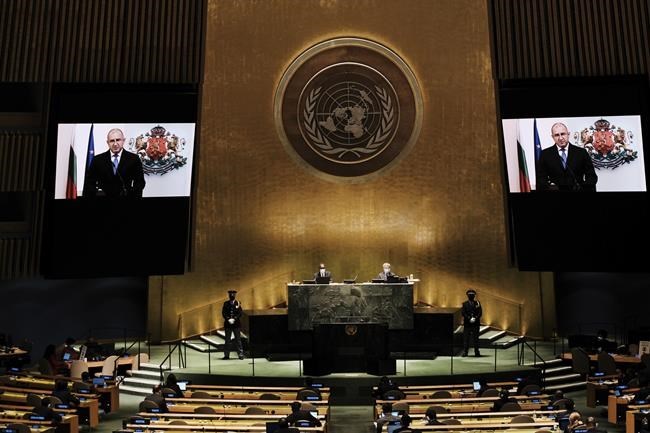
Speaker after speaker at Tuesday’s opening of the nearly week-long meeting decried the inequalities and deep divisions that have prevented united global action to end the COVID-19 pandemic, which has claimed nearly 4.6 million lives and is still raging, and the failure to sufficiently tackle the climate crisis threatening the planet.
COVID-19 and climate are certain to remain top issues for heads of state and government. But Wednesday’s U.N. agenda will first turn the spotlight on the commemoration of the 20th anniversary of the controversial U.N. World Conference Against Racism in Durban, South Africa, which was dominated by clashes over the Middle East and the legacy of slavery.
The U.S. and Israel walked out during the meeting over a draft resolution that singled out Israel for criticism and likened Zionism to racism — a provision that was eventually dropped. Twenty countries are boycotting Wednesday’s commemoration, according to the Conference of Presidents of Major American Jewish Organizations, which urged more countries to join them “in continuing to fight racism, bigotry, and anti-Semitism.”
Following the commemoration, heads of state will start delivering their annual addresses again in the vast General Assembly hall. Speakers include King Abdullah II of Jordan, Indonesian President Joko Widodo and Kenyan President Uhuru Kenyatta.
Perhaps the harshest assessment of the current global crisis came from U.N. Secretary-General Antonio Guterres, who opened his state of the world address sounding an “alarm” that “the world must wake up.”
“Our world has never been more threatened or more divided,” he said. “We face the greatest cascade of crises in our lifetimes.”
“We are on the edge of an abyss — and moving in the wrong direction,” the secretary-general warned.
Guterres pointed to “supersized glaring inequalities” in addressing COVID-19, “climate alarm bells … ringing at fever pitch,” upheavals from Afghanistan, Ethiopia, Yemen and beyond thwarting peace, and “a surge of mistrust and misinformation (that) is polarizing people and paralyzing societies.”
Turkey’s President Recep Tayyip Erdogan said the pandemic was a reminder “that the entire world are part of a big family.”
“But the solidarity test that we were put to failed us miserably,” he said. “It is a disgrace for humanity that vaccine nationalism is still being carried on through different methods,” and underdeveloped countries and poor segments of societies have been “literally left to their fate in the face of the pandemic.”
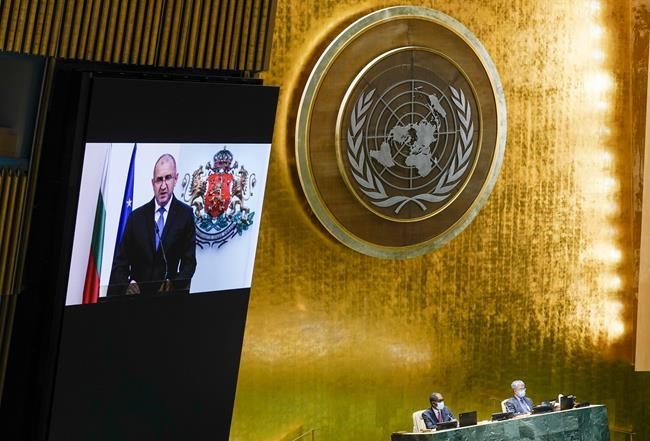
As for the climate crisis, Erdogan said whoever did the most damage to nature, the atmosphere and water, “and whoever has wildly exploited natural resources” should make the greatest contribution to fighting global warming.
“Unlike the past, this time no one can afford the luxury to say, ‘I’m powerful so I will not pay the bill’ because climate change will treat mankind quite equally,” the Turkish leader said. “The duty for all of us is to take measures against this enormous threat, with a fair burden-sharing.”
Romania’s President Klaus Iohannis did find something positive from the COVID-19 crisis.
“While the pandemic affected almost all aspects of our lives,” he said, “it also provided us with opportunities to learn, adapt and do things better.”
Two of the most closely watched speeches on Tuesday were delivered by U.S. President Joe Biden and Chinese President Xi Jinping.
In an Associated Press interview on Saturday, Guterres warned that the world could plunge into a new and probably more dangerous Cold War if China and the United States don’t repair their “completely dysfunctional” relationship. “Unfortunately, today we only have confrontation,” he said.
Biden said in his U.N. address that the United States was not attempting to be divisive or confrontational.
“We are not seeking a new Cold War or a world divided into rigid blocs,” he said. “The United States is ready to work with any nation that steps up and pursues peaceful resolution to shared challenges even if we have intense disagreements in other areas.”
Speaking later, Xi said disputes among countries “need to be handled through dialogue and cooperation.”

“One country’s success does not have to mean another country’s failure,” Xi said. “The world is big enough to accommodate common development and progress of all countries.”

By tradition, the first country to speak was Brazil, whose president, Jair Bolsonaro rebuffed criticism of his handling of the pandemic and touted recent data indicating less Amazon deforestation. He said he was seeking to counter the image of Brazil portrayed in the media, touting it as a great place for investment and praising his pandemic welfare program, which helped avoid a worse recession last year.
Bolsonaro said that his government has successfully distributed first doses to the majority of adults, but doesn’t support vaccine passports or forcing anyone to have a shot. He has said several times in the past week that he remains unvaccinated. He had COVID-19 last year.
Brazil’s health minister, Marcelo Quiroga, who was with Bolsonaro, later tested positive for the coronavirus and will remain in isolation in the United States, the government said. Quiroga got his first shot of coronavirus vaccine in January.
___
Edith M. Lederer, chief U.N. correspondent for The Associated Press, has been reporting internationally for nearly 50 years. Follow her on Twitter at http://twitter.com/EdithLedererAP
Related Articles
'Grow up': UK's Johnson says world must face climate change
Advertisement Advertise With Us
Advertisement Advertise With Us