Experts: Arizona executioners took too long to insert IV

Advertisement

Advertise with us

PHOENIX (AP) — The first execution in Arizona in nearly eight years was carried out more smoothly than the state’s last use of the death penalty, when a condemned prisoner who was given 15 doses of a two-drug combination gasped for air hundreds of times over nearly two hours.

Read this article for free:


or

Already have an account? Log in here »

To continue reading, please subscribe:

Subscribe and receive a limited-edition Free Press branded hat or tote.

Digital Subscription

One year of digital access for only $205*

  • Enjoy unlimited reading on winnipegfreepress.com
  • Read the E-Edition, our digital replica newspaper
  • Access News Break, our award-winning app
  • Play interactive puzzles

*First annual payment billed as $205.00 + GST for one year. This annual subscription will automatically renew at $233.00 + GST every 52 weeks (10% off the regular annual price of $259.35). Offer available to new and qualified returning subscribers only. Cancel any time.

To continue reading, please subscribe:

Add Free Press access to your Brandon Sun subscription for only an additional

$1 for the first 4 weeks*

  • Enjoy unlimited reading on winnipegfreepress.com
  • Read the E-Edition, our digital replica newspaper
  • Access News Break, our award-winning app
  • Play interactive puzzles
Start now

*Your next Brandon Sun subscription payment will increase by $1.00 and you will be charged $17.95 plus GST for four weeks. After four weeks, your payment will increase to $24.95 plus GST every four weeks.

Hey there, time traveller!
This article was published 12/05/2022 (1592 days ago), so information in it may no longer be current.

PHOENIX (AP) — The first execution in Arizona in nearly eight years was carried out more smoothly than the state’s last use of the death penalty, when a condemned prisoner who was given 15 doses of a two-drug combination gasped for air hundreds of times over nearly two hours.

The lethal-injection death of Clarence Dixon on Wednesday at the state prison in Florence for his murder conviction in the 1978 killing of 21-year-old Arizona State University student Deana Bowdoin appeared to follow the state’s execution protocol: After the drug was injected, Dixon’s mouth stayed open and his body did not move. He was declared dead about 10 minutes later.

But death penalty experts Thursday that said the estimated 25 minutes it took medical staff to insert an IV into Dixon’s body was too long. The workers first tried and failed to insert an IV into his left arm before they were able to connect it in his right arm. They then opted to access a vein in his groin area for another IV line.
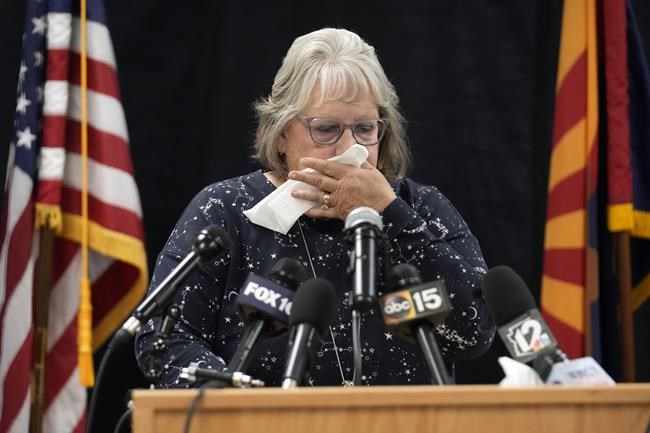
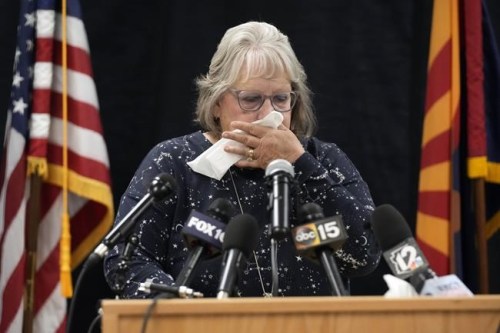
Leslie Bowdoin James, sister of Deana Lynne Bowdoin talks to the media on Wednesday, May 11, 2022, in Florence, Ariz. Inmate Clarence Dixon was put to death by lethal injection earlier Wednesday inside the state prison for his murder conviction in the killing of 21-year-old Arizona State University student Deana Bowdoin in 1978. Dixon was the first person to be executed in the state after a nearly eight-year hiatus in its use of the death penalty. (AP Photo/Rick Scuteri)

Deborah Denno, a Fordham Law School professor who has studied executions for more 25 years, said executions should take seven to 10 minutes from the beginning of the IV insertion process until the moment the prisoner is declared dead.

“It’s a sign of desperation (on the part of the execution team), and it’s a sign of an unqualified executioner,” Denno said.

Before Dixon was put to death, the last execution in Arizona took place in July 2014, when Joseph Wood was given 15 doses of a two-drug combination over nearly two hours. Wood snorted repeatedly and gasped before he died. The process dragged on for so long that the Arizona Supreme Court convened an emergency hearing during the execution to decide whether to halt the procedure.

Since then, Arizona changed its execution protocols, agreeing to no longer use one of the drugs — midazolam — that was injected into Wood. Instead, Dixon was executed with an injection of pentobarbital.

The problems with Wood’s death, combined with the difficulty the state faced in finding sources to sell it lethal injection drugs, led to the nearly eight-year hiatus in executions in Arizona.

Similar problems have occurred previously with medical workers trying to insert IV lines in condemned prisoners.

Alabama prison officials tried to execute a prisoner by lethal injection in February 2017 but had to stop because medical workers couldn’t find a suitable vein to connect the intravenous line. The prisoner died of cancer almost four years later.
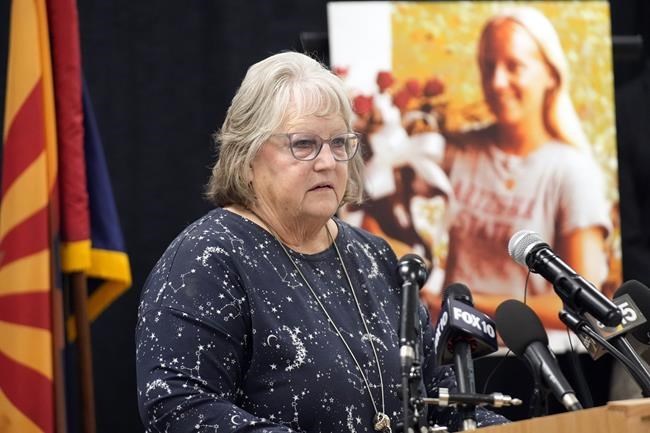
Leslie Bowdoin James, sister of Deana Lynne Bowdoin talks to the media on Wednesday, May 11, 2022, in Florence, Ariz. Inmate Clarence Dixon was put to death by lethal injection earlier Wednesday inside the state prison for his murder conviction in the killing of 21-year-old Arizona State University student Deana Bowdoin in 1978. Dixon was the first person to be executed in the state after a nearly eight-year hiatus in its use of the death penalty. (AP Photo/Rick Scuteri)

A November 2017 execution was called off in Ohio after members of the execution team told the state prisons director they couldn’t find a vein. The prisoner died of natural causes several months later.

And another lethal injection execution in Ohio was called off in September 2009 after two hours when technicians could not find a suitable vein for a condemned prisoner, who had cried in pain while receiving 18 needle sticks. He died in prison in late 2020 of possible complications of COVID-19.

Death penalty experts say the difficulty in finding IV lines could be attributed to a combination of the condemned prisoners’ physical conditions — such as past IV drug use, medical issues related to hydration or the effects of aging — and to untrained people trying to insert IV lines. It’s unknown whether the 66-year-old Dixon was ever an IV drug user.

Michael Radelet, a sociologist at the University of Colorado-Boulder who has researched the death penalty for 40 years, said the lingering element of Dixon’s death leads him to believe the execution was botched.

“I would classify it as a botch, recognizing that not everyone would agree with that. But things did not go right,” Radelet said.

In a statement Thursday, the Arizona Department of Corrections, Rehabilitation and Reentry said Dixon’s execution was carried out “flawlessly” and that it followed the state’s laws and execution protocols.

Rick Romley, who led the county prosecutor’s office in metro Phoenix that filed the murder charge against Dixon but left office before he was sentenced to death in January 2008, said the execution may have been more complicated than planned, but he didn’t consider it flawed. He said difficulty in finding veins to insert IV lines is common for people both inside and outside prison.
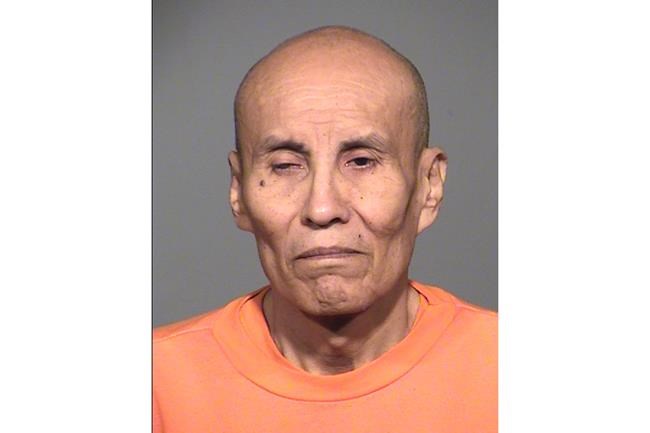
FILE - This undated file photo provided by the Arizona Department of Corrections shows Clarence Dixon. The first execution in Arizona in nearly eight years was carried out more smoothly than the state's last use of the death penalty, when a condemned prisoner who was given 15 doses of a two-drug combination gasped for air hundreds of times over nearly two hours. But death penalty experts say Wednesday's lethal-injection death of Clarence Dixon at the state prison in Florence took too long to carry out, as medical staff spent about 25 minutes to insert an IV. Similar problems have occurred before, leading lethal injection executions to be called off. (Arizona Department of Corrections, Rehabilitation and Reentry via AP, File)

“That doesn’t bother me at all,” Romley said.

Asked whether the difficulties in inserting IVs during executions violate protections against cruel and unusual punishment, Denno said there has been a history of botched executions in the U.S. since the advent of lethal injections.

“It (Dixon’s execution) may be botched, but it’s not going to affect anyone’s Eighth Amendment rights” against cruel and unusual punishment, Denno said. “The courts haven’t been sympathetic to circumstances like this.”

Amanda Bass, one of Dixon’s attorneys, didn’t immediately respond to a request for comment on Thursday.


Report Error Submit a Tip

More Stories

Experts say small companions play huge role in well-being as we age

Janine LeGal 17 minute read Preview

Experts say small companions play huge role in well-being as we age

Janine LeGal 17 minute read Friday, Sep. 18, 2026

My mother-in-law will turn 89 this year and she’s in love. In her rural home — where she’s lived for more than 60 years — her new roommate, a kitten named Pepper, has brought sheer joy to her world.

She regales my partner with play-by-plays of Pepper’s antics and activities. She repeatedly expresses how happy she is since Pepper moved in. She can’t imagine her world without him. They’re inseparable.

With the huge role tiny Pepper now plays in her life, calls to our home are less frequent, as she immerses herself in playing with Pepper, cleaning up after him and just delighting in his every move. Pepper has given her a renewed sense of happiness and purpose, keeping her mind on the present and free of worry.

And though a kitten is an unusual choice for a senior, experts agree that a pet of any age will benefit immensely from someone regularly being at home with them, the same way my mother-in-law’s quality of life has been enhanced by Pepper’s presence.

Read
Friday, Sep. 18, 2026

‘She was looking to destroy me’: convicted harasser faces new charges

Dean Pritchard 6 minute read Preview

‘She was looking to destroy me’: convicted harasser faces new charges

Dean Pritchard 6 minute read Thursday, Sep. 17, 2026

When Agnieszka Ciochon-Newton moved into the 55-plus apartment building on Stradbrook Avenue last year, she came across as “timid, soft-spoken and sensitive,” said building manager Tanya Owen.

Little did Owen know the meek-looking 58-year-old woman would soon turn her life and the lives of many of her tenants upside down and threaten her career and family.

“She was looking to destroy me for a simple tenant disagreement,” Owen said Thursday.

Court records show Ciochon-Newton was arrested earlier this month and charged with seven counts of criminal harassment, two counts of uttering threats and one count each of fraud, breaking and entering, attempting to obstruct justice, intimidation of a justice official, mischief and defamatory libel.

Read
Thursday, Sep. 17, 2026

Family account spiced with magic realism, geopolitical intrigue and a ghost story

Reviewed by Zilla Jones 4 minute read Preview

Family account spiced with magic realism, geopolitical intrigue and a ghost story

Reviewed by Zilla Jones 4 minute read Yesterday at 2:01 AM CDT

Tom Lin’s second novel Babylon, South Dakota moves beyond a historical account of an immigrant family’s struggle, delightfully blending and bending genres.

Lin is a Chinese-born novelist whose family emigrated to the U.S. when he was four years old. His debut novel, The Thousand Crimes of Ming Tsu, won the 2022 Andrew Carnegie Medal for Excellence in Fiction, making him the youngest ever recipient of that award. He earned a PhD in English from the University of California Davis and is currently an assistant professor of English and creative writing at the University of Iowa.

Babylon, South Dakota takes place in an unspecified time period that can be understood to be during the Mao era — likely the 1950s or ’60s. A young Chinese couple, the Hsuis, immigrate to the rural community that gives the book its title. They take the names Saul and Mei and settle on a 160-acre homestead left to them by a distant relative.

Saul’s dream is to breed and sell chrysanthemums from seeds he brought from China, while Mei wants to raise livestock. They speak no English, know nothing of life in the United States, are unprepared for the harshness of winter and the isolation of the farm and bring nothing with them except some gold, which Mei hides around the house for emergencies. Their only link to the outside world is a discarded and marginally functioning TV set, which Saul rescues and rigs up.

Read
Yesterday at 2:01 AM CDT

Gillingham in lead with decided voters

Nicole Buffie 6 minute read Preview

Gillingham in lead with decided voters

Nicole Buffie 6 minute read Friday, Sep. 18, 2026

A cloud of uncertainty is hanging over Winnipeg as October’s municipal election nears.

Three months after a poll showed more than 40 per cent of Winnipeggers wanted to see someone other than current mayor Scott Gillingham elected, a new Abacus Data poll indicates more than half of Winnipeg voters are undecided heading into next month’s civic election.

Of decided voters, 55 per cent favour Gillingham compared to 23 per cent for former councillor and provincial cabinet minister Kevin Klein and 11 per cent for funeral director Mike Vogiatzakis.

Of all respondents, just over 50 per cent said they were unsure while 13 per cent said they will not vote.

Read
Friday, Sep. 18, 2026

Desperate Poilievre wants Canadians to believe the sky is falling when it’s just cloudy outside

Tom Brodbeck 5 minute read Preview

Desperate Poilievre wants Canadians to believe the sky is falling when it’s just cloudy outside

Tom Brodbeck 5 minute read Friday, Sep. 18, 2026

Pierre Poilievre has a problem.

Canadians just don’t seem to be paying much attention to him anymore.

So, naturally, the Conservative Opposition leader has decided to turn up the volume.

At a recent party caucus retreat in Penticton, B.C., Poilievre delivered the familiar message: Canada is in trouble, Canadians are hurting and the Liberal government is making everything worse.

Read
Friday, Sep. 18, 2026

Experts: Arizona executioners took too long to insert IV

Jacques Billeaud, The Associated Press 6 minute read Preview

Experts: Arizona executioners took too long to insert IV

Jacques Billeaud, The Associated Press 6 minute read Thursday, May. 12, 2022

PHOENIX (AP) — The first execution in Arizona in nearly eight years was carried out more smoothly than the state’s last use of the death penalty, when a condemned prisoner who was given 15 doses of a two-drug combination gasped for air hundreds of times over nearly two hours.

The lethal-injection death of Clarence Dixon on Wednesday at the state prison in Florence for his murder conviction in the 1978 killing of 21-year-old Arizona State University student Deana Bowdoin appeared to follow the state’s execution protocol: After the drug was injected, Dixon’s mouth stayed open and his body did not move. He was declared dead about 10 minutes later.

But death penalty experts Thursday that said the estimated 25 minutes it took medical staff to insert an IV into Dixon’s body was too long. The workers first tried and failed to insert an IV into his left arm before they were able to connect it in his right arm. They then opted to access a vein in his groin area for another IV line.

Deborah Denno, a Fordham Law School professor who has studied executions for more 25 years, said executions should take seven to 10 minutes from the beginning of the IV insertion process until the moment the prisoner is declared dead.

Read
Thursday, May. 12, 2022