‘Really worrisome’: Survey suggests some Alberta doctors have anti-Indigenous biases

Advertisement

Advertise with us

Two University of Calgary researchers weren’t surprised when their survey of Alberta doctors showed biases against Indigenous patients, but they were shocked by some of the comments.

Read this article for free:


or

Already have an account? Log in here »

To continue reading, please subscribe:

Subscribe and receive a limited-edition Free Press branded hat or tote.

Digital Subscription

One year of digital access for only $205*

  • Enjoy unlimited reading on winnipegfreepress.com
  • Read the E-Edition, our digital replica newspaper
  • Access News Break, our award-winning app
  • Play interactive puzzles

*First annual payment billed as $205.00 + GST for one year. This annual subscription will automatically renew at $233.00 + GST every 52 weeks (10% off the regular annual price of $259.35). Offer available to new and qualified returning subscribers only. Cancel any time.

To continue reading, please subscribe:

Add Free Press access to your Brandon Sun subscription for only an additional

$1 for the first 4 weeks*

  • Enjoy unlimited reading on winnipegfreepress.com
  • Read the E-Edition, our digital replica newspaper
  • Access News Break, our award-winning app
  • Play interactive puzzles
Start now

*Your next Brandon Sun subscription payment will increase by $1.00 and you will be charged $17.95 plus GST for four weeks. After four weeks, your payment will increase to $24.95 plus GST every four weeks.

Hey there, time traveller!
This article was published 05/03/2023 (1309 days ago), so information in it may no longer be current.

Two University of Calgary researchers weren’t surprised when their survey of Alberta doctors showed biases against Indigenous patients, but they were shocked by some of the comments.

Pamela Roach, who has a PhD in medical and human sciences, and Dr. Shannon Ruzycki sent a survey in September 2020 to every licensed doctor in the province to determine their biases following high-profile deaths of Indigenous patients in Canada’s health-care system.

“These types of comments demonstrate a fundamental lack of knowledge about what race is, what racism is like, what power is and what privilege is,” Ruzycki said in an interview.
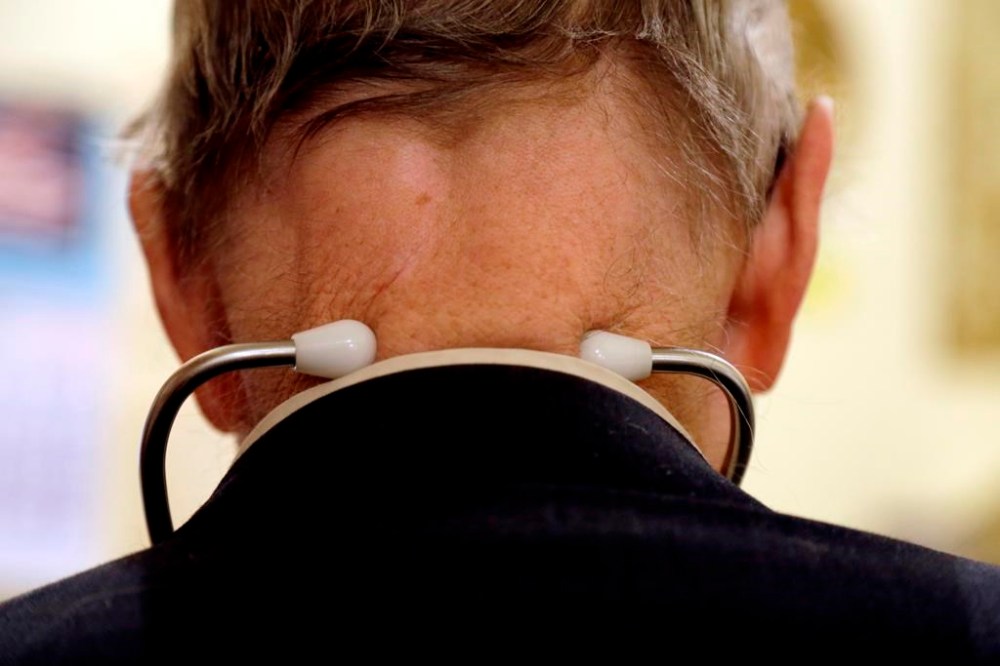
A doctor wears a stethoscope around his neck as he tends to patients in his office in Illinois, Tuesday, Oct. 30, 2012. Two University of Calgary researchers weren’t surprised when their survey of Alberta doctors showed biases against Indigenous patients, but they were shocked by some of the comments. THE CANADIAN PRESS/AP-Jeff Roberson

“I think that that’s really, really worrisome … the social determinants of health are one of the most important factors in our patients’ lives and how they heal.”

One of the survey respondents — a white doctor — said he felt racism from Indigenous people, not the other way around.

“The most common sort of racism I have seen is an Indigenous person being racist in words and actions against white people. This is 100 times more common than the converse,” the doctor wrote, according to a study about the survey published in theonline peer-reviewed journalBMJ Open last month.

Ruzycki and Roach said in some cases, when people of privilege say they’re experiencing racism, it comes from a lack of understanding the system of power.

There is already a power imbalance in the doctor-patient relationship, the researchers said, and that can pose a dangerous environment for Indigenous patients seeking medical help.

“We have so much evidence of the way Indigenous people are treated in the health-care system through the tragic deaths of people like Joyce Echaquan and Brian Sinclair,” said Roach, referring to the treatment of the Indigenous patients in Quebec and Manitoba that created significant public outcry.

The survey, which had 375 respondents out of about 12,000that it was sent to, used a “feeling thermometer” approach in two questions that asked participants to indicate their agreement.

In the question that asked doctors if they preferred white or Indigenous people, 25 per cent said they preferred white people and more than eight per cent said that they felt unfavourably towards Indigenous people.

“(The participants) self-reported an explicit bias,” said Ruzycki. “It should be zero.”

Roach, who is a member of the Metis Nation of Alberta, said that the low survey response was likely due to the timing of when it was sent out, during the second wave of the COVID-19 pandemic, when hospitals were over burdened and many health-care workers were feeling burnt out.

A good response rate for most surveys is about 20 per cent, the researchers said, adding that asking hard and straightforward questions abut race was also a deterrent.

Ruzycki said the response to a demographic question in the survey was about 10 per cent, or just under 1,100 doctors. “The first anti-Indigenous bias question, that number dropped off to 375. When we asked a really uncomfortable, challenging question, people opted out.”

Roach said that while it’s important to report cases of racism, it’s only the first step.

“Where we fall down is what happens after the reporting,” said Roach. “There needs to be more reporting structures with accountability.”

Reagan Bartel, health director at the Metis Nation of Alberta, agreed.

“I think that enforcement and accountability are two key things that are missing in the process,” said Bartel. “We can write frameworks for days, but I think we need to start holding people accountable for bad care and that is racist care.

“We cannot continue to make excuses that our system is so overrun that we can’t afford to lose a physician or a nurse who’s racist. That’s not acceptable.”

The College of Physicians and Surgeons of Alberta has a complaints process for patients and outcomes vary depending on the unique circumstances of each case, said spokesperson Melissa Campbell.

In an email, Campbell said that the college has established an Indigenous Advisory Circle to help connect Indigenous physicians and patients.

“The work in this area is just beginning. But the goal is to listen to and learn from members of the circle, to help us better understand and support Indigenous patients and better guide the physicians who care for them.”

Alberta Health Services spokesperson Kristi Bland said in an email that the agency also has a process for dealing with complaints. Bland added that the agency has established the Indigenous Wellness Core, formerly known as the Indigenous Health Program, that has dedicated staff who help Indigenous patients through the health-care system.

This report by The Canadian Press was first published March 5, 2023.

___

This story was produced with the financial assistance of the Meta and Canadian Press News Fellowship.

Report Error Submit a Tip

More Stories

Six high school hockey programs ceased operations following new Hockey Manitoba policy

Joshua Frey-Sam 7 minute read Preview

Six high school hockey programs ceased operations following new Hockey Manitoba policy

Joshua Frey-Sam 7 minute read Friday, Oct. 2, 2026

She lived the best of both worlds.

For the last three years, the 17-year-old wore a sweater for two different hockey programs — her high school team and AAA club in the Manitoba Female Hockey League — and was preparing to flourish in both colours again this winter.

Recently, however, the blue-liner was disappointed to learn she is no longer eligible to play her Grade 12 season with her school owing to a new policy imposed by Hockey Manitoba that bans players from participating in the Manitoba Women’s High School Hockey League if they are rostered on a U18 AAA team.

The rule applies to all athletes who play for both Winnipeg-based and rural AAA teams.

Read
Friday, Oct. 2, 2026

Today’s horoscope

Georgia Nicols 4 minute read Preview

Today’s horoscope

Georgia Nicols 4 minute read 2:00 AM CDT

MOON ALERT: Caution! Avoid shopping (except food and gas) and important decisions until after 6:30 p.m. today. After that, the moon moves from Cancer into Leo.

ARIES (March 21-April 19)

Don’t expect much co-operation from partners, spouses and close friends. This is why you might feel cut off from others or a bit lonely. There’s the sense a gulf exists between you and everyone else. But this is temporary. Courage!

TAURUS (April 20-May 20)

Read
2:00 AM CDT

Board game company charts winning path

Aaron Epp 5 minute read Preview

Board game company charts winning path

Aaron Epp 5 minute read Friday, Oct. 2, 2026

Dennis Northcott has launched a game without frontiers.

The Winnipeg entrepreneur is the co-designer of Galactic Cruise, a board game published last year by Kinson Key Games LLC, the business he co-founded. Since its release, Galactic Cruise has been translated into 11 languages and sold around 50,000 copies worldwide.

It’s also one of three finalists for this year’s Deutsche Spiele Preis, a prestigious community-voted board game award. Northcott will travel to Essen, Germany, later this month, where the winner will be announced at Spiel Essen, an annual board game trade fair.

“It’s been amazing,” Northcott said of the response to Galactic Cruise during an interview in his Island Lakes neighbourhood home earlier this week. “The sales have been great, but it’s also been amazing in terms of people giving their reviews.”

Read
Friday, Oct. 2, 2026

Khan should’ve taken high road: Goertzen

Carol Sanders 5 minute read Preview

Khan should’ve taken high road: Goertzen

Carol Sanders 5 minute read Friday, Oct. 2, 2026

The veteran Progressive Conservative who championed Obby Khan’s leadership bid says the former Blue Bomber dropped the ball by dissing his Tory teammates before he stepped down.

“I wouldn’t recommend it, and I didn’t recommend it,” Kelvin Goertzen (Steinbach) said in an interview Friday.

Khan resigned as PC leader and quit the caucus Monday saying some members were secretly plotting his ouster, even after he won a confidence vote on Sept. 25.

On Tuesday, Khan lashed out in a CJOB interview, naming the alleged plotters, saying constituents deserved to know which of their elected representatives “lacked moral integrity.” Khan told the Free Press he was “deeply emotionally hurt,” and felt stabbed in the back.

Read
Friday, Oct. 2, 2026

Creative powerhouse Perry Rosemond never lost Winnipeg roots

Ben Waldman 7 minute read Preview

Creative powerhouse Perry Rosemond never lost Winnipeg roots

Ben Waldman 7 minute read Yesterday at 6:00 AM CDT

He created King of Kensington, directed the troops in the Royal Canadian Air Farce, and his creative eye was behind the lens for television shows starring Johnny Cash, Tom Jones, Mr. Dress-Up and the Friendly Giant.

He also wrote and developed the Canadian version of Sesame Street during his time as the head of school and preschool programming for CBC in Toronto, and directed a televised special in 2002 for Winnipeg sketch comedy troupe Royal Liechtenstein Theatre Company.

But before his name featured in the credits of some of the most iconic and influential pieces of the Cancon canon, Perry Rosemond was an only child living in a crammed, multi-generational home in Winnipeg’s North End, racing each day to beat the morning bell next door at William Whyte School.

In memoirs that have yet to be published, the late television producer recalled his childhood. “(T)here were 14 of us in the house at 193 Andrews St., and it wasn’t that big of a house,” he writes.

Read
Yesterday at 6:00 AM CDT

Manitoba’s own Summer Howell takes on biggest role yet as Stephen King’s telekinetic teen Carrie

Randall King 7 minute read Preview

Manitoba’s own Summer Howell takes on biggest role yet as Stephen King’s telekinetic teen Carrie

Randall King 7 minute read Friday, Oct. 2, 2026

From the tender age of eight, actress Summer Howell has made her presence known in a series of horror films shot in her home province of Manitoba.

Her first film was Curse of Chucky (2013), director Don Mancini’s continuation of the venerable killer doll series he started (as a screenwriter) in 1988 with Child’s Play.

“Even then, it was obvious she was very talented, intelligent and delightful,” Mancini said of Howell.

Though she has worked in other genres, Howell gravitated to horror repeatedly, with credits in Shawn Linden’s harrowing Hunter Hunter (2020) and the 2023 possession thriller All Fun and Games. Earlier this year, she shot the horror film Sundown in Winnipeg with director Rebekah McKendry, which premièred last week at Beyond Fest in Los Angeles and is headed for a streaming berth on Shudder.

Read
Friday, Oct. 2, 2026