Court intrigue
Pickleball’s popularity rooted in sport’s accessibility, fitness benefits, plain old fun

Advertisement
Read this article for free:
or
Already have an account? Log in here »
To continue reading, please subscribe:

Digital Subscription
One year of digital access for only $205*
- Enjoy unlimited reading on winnipegfreepress.com
- Read the E-Edition, our digital replica newspaper
- Access News Break, our award-winning app
- Play interactive puzzles
*First annual payment billed as $205.00 + GST for one year. This annual subscription will automatically renew at $233.00 + GST every 52 weeks (10% off the regular annual price of $259.35). Offer available to new and qualified returning subscribers only. Cancel any time.
To continue reading, please subscribe:
Add Free Press access to your Brandon Sun subscription for only an additional
$1 for the first 4 weeks*
- Enjoy unlimited reading on winnipegfreepress.com
- Read the E-Edition, our digital replica newspaper
- Access News Break, our award-winning app
- Play interactive puzzles
*Your next Brandon Sun subscription payment will increase by $1.00 and you will be charged $17.95 plus GST for four weeks. After four weeks, your payment will increase to $24.95 plus GST every four weeks.
Read unlimited articles for free today:
or
Already have an account? Log in here »
Hey there, time traveller!
This article was published 30/04/2023 (1249 days ago), so information in it may no longer be current.
Even if you aren’t a pickleball player — yet — the chances are excellent you know someone playing one of the fastest-growing racquet sports around.
Pickleball, a cross between tennis, badminton and table tennis, is popping up on public courts, in private clubs and at gyms around the country.
Not only is it fun to play, it’s also excellent for your heart health.
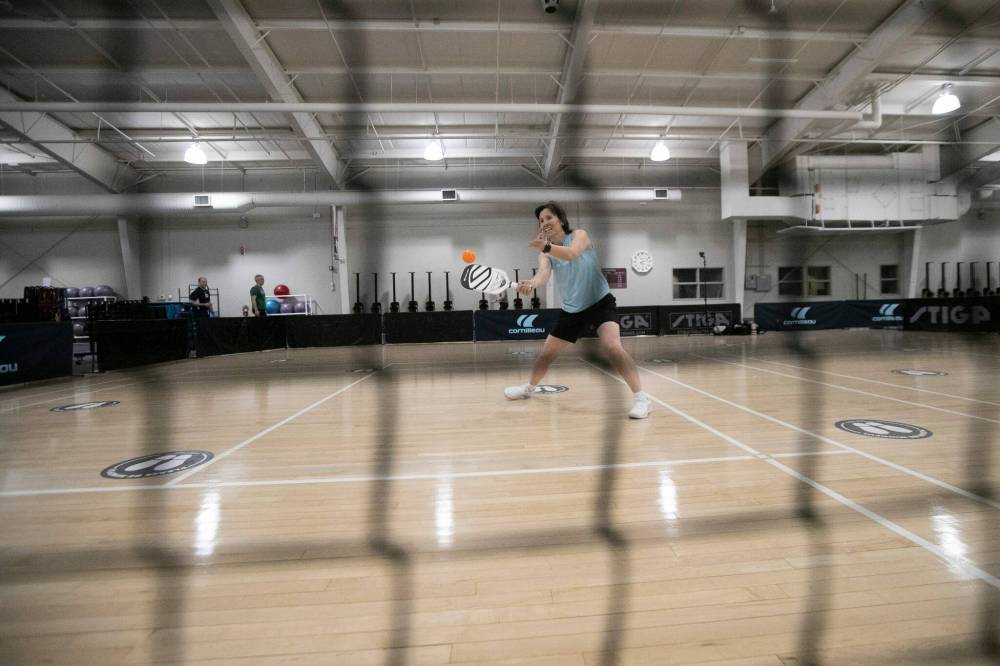
BROOK JONES / WINNIPEG FREE PRESS
Sandra Webber, an associate professor of physical therapy at the University of Manitoba, is a lead reseacher on a study into the benefits of single and doubles pickleball for older adults.
A study published in the Journal of Aging and Physical Activity suggests pickleball can provide a moderate workout for middle-aged or older adults.
It was conducted to gauge the intensity of physical activity during play, says Sandra Webber, the study’s lead researcher and a physiotherapist and research affiliate with the Centre on Aging at the University of Manitoba.
Part of pickleball’s appeal is that “it’s much easier to be successful when compared to a lot of other racquet sports, so people have fun with it early,” she says.
Researchers provided 53 recreational pickleball players with smartwatches to track their heart rates and accelerometers to measure their steps. They ranged in age from 29 to 73, though most were middle-aged or older with an average age of 62.
The study found that playing either singles or doubles pickleball helped older adults meet the recommended physical activity guidelines.
These guidelines for Canadian adults recommend at least 150 minutes of moderate-intensity or 75 minutes of vigorous-intensity aerobic physical activity per week. “Moderate intensity” typically means you’re working hard enough to raise your heart rate and break a sweat, whereas vigorous exercise means you’re breathing hard and fast, and your heart rate has gone up, as when jogging or cycling fast.
The study found the average heart rates during singles and doubles play were 111.6 and 111.5, respectively. Just over 70 per cent of the singles and doubles playtime (excluding time spent waiting for a court) was categorized in moderate to vigorous heart-rate zones.
“When you hear that 70 per cent of the time your heart rate is going to be up and you’re having a great time while doing it, that’s just a bonus,” says Webber, who has a background in tennis but took up pickleball when she turned 50.
“Some older adults are not going to the gym, and are many older adults getting 150 minutes of moderate to vigorous exercise every week? Maybe a 25-year-old is, but not a 65-year-old, depending on ailments.”
In the study, the researchers analyzed 106 minutes and 71 minutes of doubles and singles play time, respectively.
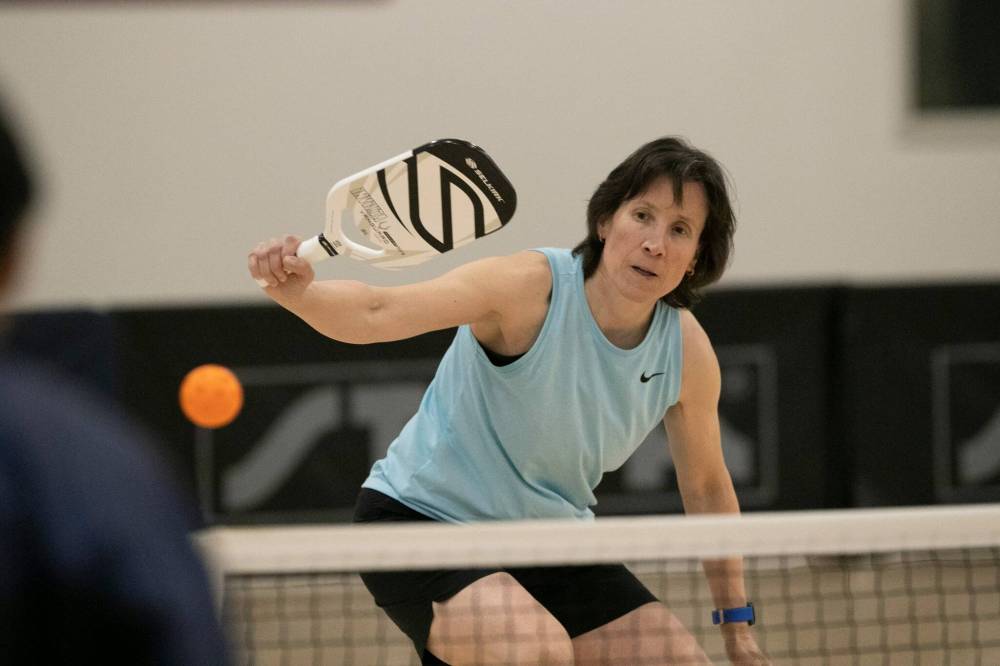
BROOK JONES / WINNIPEG FREE PRESS
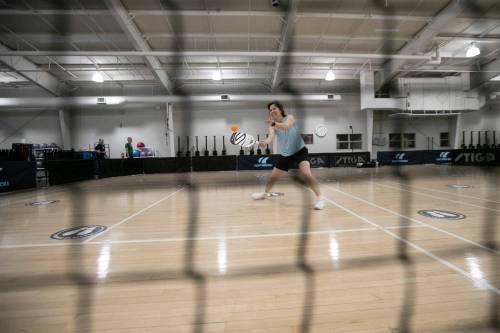
Sandra Webber, an associate professor of physical therapy at the University of Manitoba and a lead reseacher on a study into the benefits of single and doubles pickleball for older adults, gets into the game herself at the Reh-Fit Centre recently.
Although pickleball has lines for singles and doubles, the latter is the most popular. Pickleballers use a flat paddle as opposed to a stringed racket as in tennis and badminton. Players compete in a smaller space than tennis — up to four pickleball courts can fit on a tennis court.
Matches are best-of-three games and each game can last 10 to 15 minutes. Despite that time frame, many enthusiasts tend to play for hours at a go.
“You might go for a brisk walk for half an hour but people don’t tend to play pickleball for half an hour. It’s more like two or three hours and often multiple sessions per week,” says Webber. “Sure, they might not be on the court for the entire time, but if they’re there for three hours, they would still be very active for at least two of those hours. That means they’ve just made a big dent in getting towards that 150-minute target for the week.”
Although people of all ages play, the sport has long been associated with seniors and retirees. With less ground to cover, pickleball is particularly popular among older adults who have aged out of more physically demanding sports. In fact, 84 per cent of active members registered with Pickleball Canada are 55 years of age or older.
Pickleball remains popular among older adults, but the growth in numbers is coming from younger adults — particularly those aged 18 to 34, says Pickleball Canada.
In early 2022, there were more than one million pickleball players from coast to coast, according to Pickleball Canada. That’s up from about 350,000 in 2021. And early estimates suggest another 37 per cent growth over the last year, making for about 1.37 million pickleball players across the country who play the sport at least once per month, with more than half playing four or more times per month.
Greg Blanchard, 63, took up pickleball about three years ago, after he retired. His wife signed him up for lessons through the City of Winnipeg Leisure Guide.
“I said, ‘I’m not ready for that game yet. That’s for old people,’” he says.
He started playing in the fall of 2019 and it didn’t take long before he was hooked. Just as he was getting into the swing of things, the world shut down.
“We had taken the lessons in the fall and then we signed up for a 55-plus group in St. James,” he says. “We played indoors from January to March of 2020 and then the COVID lockdown happened.”
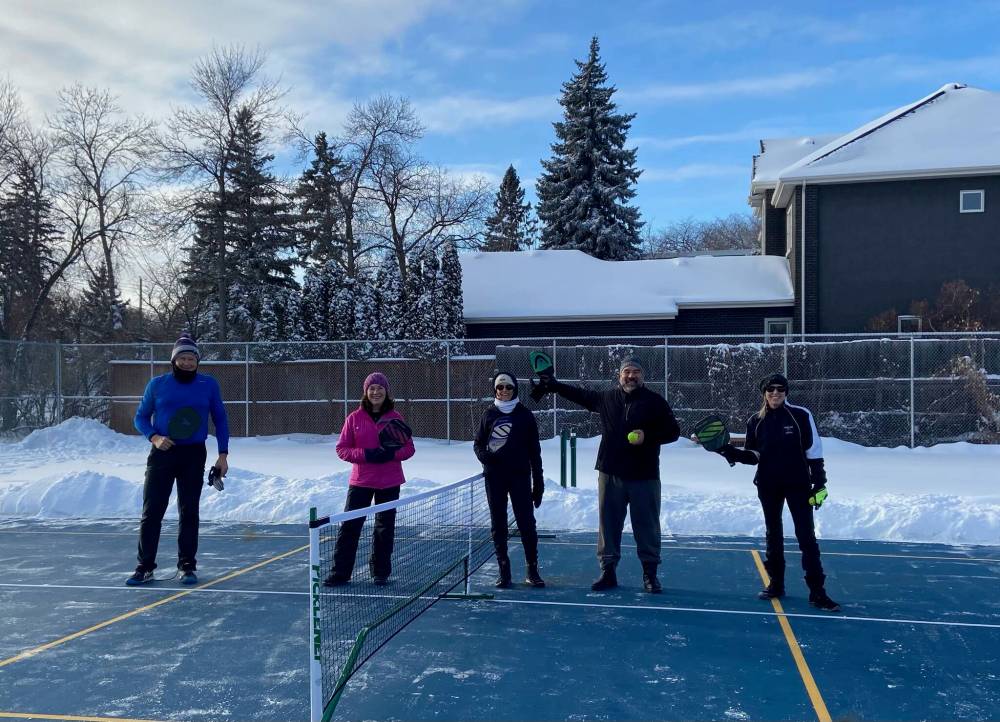
Greg Blanchard photo
Greg Blanchard gets ready for a winter game with his COVID-bubble pickleball buddies.
Blanchard was able to continue to play that summer as the Winnipeg West Pickleball Club set up a COVID protocol where people played within a bubble of six.
But once the weather cooled off and indoor play was no longer an option, Blanchard decided he was going to take his game outdoors. In the winter.
“That winter, they had just reduced some of the restrictions where you could start socializing with a group of five people outside of your household,” he says.
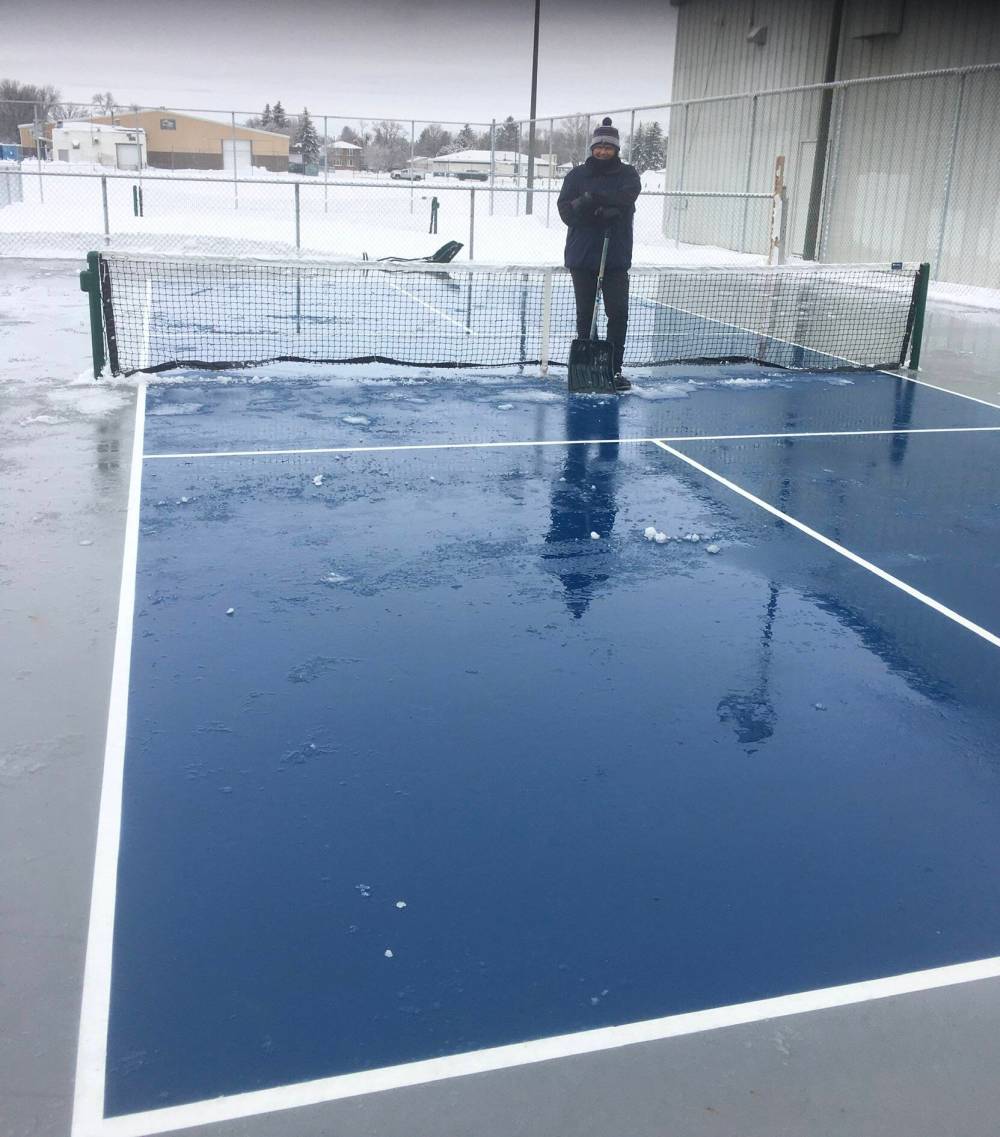
Since the outdoors was their only option, Blanchard and his COVID social bubble turned pickleball into a winter activity. Between December 2020 and March 2021, the group played outside three to four days each week.
They cleared the snow from the tennis courts on Wellington Crescent using plastic shovels to ensure the court surface wasn’t damaged.
“When it was mild, it would freeze overnight. So we’d go the night before and use windshield washer fluid and rock salt to help melt the ice overnight. Then it would be ready for the morning. We planned ahead,” Blanchard says. “Our threshold was -10 C. If it was below that, we didn’t go. The balls became like rocks.”
Blanchard continued to play pickleball throughout the pandemic within the restriction guidelines and got in some much-needed quality time with friends.
“From a social perspective, it was great to get out and see people (during those winter months). A year prior, I didn’t know any of the four people that I played with every day. We had met the summer before and now we talk all the time,” he says. “I have very fond memories (of that time). We made the best of a tough situation.”
Blanchard, who’s also a board member of the Winnipeg West Pickleball Club, says membership at the club has exploded over the last few years.
“We have 300 members. We had 30 three years ago,” he says.
Greg Blanchard photo
Greg Blanchard and his winter pickleball pals cleared courts so they could play outdoors in temperatures down to -10 C during a time of indoor COVID-19 social restrictions in 2021.
There are more than 300 affiliated pickleball clubs across the country, including several clubs and organizations throughout the province.
Depending on how you play, Webber says pickleball can be easier on the body than other sports. Long rallies in pickleball aren’t nearly as taxing as they are in tennis.
“I think people aren’t afraid to try it because they think, ‘Oh, it’s just pickleball. I can do that,’” Webber says. “And there are lots of people out there with a brace on their knee and they can still hit the ball really well and play with a lot of strategy.”
Webber says some studies have even categorized pickleball as a serious leisure activity, meaning it’s associated with meaningful engagement and high levels of commitment that often take priority over other things.
“That’s an important message to get out. It’s a good fitness activity if played at an intermediate level or higher, and it’s an accessible way to improve and maintain fitness as you get older while having fun,” she says. “Being involved in these kinds of sports is associated with greater quality of life and more positive perceptions of aging.”
sabrinacarnevale@gmail.com
Twitter: @SabrinaCsays
Sabrina Carnevale is a freelance writer and communications specialist, and former reporter and broadcaster who is a health enthusiast. She writes a twice-monthly column focusing on wellness and fitness.
Our newsroom depends on a growing audience of readers to power our journalism. If you are not a paid reader, please consider becoming a subscriber.
Our newsroom depends on its audience of readers to power our journalism. Thank you for your support.
Sabrina Carnevale is a freelance writer and communications specialist, and former reporter and broadcaster who is a health enthusiast. She writes a twice-monthly column focusing on wellness and fitness.
Our newsroom depends on a growing audience of readers to power our journalism. If you are not a paid reader, please consider becoming a subscriber.
Our newsroom depends on its audience of readers to power our journalism. Thank you for your support.
Advertisement Advertise With Us
Advertisement Advertise With Us