Quebec ER overcrowding will ‘continue to be difficult,’ says health minister

Advertisement

Advertise with us

MONTREAL - Quebec Health Minister Christian Dubé had mostly bad news Wednesday as he provided an update on the province's overtaxed emergency room network.

Read this article for free:


or

Already have an account? Log in here »

To continue reading, please subscribe:

Subscribe and receive a limited-edition Free Press branded hat or tote.

Digital Subscription

One year of digital access for only $205*

  • Enjoy unlimited reading on winnipegfreepress.com
  • Read the E-Edition, our digital replica newspaper
  • Access News Break, our award-winning app
  • Play interactive puzzles

*First annual payment billed as $205.00 + GST for one year. This annual subscription will automatically renew at $233.00 + GST every 52 weeks (10% off the regular annual price of $259.35). Offer available to new and qualified returning subscribers only. Cancel any time.

To continue reading, please subscribe:

Add Free Press access to your Brandon Sun subscription for only an additional

$1 for the first 4 weeks*

  • Enjoy unlimited reading on winnipegfreepress.com
  • Read the E-Edition, our digital replica newspaper
  • Access News Break, our award-winning app
  • Play interactive puzzles
Start now

*Your next Brandon Sun subscription payment will increase by $1.00 and you will be charged $17.95 plus GST for four weeks. After four weeks, your payment will increase to $24.95 plus GST every four weeks.

Hey there, time traveller!
This article was published 10/01/2024 (997 days ago), so information in it may no longer be current.

MONTREAL – Quebec Health Minister Christian Dubé had mostly bad news Wednesday as he provided an update on the province’s overtaxed emergency room network.

With emergency departments across the province averaging 137 per cent capacity, Dubé told reporters in Montreal the situation would persist for much of the winter.

“I said it has been difficult and it will continue to be difficult,” Dubé said.
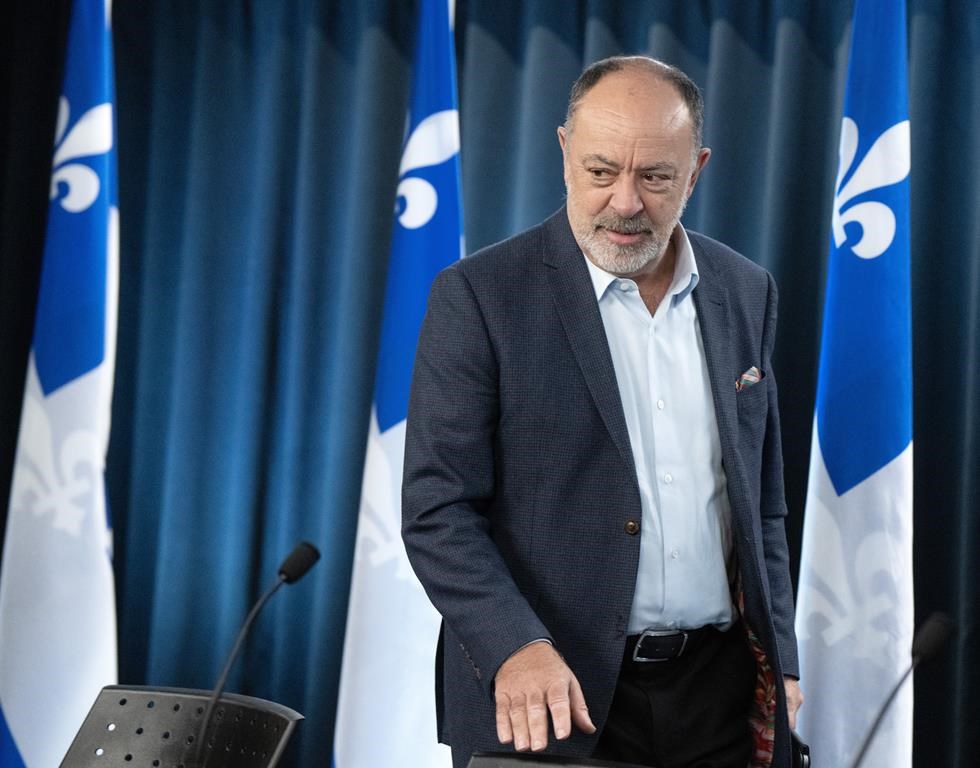
Quebec health authorities and stakeholders will provide an update to overcrowding in the province's emergency rooms. Quebec's Health Minister Christian Dubé arrives to update the vaccination and emergency room situation during a press briefing in Montreal, Tuesday, Dec. 19, 2023. THE CANADIAN PRESS/Ryan Remiorz

Dubé said on any given day an average of 10,000 people visit emergency rooms in the province. In the past two weeks, there have been 1,000 extra visits daily. He said about 1,900 people a day are visiting emergency rooms for respiratory viruses, a rate roughly double what was seen at the same time last year.

As well, Dubé said more people over the age of 65 are going to ERs, which results in more complex cases in addition to increased volume.

Emergency rooms in the greater Montreal region, including the suburbs to the north and south, are most affected.

Three circulating viruses — COVID-19, influenza and Respiratory syncytial virus, or RSV — have complicated issues. A later flu season compared to last year hit hard during Christmas when staff was minimal, and the number of cases is rising. Meanwhile, COVID-19 seems to be reaching a peak, with an estimated three million Quebecers having been infected since the fall. And the number of RSV cases has stabilized.

Dubé noted vaccination is still available and could help ease the situation, particularly for flu infections. And Dubé said workers who took time off for the holidays are returning to the health system this week and easing pressure on overworked staff.

The minister said almost half of the daily ER visits are for ailments that aren’t urgent and could be treated at family medicine clinics or with family doctors, but he acknowledged such appointments are hard to come by.

“The system needs to do a better service for those (minor cases),” said Dr. Gilbert Boucher, president of the Association des spécialistes en médecine d’urgence du Québec and an emergency physician at the Montreal Heart Institute.

“We often hear, ‘It has been three weeks that I’ve been trying to see somebody to get some advice’ and they are failing, and then they end up in the emergency,” he said.

Dubé drew criticism before Christmas when he called on Quebecers to avoid the ER, with the Canadian Association of Emergency Physicians expressing concern about the messaging. He said Wednesday he was referring to non-urgent cases, such as a minor allergic reaction or an infection that could be treated at a clinic.

“First of all, every time we ask people not to come to the emergency, we also mention that if you feel sick, if you’re not well, we are there for you,” Boucher said. “We’re sorry if that wasn’t clear, but people have to understand we are there for the sickest patients all the time, 24/7.”

Boucher added that much of the criticism was coming from outside the province, where doctors are not grappling with ER occupancy rates that can hit 200 to 250 per cent and half of patients leave without seeing a doctor, as is the case in some Quebec hospitals.

“In (the) face of the congestion we’re facing right now, we decided to ask everybody to help us a little bit,” Boucher said.

This report by The Canadian Press was first published Jan. 10, 2024.

Report Error Submit a Tip

More Stories

Gordon Bell rings in a century

Maggie Macintosh 13 minute read Preview

Gordon Bell rings in a century

Maggie Macintosh 13 minute read Updated: Yesterday at 8:06 PM CDT

Mischka Valencia had gotten used to the hum of heavy machinery at Gordon Bell High School.

“Ever since I’ve been here, it’s all been under construction,” the Grade 12 student said, standing on the sidelines of the brightly painted revamped outdoor basketball court. “I had no idea this was a court.”

The Filipina teenager landed in Winnipeg several months after the inner-city campus had transformed into a construction site.

It was the fall of 2023 and Mischka’s priorities were fitting in, befriending classmates and learning a third language via first-period French.

Read
Updated: Yesterday at 8:06 PM CDT

Broadening prediction-market gambling a bad idea

Editorial 4 minute read Preview

Broadening prediction-market gambling a bad idea

Editorial 4 minute read 2:01 AM CDT

Let’s make a prediction: sooner or later, when Canadian governments find a way to take their own cut of the action, prediction-contract gambling on everything from sports to entertainment to political decisions is going to come to Canada.

And that’s a horrible, dangerous, pernicious idea.

Unless you have particular access to information — either inside information or strategic information based on skills or education — you’re not likely to make money at it. In fact, structurally, you’re likely to lose. In prediction markets, you basically pay an amount, plus fees from the company involved, to bet on whether something will or will not happen within a certain time frame. The amount you pay for your contract depends on how other people are also betting.

As Wealthsimple describes it, “You buy whichever side you think is right. Prices move with demand, so if the market leans towards one outcome, the more that side costs. If a lot of people are backing the TSX to finish above 38,000, yes gets more expensive and no gets cheaper.”

Read
2:01 AM CDT

Puzzles Palace

1 minute read Monday, Jul. 27, 2026

To solve our puzzles, please subscribe with this special offer: |

A day on the campaign trail: Winnipeg's mayor, seeking a second term, does double duty

Malak Abas 12 minute read Preview

A day on the campaign trail: Winnipeg's mayor, seeking a second term, does double duty

Malak Abas 12 minute read Updated: Yesterday at 5:56 PM CDT

In the weeks leading up to the civic election, Scott Gillingham has been performing a juggling act: he’s running to be Winnipeg’s 45th mayor, while still serving as its 44th.

“If someone asks me about the campaign, I’m going to answer them. But I think for most people, I’m the mayor of Winnipeg, even if I’m showing up as a candidate,” Gillingham, 58, says. “I try to do all I can to maintain that distinction.”

The Free Press joined Gillingham on a recent rainy September Saturday on the campaign trail, where he served in both roles during an event-laden day. City council’s final meeting before the Oct. 28 election was days earlier.

In Winnipeg, it’s rare for an incumbent to be defeated. But Gillingham knows his win in 2022 wasn’t exactly a landslide — he won with 27.5 per cent of the vote — and he’s been thinking about his second term ever since.

Read
Updated: Yesterday at 5:56 PM CDT

Nearly four in 10 Manitobans hope Canada restarts trade talks after U.S. midterm elections, poll reveals

Gabrielle Piché 4 minute read Preview

Nearly four in 10 Manitobans hope Canada restarts trade talks after U.S. midterm elections, poll reveals

Gabrielle Piché 4 minute read Yesterday at 7:00 AM CDT

Disorganized — that’s what Marcus Langlois calls recent United States tariffs.

He expects suppliers’ prices to increase — on mugs, pens, hoodies — for his employer, Dreamcatcher Promotions, if the United States–Canada trade war persists.

Still, he’s not pining for a quick trade deal.

“I think it should wait,” said Langlois, Dreamcatcher Promotions’ vice-president. “Let’s hope that it’s later on with proper negotiations happening.”

Read
Yesterday at 7:00 AM CDT

A spiritual vision will help anchor a health civic outlook

John Longhurst 5 minute read 2:01 AM CDT

We have an election coming up. With that in mind, the Free Press asked some of their columnists to write about the challenges ahead and how the city can become better.

For Tom Brodbeck, the main challenge is finances — and how candidates will pay for their many promises for fixing roads, improving public safety and making transit better.

Rebecca Chambers said that the concerns of inner-city residents need to be taken seriously by those who aspire to work at city hall.

Niigaan Sinclair said the most pressing issue in Winnipeg isn’t construction projects, light-rail transit, public safety, taxes or social services. For him, it’s the city’s relationship with Indigenous people.