Task force lambasted for holding firm on breast cancer screening advice
Advertisement
Read this article for free:
or
Already have an account? Log in here »
To continue reading, please subscribe:

Digital Subscription
One year of digital access for only $205*
- Enjoy unlimited reading on winnipegfreepress.com
- Read the E-Edition, our digital replica newspaper
- Access News Break, our award-winning app
- Play interactive puzzles
*First annual payment billed as $205.00 + GST for one year. This annual subscription will automatically renew at $233.00 + GST every 52 weeks (10% off the regular annual price of $259.35). Offer available to new and qualified returning subscribers only. Cancel any time.
To continue reading, please subscribe:
Add Free Press access to your Brandon Sun subscription for only an additional
$1 for the first 4 weeks*
- Enjoy unlimited reading on winnipegfreepress.com
- Read the E-Edition, our digital replica newspaper
- Access News Break, our award-winning app
- Play interactive puzzles
*Your next Brandon Sun subscription payment will increase by $1.00 and you will be charged $17.95 plus GST for four weeks. After four weeks, your payment will increase to $24.95 plus GST every four weeks.
Read unlimited articles for free today:
or
Already have an account? Log in here »
Hey there, time traveller!
This article was published 30/05/2024 (861 days ago), so information in it may no longer be current.
Several cancer experts, surgeons and radiologists swiftly condemned a national task force’s draft decision not to lower the recommended routine breast cancer screening age to 40 on Thursday.
The criticisms were echoed by federal Health Minister Mark Holland, who said he was “concerned” and “disappointed” in the task force’s findings and wanted leading experts to review the guidelines. He also called for the public consultation period to be extended.
The Canadian Task Force on Preventive Health Care, which provides guidance for primary health-care providers, said it is maintaining current advice that routine breast cancer screening start at age 50 and end after age 74.
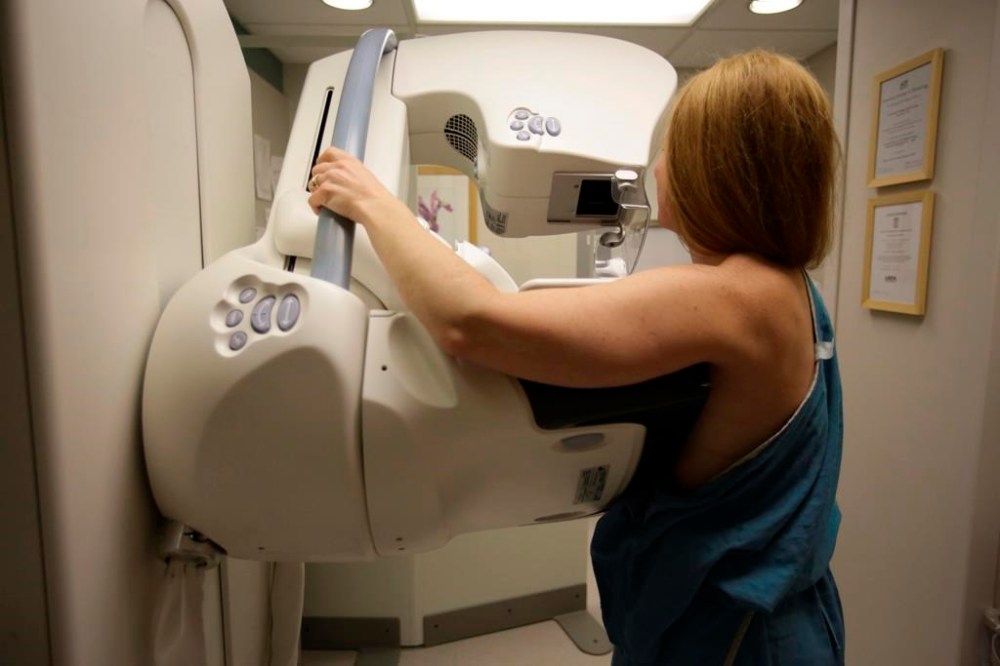
Although they refrained from lowering the age for routine screening, the task force did suggest women age 40 to 49 be eligible for mammograms every two to three years if they want one after learning the harms and benefits of early screening, ideally from a conversation with their health-care provider.
The Canadian Cancer Society was also disappointed in the draft guidance.
“It places the onus on people to advocate for their own early detection and screening and gain access to a referral rather than being automatically invited to provincial and territorial (screening) programs,” the society said in a news release.
Dr. Jean Seely, head of the breast imaging section at the Ottawa Hospital, called the task force advice “bad news” that will lead to confusion for women in Canada.
“Unfortunately, we know that will lead to loss of lives. We know that by screening women, we save at least three out of every thousand women screened,” she said.
Seely was one of the experts who reviewed evidence to inform the guidance, and said the task force did not put enough emphasis on newer studies that show benefits to screening starting at age 40 and relied too heavily on randomized control trials that were conducted decades ago.
Dr. Henry Siu, a spokesperson for the task force and a family doctor in Hamilton, said the task force looked at 92 observational studies, “some of which were published after 2018,” as well as 82 studies on “patient preferences and values,” as well as the older randomized control trials.
Siu said the potential harms of earlier screening include false positives, which can lead to unnecessary painful biopsies, as well as “overdiagnosis” of cancers that wouldn’t have become a problem if they hadn’t been found.
Seely said failing to lower the age for routine screens puts racialized women at higher risk.
“The peak incidence of breast cancer for Black, Asian, Hispanic (and) Indigenous women are all in their 40s,” she said.
“By saying that they should not start until (age) 50 puts them all at a big disadvantage and is one of the reasons why we see in Canada that they’re more likely to be diagnosed at advanced stage of breast cancer.”
The president of the Black Physicians’ Association of Ontario also condemned the task force recommendations, agreeing that the onset of breast cancer is earlier for racialized women.
“Data shows that this group have a decreased mortality than other groups with early screening. This is attributed to the genetic variation that leads to more aggressive cancers in Black women despite similar treatment. They have the most to benefit from early screening,” Dr. Mojola Omole, who is also a breast surgical oncologist and general surgeon, said in an email.
The task force said “more research is needed” to determine whether or not earlier screening should be recommended for racialized women.
The task force said it recognized that not all women have access to a primary health-care provider and encouraged them to use information on screening benefits and harms it would post on its website.
Meanwhile, Holland said he was concerned about the task force’s findings, including the emphasis on potential harms of earlier screening.
“The task force concern that a false positive would cause distress, frankly I don’t buy it. I know that for the women in my life, they’d much rather have a false positive that they get to prove negative than not to be tested,” Holland said.
“I really want to encourage women everywhere, notwithstanding what has come out today, to have conversations with their physicians and make sure that they are taking appropriate action in terms of their screening.”
Shira Farber, a volunteer with Dense Breasts Canada who was diagnosed with advanced-stage breast cancer just after turning 48, said she was grateful for the minister’s stance after being “very upset” by the task force’s announcement.
“We’ve been advocating for better screening guidelines because we believe that we are casualties of these current screening guidelines,” Farber said in an interview.
Farber said she asked her family doctor twice during her 40s if she should get a mammogram.
“I was told no, because the guidelines said that we didn’t need to start before 50,” said Farber, who is now 51 and has had both breasts and 40 lymph nodes removed. She said she also had aggressive chemotherapy because her cancer was so advanced.
The draft recommendations will be open to public consultation for six weeks before it becomes final, but Holland called for that to be extended to at least 60 days. He also said he wants breast cancer experts to examine the task force’s recommendations.

It is up to the provinces and territories to decide when to offer mammograms free of charge.
Several provinces and territories, including British Columbia, Nova Scotia, Prince Edward Island and Yukon, already offer breast cancer screening starting at age 40. Ontario, New Brunswick, Saskatchewan and Newfoundland and Labrador have committed to doing the same, according to the Canadian Cancer Society.
—With files from Laura Osman in Ottawa.
This report by The Canadian Press was first published May 30, 2024.
Canadian Press health coverage receives support through a partnership with the Canadian Medical Association. CP is solely responsible for this content.
Related Articles
There’s nothing else for province to study; earlier screening for breast cancer saves lives

Advertisement Advertise With Us
Advertisement Advertise With Us