Meet the centenarians: Canada’s oldest age group is also its fastest-growing
Advertisement
Read this article for free:
or
Already have an account? Log in here »
To continue reading, please subscribe:

Digital Subscription
One year of digital access for only $205*
- Enjoy unlimited reading on winnipegfreepress.com
- Read the E-Edition, our digital replica newspaper
- Access News Break, our award-winning app
- Play interactive puzzles
*First annual payment billed as $205.00 + GST for one year. This annual subscription will automatically renew at $233.00 + GST every 52 weeks (10% off the regular annual price of $259.35). Offer available to new and qualified returning subscribers only. Cancel any time.
To continue reading, please subscribe:
Add Free Press access to your Brandon Sun subscription for only an additional
$1 for the first 4 weeks*
- Enjoy unlimited reading on winnipegfreepress.com
- Read the E-Edition, our digital replica newspaper
- Access News Break, our award-winning app
- Play interactive puzzles
*Your next Brandon Sun subscription payment will increase by $1.00 and you will be charged $17.95 plus GST for four weeks. After four weeks, your payment will increase to $24.95 plus GST every four weeks.
Read unlimited articles for free today:
or
Already have an account? Log in here »
Hey there, time traveller!
This article was published 25/06/2024 (827 days ago), so information in it may no longer be current.
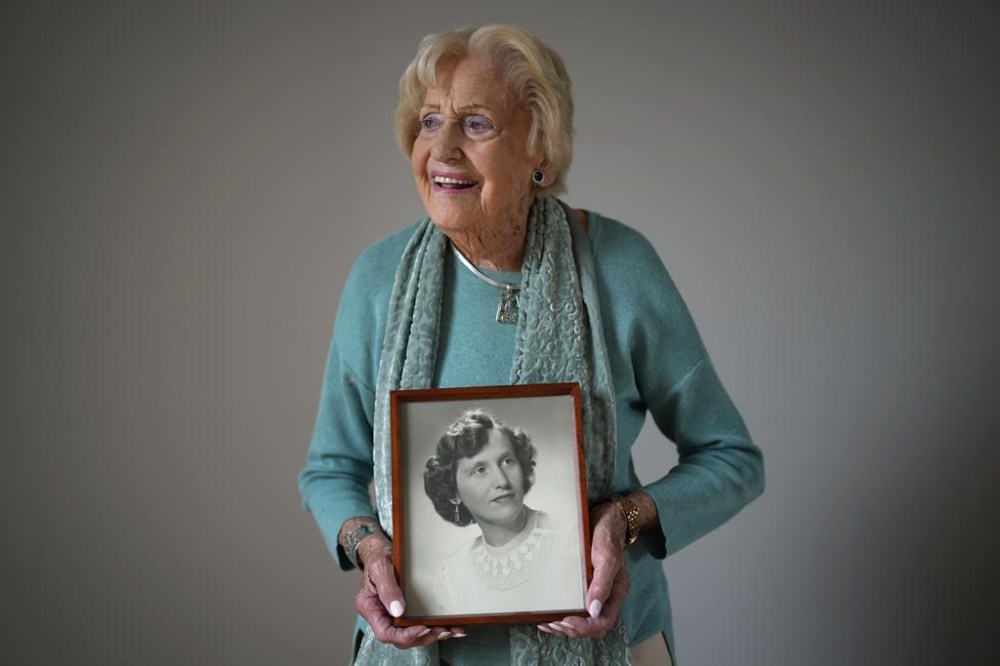
VANCOUVER – Vi Roden said she reads an average of 50 books a year, attends history lectures at her local seniors centre, and does yoga twice a week.
She’s 101, and still lives in her own condo in West Vancouver, B.C.
“It never occurred to me that I would live this long,” said Roden, a former Air Force typist who was 65 when she founded a charity for survivors of sexual abuse. “I don’t know why, but I think it’s because I just enjoy every single day.”
Joseph Novak, a 100-year-old Second World War veteran who lives in Whitehorse, lost his eyesight about a decade ago and spends his days listening to music and audiobooks.
Margaret Friend, 101, who lives in a long-term care home in Hamilton, was one of 14 children. Although she has dementia, she easily rattled off her siblings’ names — and noted that she was the only one left.
Lives as long as those of Roden, Novak and Friend, their challenges and joys, were once unlikely. But now they are part of a striking demographic phenomenon — Canada’s centenarian population is soaring.
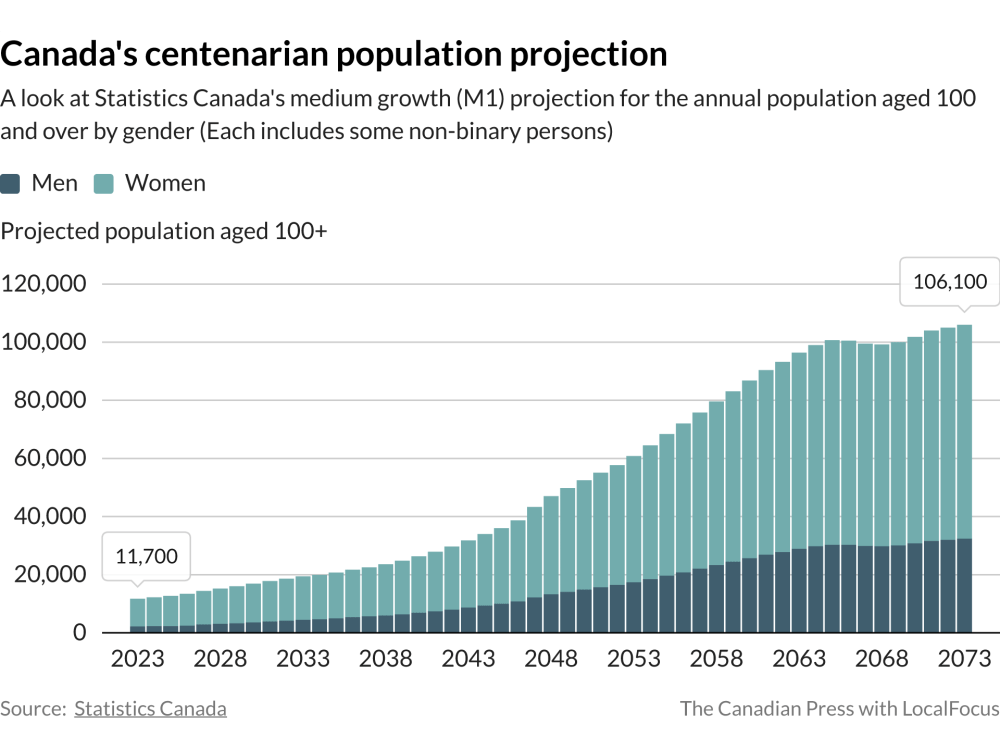
Statistics Canada data show the country’s population of people aged at least 100 more than tripled between 2000 and 2023, up from 3,393 to 11,705. That makes centenarians the fastest growing age group in Canada, and the agency says their numbers are poised to rise almost ten times higher over the next half-century.
Experts attribute the rise to improvements in health care and medical awareness, although genetics likely plays a key role in individual cases.
Some relatives interviewed by The Canadian Press see their loved ones’ great longevity as a blessing, but a testing one. And medical professionals, sociologists and demographers are calling for policy changes to address issues faced by the centenarian population, such as dementia and social isolation.
Anne Martin-Matthews, a now-retired professor at the University of British Columbia, spent more than 40 years studying the sociology of aging.
“People are living longer, and they’re in many ways healthier than they’ve ever been,” she said.
But she said sectors including health care and housing are largely unprepared for such an aging population despite decades of warning.
Statistics Canada on Monday released a forecast that the centenarian population would hit 106,100 by 2073, under a medium-growth scenario that would also see the population of people aged 85 or over more than tripling.
“It’s with some surprise that we find ourselves now in 2024 and we’re still talking about how to plan for an aging population, (though) we have known for 50 years that this was coming,” Martin-Matthews said.
“Certainly, this is a vibrant, vital population but the issue is how we, as a society, are positioned to provide assistance and support when it’s needed in later life, and that’s where I think we’ve not lived up to the expectations.”
Bill Hamill, 100, moved from Ontario to Gibsons, B.C., in 2015 after he lost his longtime partner, 96-year-old Thelma Weeks. Hamill now lives with his 70-year-old daughter, Mary Lou Hamill, in a duplex a few blocks from the town’s main strip.
The house is divided into two parts, allowing the father and daughter to maintain their independence. Bill lives in an apartment on the main floor, while Mary Lou Hamill stays in a suite upstairs.
She said she checks on her father every day and buys his groceries, but he is still able to cook and entertain himself.
Her father said he enjoys living in Gibsons, on B.C.’s Sunshine Coast about 50 kilometres northwest of Vancouver, and is often seen on his twice-daily walks around the neighbourhood.
But the war veteran, who took part in D-Day operations 80 years ago, now lives a solitary life.
“Of course, I’m lonely,” he said. “Some days I don’t talk to a person.”
‘GOOD FOR THE BODY … GOOD FOR THE BRAIN’
Hamill said the secret to his longevity — and his life motto — is “everything in moderation.”
Dr. Roger Wong, a clinical professor in geriatric medicine at the University of British Columbia, said many potential factors could be at play when someone reaches 100.
“We know that one of those factors has to do with the fact that people are more aware of health conditions that may have in the past limited life expectancy,” Wong said.
Research suggests that a combination of public health and medical improvements have contributed to the rise in centenarians. Studies show that on an individual level, staying active, eating well and managing stress are important for long lives, but genetics also play a big part.
It’s not just in Canada — the number of centenarians is booming around the world. They made up only about one out of every 200,000 people in the world in 1950, according to the United Nations. By 2021, the global rate was about 13 times higher.
But Canada has a much bigger share than most countries, per capita. Statistics Canada reports that the centenarian rate last year was about 29 per 100,000 population, compared with 6.9 per 100,000 globally in 2020.
And it’s not just the centenarian population that is on the rise. Between 2000 and 2023, Canada’s population of people in their 90s rose 175 per cent to 344, 273, while those in their 80s was up 89 per cent to 1.46 million. At the same time, the total population of Canada was up by 30 per cent, driven mainly by immigration, and the population of children aged up to nine rose 4.6 per cent.
As Canada’s elderly population rises, the number of people with cognitive decline is also set to increase, said Wong. He said projections suggest Canadians living with dementia “will go up three times in the next 30 years.”
That’s even as the actual rate of dementia decreases worldwide, likely due to better nutrition, exercise, and preventive behaviours, said Martin-Matthews.
Centenarian Margaret Friend was upbeat as she took part in a Zoom interview, telling stories from her life and describing the activities she likes in her care home: bingo, bowling, watching television.
Her son, Jim Friend — who attributes his mother’s longevity to “good genes” — sat in on the interview and said some days her memory is better than others.
“In the last year, it has been very noticeable and the decline is becoming more prevalent. It has been a learning curve for me personally,” he said.
Throughout the interview, Margaret often repeated the same phrase: “My parents were strict.” Her son tried to keep her on track, sometimes restating the questions.
“She’s still with us and we’re very thankful for that, but it’s been a challenge in all honesty,” he said.
Short-term memory loss was a common concern among centenarians interviewed by The Canadian Press, even among those whose stories of a long life flow freely.
Hamill in Gibsons, for example, “remembers things vividly” when asked about his time in the military.
“I’ve worked for the railway. I lived in Africa for five years, and I was attached to the Royal Canadian Air Force, and we bombed D-Day at 6:10 in the morning. That was a sight you’d never want to see,” he said.
Ask him about something more recent? “It’s yesterday I have trouble with,” he said with a laugh.
Others seem to have no such problems.
Roden, the yoga fan from West Vancouver, vividly described the “wonderful afternoon” spent celebrating her 101st birthday on a recent Sunday at a granddaughter’s farm in Cloverdale. Guests included all six grandchildren, her 10 great-grandchildren and a llama.
“And they are huge, and he came right up to me and he blew in my face,” laughed Roden, as she recalled her encounter with the llama.
In addition to yoga, Roden is in a book club and is “very involved in politics.”
“I’m in extremely good health, and I’m very lively, and I like to get involved in situations,” she said.
Wong said science shows “what’s good for the body is also good for the brain.”
“We know that exercise, socialization, prevention of stroke, and interestingly, fixing hearing loss and hearing problems, these are some of the things that are really helpful to keep in the brain healthy,” he said.
“That said, we still have a long way to go, because there are many things that we can do to prevent deterioration.”
Wong said social isolation is a huge issue facing this population, most of whom live alone.
Centenarians have typically outlived their siblings, childhood friends and partners. Hamill, who had nine siblings, and Friend, one of 14, are such examples.
Novak, from Whitehorse, misses Mary, his wife of 73 years, terribly. She died in 2019, within three months of their eldest son, Peter. “You can imagine how bad (2019) was for me,” said Novak, who lives in a senior care residence.
“Mary was an exceptional girl and she also made me the better man that I am today,” he said.
Novak said the beginning of June brought back “sad memories” as it marked the 80th anniversary of D-Day and the anniversary of Mary’s death. “But life must go on, the best you can,” he said.
Wong said that loneliness has been shown to have negative health impacts. “So, it’s not just about living to an old age, it’s their whole journey and experience,” Wong said, before adding that”living alone does not necessarily mean that a person is lonely.”
“What we are looking for is the connectivity with others,” he said. “We know for example, that exercise, physical activities, visualization, this social connectivity are all important.”
Martin-Matthews, who previously served as the scientific director of the Institute of Aging, also emphasized the importance of social connection.
“That is crucial as we get older,” she said. “So, that’s family ties, or friendship ties or whatever they may be, but having that sense of social connection is absolutely vital as we get older.”
‘GRACE AND HUMOUR’
As the population of centenarians continues to rise, experts worry that the questions of how they will be housed and cared for have gone largely unaddressed by authorities, despite years of warnings.
Those issues have knock-on effects for their children, who are typically elderly themselves. Mark Rosenberg, a geographer and professor emeritus at Queen’s University, Kingston, Ont., said the issue “is going to be hard to sort out.”
He said this type of scenario often comes at a high cost for the caregiver, who is also aging and often lacks the “energy and strength” to take care of a person who needs more and more help.
He flagged an urgent need to create “many more housing alternatives” for seniors.
He said older people typically have two options: to stay in their own homes or move into long-term care.
“There’s very little in between, particularly for people who are low income, or even middle income,” he said.
And the longer people live, the more their resources dwindle, he said.
“Once they retire, for most older people, they’re living off of their pensions, and pensions are rarely, in this day and age, keeping up with the cost of living,” he said. “So, they’re slowly running down their assets.”
“My feeling is that people who don’t have really strong social networks are more and more likely, as they approach 100, to find themselves alone with fewer resources to manage the everyday challenges of their lives.”
Martin-Matthews said the biggest issues that need addressing are improving care facilities and community assistance for those still living at home. She said the COVID-19 pandemic and high mortality rates in long-term care homes showcased “horrific conditions, understaffing and overcrowding.”
“Many of us assumed it would be a wake-up call, in terms of how we are dealing with the care of frail, elderly people in the last years of their lives, and it didn’t change. Nothing’s changed,” she said.
Martin-Matthews also noted the increasing trend of children, like Mary Lou Hamill, who are also over the age of 65, taking care of very elderly parents.
Bill Hamill, who turns 101 in August, said he was grateful that he could move to B.C. to live with his daughter after the deaths of a son then his partner Thelma in Ontario. “I thought I’d be staying in Toronto but I’m glad I didn’t because I really need her,” Hamill said of his daughter.
He flipped through a photobook he was gifted for his 100th birthday, and pointed to a black-and-white photo of six young men in suits.
“That was my wedding night,” he said without hesitation. The photo depicts him and his brothers, who served as his groomsman.
“They’re all gone,” he said matter-of-factly. “I’m from a family of 10 kids and I was number seven. My last brother just died a couple of months ago, and so I’m the last of my generation.”
But he said he was still optimistic.
“Right now, there’s not much to complain about other than getting up throughout the night, but evidently that happens to most old guys,” he joked.
Roden, too, sees the lighter side of her unexpected longevity. It comes easily to a woman who says the biggest challenge of being 101 is to “stay upright.”

“Growing old, a friend asked me what it was like, and I said, I think you have to do it with grace and humour,” said Roden.
She added: “I think you have to laugh at yourself sometimes. ‘I can’t do that. I can’t do this.’ You just laugh, laugh at yourself.”
And then she did.
— With files by Nono Shen
This report by The Canadian Press was first published June 25, 2024.
Related Articles
She's still busy at 105. What secrets and science are behind Canada's 'super agers'?



Advertisement Advertise With Us
Advertisement Advertise With Us