In Montreal, services for the vulnerable trigger backlash, but no easy solutions

Advertisement

Advertise with us

MONTREAL - Officials in Montreal are struggling to get the public on board with the city's approach to treating people with severe addiction and homelessness, as those social crises become fodder for political attacks.

Read this article for free:


or

Already have an account? Log in here »

To continue reading, please subscribe:

Subscribe and receive a limited-edition Free Press branded hat or tote.

Digital Subscription

One year of digital access for only $205*

  • Enjoy unlimited reading on winnipegfreepress.com
  • Read the E-Edition, our digital replica newspaper
  • Access News Break, our award-winning app
  • Play interactive puzzles

*First annual payment billed as $205.00 + GST for one year. This annual subscription will automatically renew at $233.00 + GST every 52 weeks (10% off the regular annual price of $259.35). Offer available to new and qualified returning subscribers only. Cancel any time.

To continue reading, please subscribe:

Add Free Press access to your Brandon Sun subscription for only an additional

$1 for the first 4 weeks*

  • Enjoy unlimited reading on winnipegfreepress.com
  • Read the E-Edition, our digital replica newspaper
  • Access News Break, our award-winning app
  • Play interactive puzzles
Start now

*Your next Brandon Sun subscription payment will increase by $1.00 and you will be charged $17.95 plus GST for four weeks. After four weeks, your payment will increase to $24.95 plus GST every four weeks.

Hey there, time traveller!
This article was published 20/07/2024 (784 days ago), so information in it may no longer be current.

MONTREAL – Officials in Montreal are struggling to get the public on board with the city’s approach to treating people with severe addiction and homelessness, as those social crises become fodder for political attacks.

In Montreal’s St-Henri neighbourhood, a supervised consumption site that also provides transitional housing for homeless people with addiction or mental health issues has nearby residents fuming because it’s located near an elementary school. A few kilometres away, in downtown Montreal, another supervised drug use site has helped turn part of the district into what has become known as “crack alley.”

The city is feeling the heat from residents, and in response will hold public consultations on how to integrate services for vulnerable people within urban areas. Montreal’s mayor is also getting criticized by federal Conservative Leader Pierre Poilievre, who held a news conference outside St-Henri’s Maison Benoît Labre on July 12, saying the mayor is forcing children to go to school near a “drug den.”
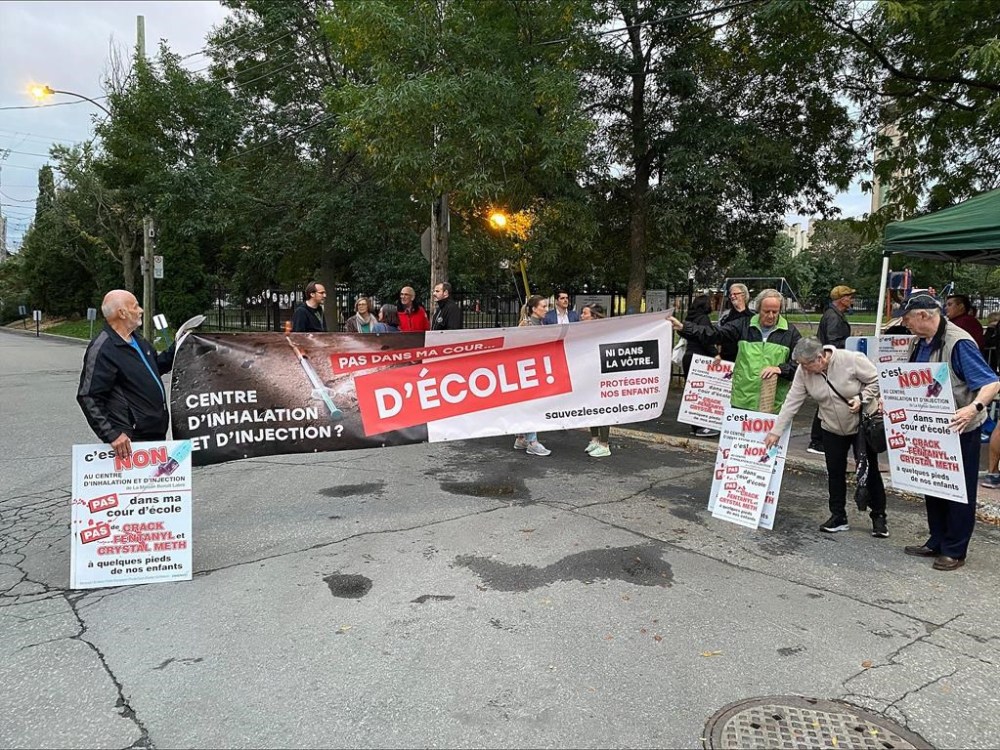
Demonstrators hold a protest against the construction of a supervised drug-use site in Montreal on Sept. 19, 2023. THE CANADIAN PRESS/Thomas MacDonald

But there are no easy solutions, according to experts, who say people with severe drug addiction need services like supervised consumption sites — where they can be treated if they overdose — or else they risk dying on the streets.

Elaine Hyshka, Canadian Research Chair in health systems innovation and associate professor at the University of Alberta, says city officials open safe-injection sites in urban areas because that’s where drug users are. These sites, she said, can’t be located in isolated parts of the city because “the vast majority of people will not go more than one kilometre to access the supervised consumption service.”

François Gagnon, senior scientist and special policy adviser at the Canadian Centre on Substance Abuse and Addiction, says that, ideally, safe-consumption sites wouldn’t be located near a school — but that isn’t always possible in densely populated Montreal.

“In a city as dense as Montreal it’s pretty difficult to find something that’s not close to a kindergarten or to a school,” he said.

But these facts don’t console André Lambert, who has lived in St. Henri for the past 15 years, a block away from Maison Benoît Labre. He says that since the facility opened in April, his neighbourhood feels less safe.

“People are scared to live around here,” Lambert said, adding that his neighbour was assaulted the previous weekend by people smoking crack on his doorstep.

Lambert wants to see the centre shut down; he is part of a group of residents who have penned multiple letters to a host of Quebec officialsasking for them to intervene.

Waiting for the bus by Maison Benoît Labre, Marie-Ève Pelletier, who works at a nearby dental clinic, says she often gets yelled at on her way to the bus stop. “It’s always a problem when I take the bus here because I never know how the people will react because they are often aggressive.”

Hyshka says people may linger outside safe-injection sites because there isn’t enough housing. Some of the sites, she said, have become “lightning rods” because they tend to be few and far between, serving large groups of people instead of being spread out across the city over a broader range of facilities.

What is not helping bridge the divide between the public and vulnerable populations, Hyshka says, is that some politicians at all levels of government are “using supervised consumption services as a wedge issue to increase their popular support without thinking about the potential negative costs of their actions.”

Dr. Julie Bruneau, Canada Research Chair in addiction medicine and clinical researcher at Université de Montréal, says homelessness, drug addiction and mental health issues have become much more severe and visible across Canada’s major cities since the COVID-19 pandemic. Supervised consumption sites like CACTUS Montréal, in so-called “crack alley” — a term used by several local media organizations in the city — are struggling because of understaffing, low-pay, precarious program funding and a lack of space to accommodate the large numbers of people who need life-saving services.

The result, Bruneau says, is that in some areas people are upset to see their neighbourhoods becoming the face of social crises, especially if they have paid high prices to buy property nearby. But she says services must be provided where vulnerable people are located.

Gagnon says several measures can be implemented to help prevent backlash from residents who live near supervised consumption sites. They include asking users not to leave the premises while they are highly intoxicated, organizing regular cleanups of discarded needles, and co-ordinating with police or hiring private security to maintain order around sites.

This report by The Canadian Press was first published July 20, 2024.
Report Error Submit a Tip

More Stories

Retired sportscaster Scott Oake determined as fundraising for women's addictions treatment facility enters home stretch

Melissa Martin 4 minute read Preview

Retired sportscaster Scott Oake determined as fundraising for women's addictions treatment facility enters home stretch

Melissa Martin 4 minute read Thursday, Sep. 10, 2026

For now, the patch of land just east of the Victoria Hospital doesn’t look like much: just a field of rocks, mounded dirt, and concrete piles driven into the earth. Yet when Scott Oake looks over the site, he can already imagine how it will look in just over a year’s time, when the new Anne Oake Family Recovery Centre is expected to open.

It’s easier to picture this time around. In 2020, when the recently-retired CBC sportscaster and his late wife, Anne, were building their first labour of intermingled grief and love, the Bruce Oake Recovery Centre for men, it was hard for him to wrap his mind around how a raw construction site could transform into a welcoming addictions treatment facility.

When that centre opened in 2021, Oake found it looked “almost identical” to the architect’s renderings. So it’s easy to hope the Anne Oake Centre will be the same. It will be the first facility of its kind, its founders believe, not only in Canada but in North America: a place where 50 to 70 women can pursue sobriety while staying with their children.

“At Bruce Oake there’s a culture of love, and most of all a culture of hope,” Oake said, speaking at the site Thursday after a media conference to announce the final push of the centre’s fundraising campaign. “I can feel it every time I walk into that building. And I know it will be the same here.”

Read
Thursday, Sep. 10, 2026

Puzzles Palace

1 minute read Monday, Jul. 27, 2026

To solve our puzzles, please subscribe with this special offer: |

Chrétien says Canada bows to no one in fiery address at 9/11 commemoration

Sarah Smellie, The Canadian Press 6 minute read Preview

Chrétien says Canada bows to no one in fiery address at 9/11 commemoration

Sarah Smellie, The Canadian Press 6 minute read Updated: Yesterday at 8:15 PM CDT

GANDER - Former prime minister Jean Chrétien drew a standing ovation inside a Gander, N.L., hockey arena on Friday as he delivered a pointed message to American leaders during a ceremony marking the 9/11 terrorist attacks in the United States, 25 years ago.

The 92-year-old warned Americans never to mistake Canadian generosity for weakness, nor its kindness for softness.

U.S. Ambassador Pete Hoekstra looked on as Chrétien insisted his pointed words were a sign of friendship. Friends tell each other the truth, he said.

“We embraced our friends and we helped them in their moment of need, but we bow to no one,” Chretien said, as the crowd erupted again.

Read
Updated: Yesterday at 8:15 PM CDT

‘We feel lucky — and a bit traumatized’: Tornado confirmed in River Heights Sunday

Malak Abas 6 minute read Preview

‘We feel lucky — and a bit traumatized’: Tornado confirmed in River Heights Sunday

Malak Abas 6 minute read Thursday, Sep. 10, 2026

Tanner Lemieux wasn’t surprised to learn the violent winds that tore through River Heights and reached their peak near his home Sunday night have been classified as a tornado.

While driving back to his Lindsay Street home from a shopping trip with his wife Sunday, it became clear they were not in the middle of an ordinary thunderstorm when rain and wind started coming from every direction and hit every side of their truck.

The forceful wind made it impossible for him to open his door after they had parked. He climbed through the window, over the top of his vehicle, and the couple struggled to fight the whipping winds to make it into the house.

“As we were running in, the wind started pulling me backwards out of the door,” he told the Free Press while cleaning debris from his yard Thursday.

Read
Thursday, Sep. 10, 2026

Goodness alive, well in N.L.-set musical

Jen Zoratti 4 minute read Preview

Goodness alive, well in N.L.-set musical

Jen Zoratti 4 minute read 2:01 AM CDT

I first saw Come From Away — the true-story musical about the incredible efforts of the residents of Gander, N.L. on Sept. 11, 2001, who welcomed nearly 7,000 travellers diverted to their remote town after the attacks on the World Trade Center and the Pentagon — in 2022, when Broadway Across Canada brought it to the Centennial Concert Hall.

I went in cold, but with blunted expectations; it seemed, on premise alone, like it could tilt too far into shmaltzy sentimentality, that it would be too earnest in its goodness.

So, when I wept until my face was as wet and salty as though it had been slapped by the waves of the North Atlantic, I was pleasantly surprised. I loved it. It’s emotional, yes. It’s sentimental, yes. But you can’t help but feel both buoyed — and, dare I say, patriotic — by the end of it.

Written by Canadians Irene Sankoff and David Hein, Come From Away seemed an unlikely hit when it opened on Broadway in 2017. But there was, by then, an appetite for it.

Read
2:01 AM CDT

Fallis’s comic thriller infiltrates book club

Ben Sigurdson 3 minute read Preview

Fallis’s comic thriller infiltrates book club

Ben Sigurdson 3 minute read 6:00 AM CDT

The Free Press Book Club and McNally Robinson Booksellers are pleased to welcome Toronto author Terry Fallis to the next virtual meeting on Tuesday, September 29 at 7 p.m. to read from and discuss his novel The Marionette.

Fallis, a former lawyer, bureaucrat and political consultant, is the author of 10 bestselling novels and the two-time winner of the Stephen Leacock Medal for Humour (in 2015 for No Relation and in 2008 for The Best Laid Plans, which also won CBC’s Canada Reads in 2011).

His 11th novel, An End In Itself, will be published in November by McClelland & Stewart, who also published The Marionette in October 2025 (and which was also longlisted for the Leacock medal).

The Marionette follows James Norval, bestselling author of a series of thrillers featuring fictional CIA agent Hunter Chase. While in Tajikistan researching his next Hunter Chase novel, Norval is detained by local officials and subsequently freed and ferried away by the Canadian Security Intelligence Service (CSIS).

Read
6:00 AM CDT