After hurricane, with no running water, residents organize to meet a basic need
Advertisement
Read this article for free:
or
Already have an account? Log in here »
To continue reading, please subscribe:

Digital Subscription
One year of digital access for only $205*
- Enjoy unlimited reading on winnipegfreepress.com
- Read the E-Edition, our digital replica newspaper
- Access News Break, our award-winning app
- Play interactive puzzles
*First annual payment billed as $205.00 + GST for one year. This annual subscription will automatically renew at $233.00 + GST every 52 weeks (10% off the regular annual price of $259.35). Offer available to new and qualified returning subscribers only. Cancel any time.
To continue reading, please subscribe:
Add Free Press access to your Brandon Sun subscription for only an additional
$1 for the first 4 weeks*
- Enjoy unlimited reading on winnipegfreepress.com
- Read the E-Edition, our digital replica newspaper
- Access News Break, our award-winning app
- Play interactive puzzles
*Your next Brandon Sun subscription payment will increase by $1.00 and you will be charged $17.95 plus GST for four weeks. After four weeks, your payment will increase to $24.95 plus GST every four weeks.
Read unlimited articles for free today:
or
Already have an account? Log in here »
Hey there, time traveller!
This article was published 17/10/2024 (720 days ago), so information in it may no longer be current.
ASHEVILLE, N.C. (AP) — It takes water to flush a toilet and tens of thousands of North Carolinians have been without it since Hurricane Helene ripped through the state three weeks ago. When Lark Frazier went around asking her Asheville neighbors how they were doing as far as water to flush, several burst into tears over the stress of where to go to the bathroom and what to do with the waste.
Some told her they were eating less to avoid going. Others said they were dumping poop in the yard and covering it with leaves. An elderly woman mentioned planning to scoop it out of the toilet with her hands.
“Not only is that horrifying and inhumane but it’s dangerous for her to be handling her waste like that,” Frazier said.

Since Helene swallowed mountain towns, damaged water infrastructure and killed nearly 250 people across the Southeast, local governments have been overwhelmed, and that’s spurred community organizing and innovation.
Frazier is one of the newly-minted leaders to have stepped up. She grew up in rural Colorado, using an outhouse for years before her family got a flush toilet. She drew on that experience, then came across the Emergency Toilet Guidebook online, published by the Regional Disaster Preparedness Organization in Oregon. She began fashioning rudimentary toilets and training others to do it, too.
The concept is simple: line a sturdy bucket with a thick plastic bag, cover the top with a toilet seat or a water-resistant foam noodle for comfort, then drop in a handful of wood chips or other dry material after every use to absorb liquid and reduce odor. Pee should stay separate.
“Not having waste treated appropriately can absolutely lead to a major public health crisis,” said Sue Mohnkern, who developed the guidebook. Mishandling fecal matter can lead to cholera, dysentery and other serious, even fatal diseases.
Mohnkern recommends everybody living in a disaster-prone area have an emergency toilet handy.
Neither the city nor the county have released official guidelines on how to manage human waste without water to flush.
Frazier called that lack of guidance “astounding.”
County spokesperson Lillian Govus said no county could give sufficient attention to every important issue in a disaster of this scale. City councilwoman Kim Roney has released a video explaining how to use an emergency toilet.
The city set up the first water refill sites about a week after Helene, when some 136,000 people across the Southeast had nonoperational water providers, according to the EPA. Around 100,000 were in the Asheville area, although the city says that number has been reduced significantly in the past week. Still, thousands lack water, and it’s unclear when it’ll be back on. Those who can’t get to these refill sites are getting missed, and here again, volunteers fil the gap.
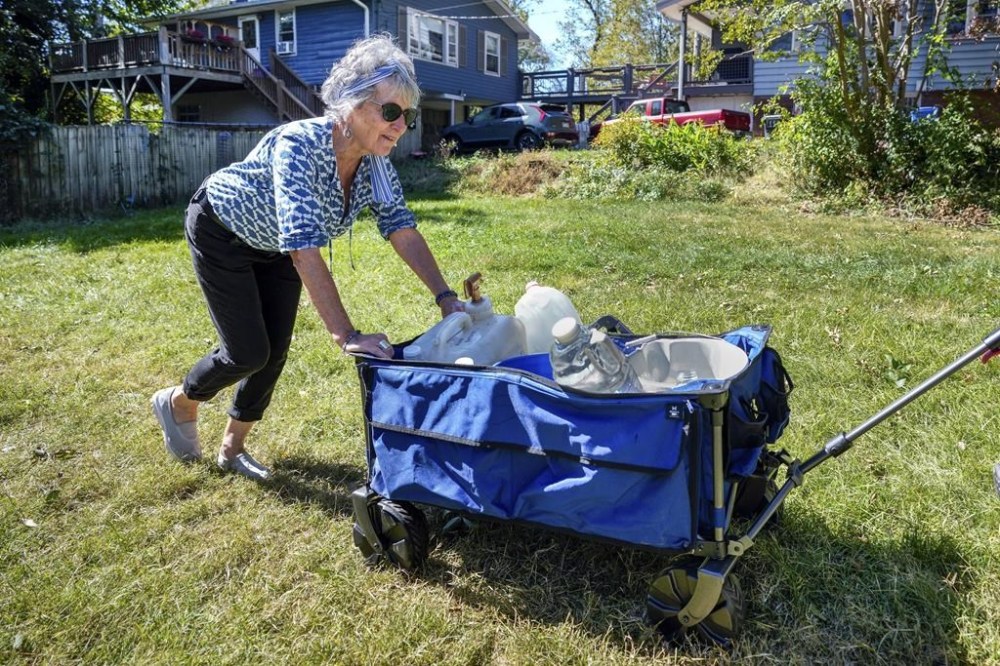
Molly Black and Elle DeBruhl, strangers before the storm, now coordinate an army of neighbors from dawn to dusk to get flush water to people. From Florida to Ohio to Texas, people have donated cube-shaped, 250-gallon, white plastic containers known as IBC totes that are often used on farms, in the chemical industry and disasters. A single tote can nearly fill a 6-foot pickup bed. Black and DeBruhl have organized people to haul the totes to ponds, fill them using pumps, then take them to where they’re needed, like apartment buildings. Other neighbors and volunteers pick up the work from there, taking buckets of water to residents in need.
“I don’t even feel like I’m living my real life,” said DeBruhl, whose employer EY, a global accounting firm, gave her paid leave to serve her community following the storm. “I went from a six-man tote operation to now I’m in charge of solving the nonpotable flushing water for the impacted area? Its crazy.”
With cell service returned now, residents can text Black and DeBruhl’s grassroots group, Flush AVL — AVL is the shorthand for Asheville — to request a refill when their tote is empty. The group replenishes some 400 sites every other day. The city is helping with some of those, but this stopgap effort to preserve dignity and public health is mainly individuals donating their time and money.
Govus applauded the volunteer efforts.
“It helps fill the gaps and meet peoples needs as we’re working on systems and major processes to get people food, shelter and water,” she said.
Yet another water solution is coming from people who still have water — because they have a well. Erik Iverson lives near a well owned by an urban farm that wanted to help after the hurricane. He laid two 200-foot lengths of plastic PEX pipe to route the well water to the road for public access.
Then he added filtration and ultraviolet light in order to offer drinkable water in addition to the flush water (the city, however, recommends boiling all water sources). Now people driving by can access multiple spouts, operated by a foot pedal connected to a chain, touch-free to minimize germs spreading.
“With climate change this is probably not going to the be last time this happens,” Iverson said. “No matter how resilient Asheville rebuilds their water system, it’s simply poor planning to not have this infrastructure in place to deal with something like this again.”
Wine to Water, a global nonprofit focused on clean water, paid for the purification for this and nine other wells whose owners have agreed to community access.
The private well owners “benefit from having purified water on their property, and when this happens again, they can jump right into offering this purified water again. That is resilience,” Iverson said.
Yet another grassroots group, Be Well AVL sprang up in the last two weeks and is pulling water from higher-capacity commercial wells offered up by local businesses, distributing it at apartments for low-income, elderly and disabled residents. They can’t guarantee it’s potable, given the official warning to boil water, but well water is typically cleaner than the pond water being distributed for flushing.
Both sources are essential, said Grace Barron, an organizer with Be Well AVL.
“We absolutely need toilets to be flushed,” Barron said. And “there’s this other area of need for sanitation … washing dishes, clothing and bathing,” she said. There are infants in the community, she said, and they shouldn’t be bathed in pond water.
Barron, an Asheville resident of 18 years, said Hurricane Helene has reminded residents of the caring culture that was a foundation of the city before it ballooned into one of the most expensive places to live in the state.
“Mutual aid has been a part of our community prior to this,” she said. “The community connections we had before have only grown.”
__
Videojournalist Erik Verduzco contributed from Asheville.
__
The Associated Press receives support from the Walton Family Foundation for coverage of water and environmental policy. The AP is solely responsible for all content. For all of AP’s environmental coverage, visit https://apnews.com/hub/climate-and-environment