Ontario’s opioid strategy outdated, auditor general says

Advertisement

Advertise with us

TORONTO - Ontario's opioid strategy, even with its new abstinence-based model for treatment, is outdated and does not serve the current needs of the people, the auditor general found in her annual report released Tuesday.

Read this article for free:


or

Already have an account? Log in here »

To continue reading, please subscribe:

Subscribe and receive a limited-edition Free Press branded hat or tote.

Digital Subscription

One year of digital access for only $205*

  • Enjoy unlimited reading on winnipegfreepress.com
  • Read the E-Edition, our digital replica newspaper
  • Access News Break, our award-winning app
  • Play interactive puzzles

*First annual payment billed as $205.00 + GST for one year. This annual subscription will automatically renew at $233.00 + GST every 52 weeks (10% off the regular annual price of $259.35). Offer available to new and qualified returning subscribers only. Cancel any time.

To continue reading, please subscribe:

Add Free Press access to your Brandon Sun subscription for only an additional

$1 for the first 4 weeks*

  • Enjoy unlimited reading on winnipegfreepress.com
  • Read the E-Edition, our digital replica newspaper
  • Access News Break, our award-winning app
  • Play interactive puzzles
Start now

*Your next Brandon Sun subscription payment will increase by $1.00 and you will be charged $17.95 plus GST for four weeks. After four weeks, your payment will increase to $24.95 plus GST every four weeks.

Hey there, time traveller!
This article was published 03/12/2024 (654 days ago), so information in it may no longer be current.

TORONTO – Ontario’s opioid strategy, even with its new abstinence-based model for treatment, is outdated and does not serve the current needs of the people, the auditor general found in her annual report released Tuesday.

Shelley Spence said the province needs to develop a new comprehensive strategy to deal with the opioid crisis as the current one has not been updated since 2016.

More than 2,600 Ontarians died last year due to overdoses, the vast majority due to opioid toxicity.

Ontario's auditor general says the province's opioid strategy with its new abstinence-based model for treatment is outdated and does not serve the current needs of the people. A Naloxone anti-overdose kit is held in downtown Vancouver, Friday, Feb. 10, 2017. THE CANADIAN PRESS/Jonathan Hayward

“We concluded that the ministry does not have effective processes in place to meet the challenging and changing nature of the opioid crisis in Ontario,” Spence wrote.

Premier Doug Ford’s Progressive Conservative government has taken a hard line on drug-consumption sites, passing legislation that prohibits and closes any sites within 200 metres of a school or daycare, and effectively stops any new sites from opening.

The government fast-tracked that legislation with reduced debate time and skipped the committee stage entirely.

In their place, the government is launching 19 new “homelessness and addiction recovery treatment hubs,” plus 375 highly supportive housing units at a planned cost of $378 million.

Spence applauded that move.

“Investing more in treatment, recovery and housing is a positive development toward addressing the opioid crisis,” she said at a news conference.

But Spence said the province has not planned properly for the transition to the new hubs.

Her team reviewed internal ministry documents that warned of increasing overdoses and deaths and increased public drug use.

“They identified it as a risk, but they haven’t identified their mitigation processes around that risk,” Spence said.

Health workers, advocates and users of the sites have warned of a spike in deaths when the sites close by March 31, 2025.

The province is set to close 10 supervised consumption sites because they are too close to schools and daycares. More than 1,600 overdoses were reversed at those sites in 2022-23, the auditor general found.

Not a single person died of an overdose at those spots during the same time frame, Spence said.

Health Minister Sylvia Jones said in August when announcing the new hub model that no one would die as a result of the transition.

The ministry did not provide a thorough, evidence-based business case for the hub model and did not provide proper impact analysis or do proper consultations with all affected people, Spence found.

“The ministry has not developed plans to mitigate the risks prior to making the decision, which include the number of impacted individuals, the increased overdoses and risk of death and the financial and operational burden on emergency departments,” Spence said.
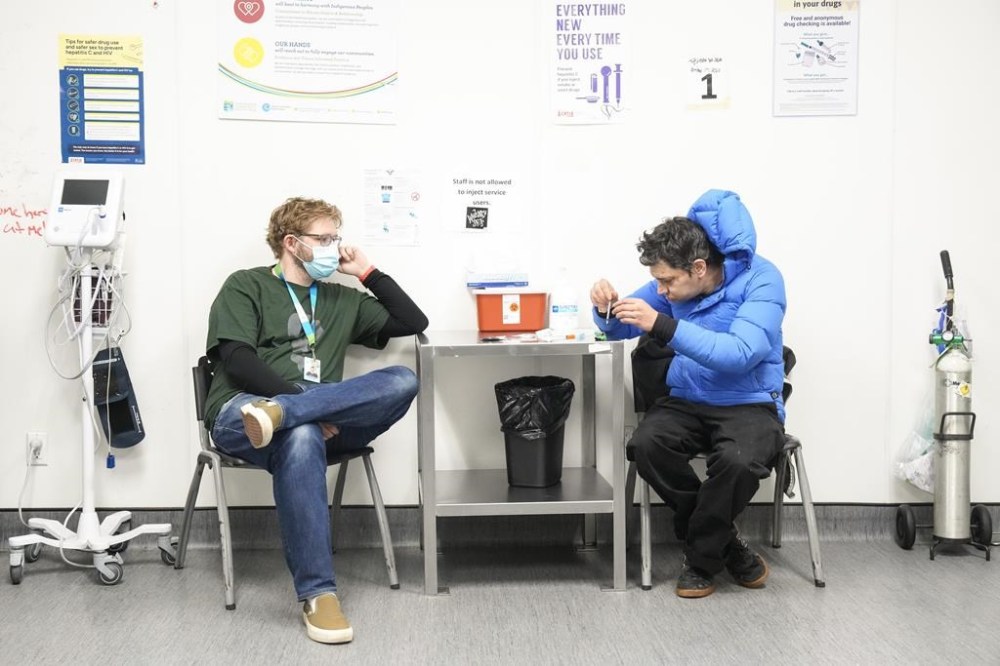
Community Health Worker Callan Pepper sits with a client in the consumption room at Moss Park Consumption and Treatment Service, in Toronto, Tuesday, Dec. 3, 2024. THE CANADIAN PRESS/Chris Young

The auditor general also found multiple branches of ministries are responsible for managing different parts of the opioid crisis with no one taking the lead.

“We found that accountability is lacking and remains unclear, with no specific party being designated as a lead to oversee and co-ordinate the work, no specific goals or targets being set for different parties to work toward and no ongoing monitoring or evaluation of performance and outcomes,” Spence wrote.

Only 10 of 24 performance indicators were tracked by the province. The remainder were either not tracked at all or monitored inconsistently, Spence found.

She also found a lack of data on the number and rate of hospitalizations for opioid overdoses and the percentage of people who are prescribed opioids and develop an addiction, among other oversights.

The ministry has accepted all seven of the auditor general’s recommendations, including the need to develop a new opioid strategy.

Jones did not answer several questions Tuesday about the lack of an opioid-specific strategy, missing mitigation plans or data tracking problems. But she defended her government’s approach to the ongoing opioid crisis.

“We are enabling and investing in a model that I believe will ultimately lead to people getting some hope and getting some pathways to treatment,” Jones said at a news conference.

New Democrat and Opposition leader Marit Stiles blasted Jones for her handling of the opioid crisis, especially the move away from harm reduction and supervised consumption sites.

“More people will die, lives will not be saved in the interim and they had no intention to,” Stiles said.

“They weren’t going to look at the data, they weren’t looking at the science, they weren’t looking at the experience and they certainly didn’t want to hear from any people about how this might impact them.”

This report by The Canadian Press was first published Dec. 3, 2024.

Report Error Submit a Tip

More Stories

Fiddling and a jig mark ceremony to rename Wolseley-area school

Maggie Macintosh 4 minute read Preview

Fiddling and a jig mark ceremony to rename Wolseley-area school

Maggie Macintosh 4 minute read 2:00 AM CDT

Beckoned by a fiddle, students broke out into a jig behind Little Bluestem School on Thursday evening to mark the end of a multi-year renaming process.

“I couldn’t help myself. I just had to dance,” eight-year-old Stevie Morrison said at a ribbon-cutting event to celebrate the new signage at 511 Clifton St., formerly known as Wolseley School.

Stevie and Fallon Lovelace Sharkey, 7, were out of breath after bouncing up and down to the beat, attempting to execute the Red River Métis dance moves they were taught at school.

There were cheers and tears as adults watched jigging on school grounds once named after a man who did not believe in Métis peoples’ right to self-determination.

Read
2:00 AM CDT

Puzzles Palace

1 minute read Monday, Jul. 27, 2026

To solve our puzzles, please subscribe with this special offer: |

Manitoba abandoning spring, fall clock changes

Carol Sanders 8 minute read Preview

Manitoba abandoning spring, fall clock changes

Carol Sanders 8 minute read Updated: Yesterday at 5:36 PM CDT

Time’s up for the time change in Manitoba.

Manitobans won’t be setting their clocks back an hour in November. The province has decided to permanently stay on daylight time after surveying residents on the twice annual clock adjustment.

“We heard from Manitobans loud and clear — no more changing the clocks in Manitoba,” Premier Wab Kinew said in a news release Thursday.

Most of the 72,000 votes submitted in an online EngageMB survey — 92 per cent — said they would like to see the practice end. The survey asked if they preferred earlier sunrises in winter with standard time or the later sunsets in summer with daylight time. More than half of survey participants (58 per cent) indicated a preference to stay on permanent daylight time; 34 per cent voted to eliminate the time change but stay on standard time.

Read
Updated: Yesterday at 5:36 PM CDT

Building Northern Manitoba right

Morris Beardy 4 minute read 2:00 AM CDT

I had the pleasure of attending the recent celebrations welcoming grain shipments back to the Port of Churchill, alongside business leaders, port workers, community members and government partners. We find ourselves at an important and pivotal moment and there is a lot of optimism about Northern Manitoba.

Whether it’s the Port of Churchill Plus, all-weather roads and trade corridors, new mines and exploration, a transmission line to Nunavut or billions going into modernizing our hydro-electric systems, one thing is clear: Northern Manitoba needs to be prepared for a potential boom in development.

Now more than ever, Canada and Manitoba have to get this right.

Prime Minister Carney and Canada’s premiers have met with some of the world’s largest investors to discuss nation-building projects that will shape our country’s future.

Teenage e-scooter driver in critical condition after crash

Chris Kitching 6 minute read Preview

Teenage e-scooter driver in critical condition after crash

Chris Kitching 6 minute read Wednesday, Sep. 16, 2026

A teenager riding an e-scooter suffered life-threatening injuries when he was struck by an SUV in southwest Winnipeg on Monday night.

Witnesses provided first aid to the injured rider, who police said is under 18, after the collision happened at Waverley Street and Arbour Meadow Gate/Lake Crest Road at about 9:30 p.m.

“It feels like it happened in slow motion,” said driver Audrey Vanderspek, who was waiting at a red light when she witnessed the incident. “Maybe it’s because you’re helpless, that it just feels like everything slows down in the moment.”

Police said the electric scooter rider was crossing Waverley and was hit by a southbound 2010 Honda CR-V. The posted speed limit on that stretch of Waverley is 70 kilometres per hour.

Read
Wednesday, Sep. 16, 2026

Quilt tradition from Underground Railroad period big part of new exhibition

Conrad Sweatman 6 minute read Preview

Quilt tradition from Underground Railroad period big part of new exhibition

Conrad Sweatman 6 minute read 2:00 AM CDT

Long before she became a professional quilter, Melinda Clayton Patterson used to watch her mother make quilts from clothing scraps and cardboard templates.

“I came from a family of 14 kids, so going to whatever the store was back then, K-Mart or Woolworth, to buy quilts or blankets for 14 kids was just not feasible because the people were not wealthy,” she says.

“Quilts were not viewed as art. But when I came to Winnipeg, I started taking quilting seriously in my 30s … the heritage came later.”

Today, the 61-year-old native of East Preston, N.S., lives in Winnipeg, stitching together stories of her Black Loyalist heritage and Preston’s foundational role in the birth of Canadian Black culture.

Read
2:00 AM CDT