North Carolina Republicans push for tougher bail rules and potentially new execution methods
Advertisement
Read this article for free:
or
Already have an account? Log in here »
To continue reading, please subscribe:

Digital Subscription
One year of digital access for only $205*
- Enjoy unlimited reading on winnipegfreepress.com
- Read the E-Edition, our digital replica newspaper
- Access News Break, our award-winning app
- Play interactive puzzles
*First annual payment billed as $205.00 + GST for one year. This annual subscription will automatically renew at $233.00 + GST every 52 weeks (10% off the regular annual price of $259.35). Offer available to new and qualified returning subscribers only. Cancel any time.
To continue reading, please subscribe:
Add Free Press access to your Brandon Sun subscription for only an additional
$1 for the first 4 weeks*
- Enjoy unlimited reading on winnipegfreepress.com
- Read the E-Edition, our digital replica newspaper
- Access News Break, our award-winning app
- Play interactive puzzles
*Your next Brandon Sun subscription payment will increase by $1.00 and you will be charged $17.95 plus GST for four weeks. After four weeks, your payment will increase to $24.95 plus GST every four weeks.
Read unlimited articles for free today:
or
Already have an account? Log in here »
Hey there, time traveller!
This article was published 22/09/2025 (373 days ago), so information in it may no longer be current.
RALEIGH, N.C. (AP) — North Carolina Republican legislators are poised this week to approve criminal justice measures designed to toughen bail rules, restrict magistrates’ powers and evaluate offenders’ mental health after the fatal stabbing of a Ukrainian refugee on a Charlotte commuter train. The bill also could help get the death penalty carried out again in the ninth-largest U.S. state.
Senate and House Republicans unveiled legislation that their leaders previously signaled would surface when the General Assembly reconvened on Monday after nearly two months away from Raleigh.
The Aug. 22 death of 23-year-old Iryna Zarutska — her attack caught on camera — and subsequent charges against a suspect who had previously been arrested more than a dozen times caused public outrage. An array of Republicans, President Donald Trump among them, have attempted to blame Zarutska’s death on Charlotte-area leaders and Democratic state officials for what they call soft-on-crime policies.
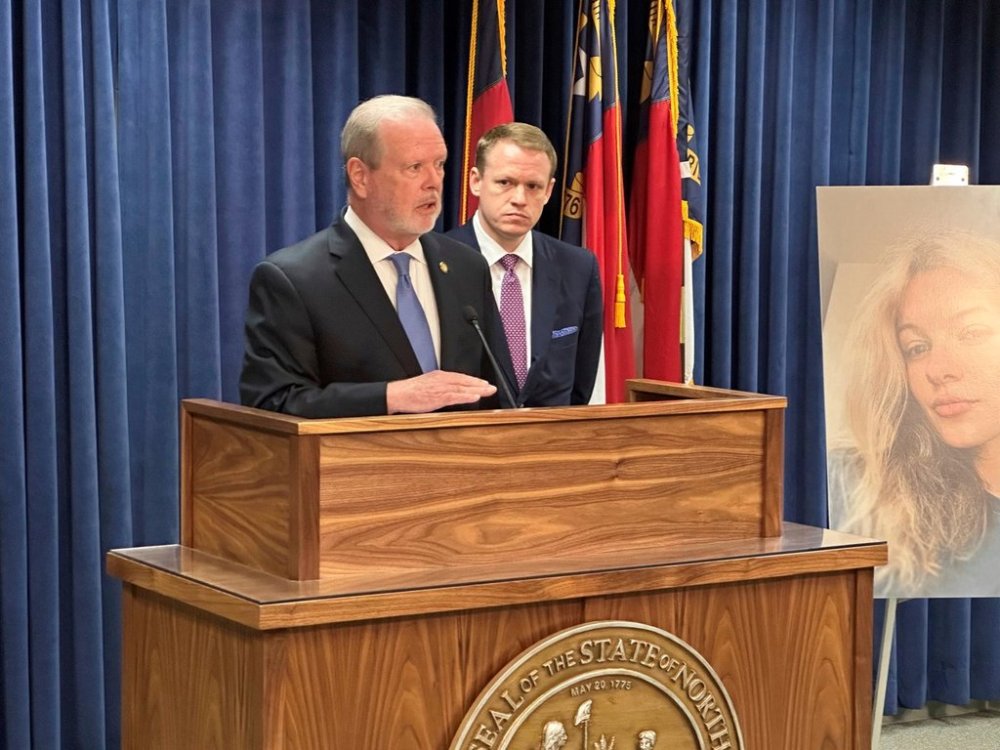
The Senate approved the legislation 28-8 late Monday, with many Democrats absent from the otherwise party-line vote. The bill now goes to the House, where a vote is likely Tuesday.
Any final measure would then go to Democratic Gov. Josh Stein’s desk. Stein, the former attorney general, has suggested pretrial release changes and greater emphasis on mental health are needed in light of Zarutska’s death.
But the measure took a different direction — away from bipartisan support — when Senate Republicans approved an amendment that could in the future open the door to other forms of capital punishment beyond lethal injection, which is currently the state’s sole method. North Carolina last carried out an execution in 2006.
Suspect was released on misdemeanor months before attack
The stabbing suspect, Decarlos Brown Jr., could received a death sentence if convicted of first-degree murder in state court or a federal count filed against him.
Brown, whose criminal record included serving more than five years in prison after pleading guilty to robbery using a deadly weapon, had been charged in January in Mecklenburg County, which includes Charlotte, with misusing the 911 system, a misdemeanor, according to court records.
But a magistrate — a nonelected local court official who often determines if a defendant can be released while awaiting trial — released him on a written promise to return for court. And it took more than six months for a court to order a mental evaluation for him. Brown’s mother told Charlotte-area television that she had sought an involuntary psychiatric commitment this year after he became violent at home.
GOP Sen. Ralph Hise said the legislation has nothing to do with winning political points, but rather is a response to the failure of the criminal justice system.
“We need a criminal justice system that protects society from individuals. I believe these are many great steps in this bill,” Hise said.
Bill would end bail for some crimes, reduce magistrates’ discretion
The measure, named “Iryna’s Law,” would prohibit cashless bail for certain crimes and eliminate some of the discretion that magistrates and judges have for pretrial release decisions.
For example, first-time defendants accused of a violent offense could only be released on a secured cash bond or receive house arrest with electronic monitoring. Such house arrest and monitoring would be the only option for some repeat defendants.
The bill also attempts to ensure that more suspects are subject to psychological examinations before their potential release. Defendants accused of a violent crime and committed involuntarily in recent years to a mental health facility would be subject to a psychological evaluation.
The legislation also would give the state Supreme Court’s chief justice the ability to suspend a magistrate from their post and lay out grounds why the official should be removed permanently. Such actions now sit with local judges.
Amendment could lead to new execution methods

Executions in North Carolina have been put on hold in part over legal challenges over the use of the injection drugs and a doctor’s presence at executions.
Senate leader Phil Berger offered a floor amendment — also approved along party lines — that would direct the state Adult Correction Department secretary to determine another form of execution should lethal injection be declared unconstitutional or it’s “not available,” potentially if the lethal drugs can’t be accessed.
The secretary — a member of the governor’s Cabinet — would have to select another method that’s been adopted by another state and has not been found unconstitutional by the U.S. Supreme Court. That could include the use of a firing squad, a method that’s been used to execute South Carolina inmates twice this year.
The measure already contained language that attempted to speed up death penalty appeals in North Carolina.
“Those provisions do part of the job,” Berger said during Senate floor debate. “This amendment hopefully will do the remainder of the job.”
Some Democrats criticized their GOP colleagues for seeking to expand ways to administer the death penalty for their sheer cruelty, let alone within a bill designed to address problems following last month’s Charlotte attack.
“To put in an express lane to bring the firing squad to North Carolina is beneath the dignity of this body,” Democratic Sen. Michael Garrett said. “That we are exploiting this situation to bring back methods that are truly violent to execute our fellow citizens is, quite frankly, immoral.”
A month later, hundreds attend vigil in Charlotte
Kelli Allen of Charlotte was one of a couple hundred people who attended a candlelight vigil honoring Zarutska near a light rail station in the city on Monday night, organized by some churches and the local Republican Party. Allen said she’s hopeful that “we are on the path to making this a better and safer city. I think that’s what everyone wants here.”
“I just know she wanted a better life and she deserved that,” Allen added. “So I’m here just to honor her tonight.”
___
Associated Press video journalist Erik Verduzco in Charlotte contributed to this report.